How do typically developing children acquire language?
Typically developing children can learn language primarily through exposure to language in their environment, without the need for explicit instruction or reinforcement.
What is the term for the loss or impairment of language processing abilities?
The term for the loss or impairment of language processing is aphasia.
If a child reads the word 'healthy' incorrectly as /heel-thy/, what aspect of language does the child still need to develop?
The child still needs to develop phonological awareness, which is the ability to recognize and manipulate the sounds within words.
Which language milestone is characterized by infants endlessly repeating sounds and syllables?
Babbling is the language milestone characterized by infants endlessly repeating sounds and syllables.
What is an example of evidence for the biological foundation of language?
Evidence for the biological foundation of language includes infants' initial ability to distinguish all phonemes across languages and the existence of sensitive periods for language acquisition.
Which statement by a 17-month-old best represents telegraphic speech?
A statement like 'throw ball' best represents telegraphic speech, as it uses only essential content words without articles or pronouns.
Saying that someone has been 'let go' instead of 'fired' is an example of which language behavior?
This is an example of a euphemism, where a mild or indirect word is used in place of a more direct or harsh one.
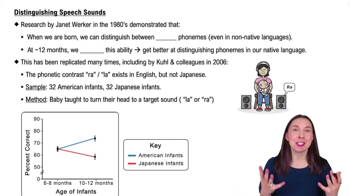
What does research on infants' recognition of language sounds demonstrate about their abilities?
Research shows that infants are born able to distinguish all phonemes in human languages, but by about 12 months, they specialize in the sounds of their native language.
How many morphemes are in the word 'bats'?
There are two morphemes in the word 'bats': 'bat' (the root) and 's' (the plural marker).
Which of these Spanish words is feminine: papel, luz, calendario, examen?
The word 'luz' is not masculine; it is feminine in Spanish.
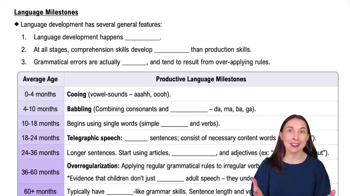
What is a true statement about the development of language over time?
Language development occurs rapidly in early childhood, with comprehension skills generally developing before production skills, and children typically achieve adult-like grammar by age five.
Approximately how large is the average person's vocabulary?
The average adult's vocabulary consists of tens of thousands of words, with rapid growth occurring in early childhood.
How many graphemes are in the word 'weight'?
There are six graphemes in the word 'weight': w, e, i, g, h, t.
How does language help create our sense of reality?
Language helps shape our sense of reality by providing the categories and concepts through which we interpret and understand the world.
How does a student's level of oral vocabulary impact their decoding and reading abilities?
A student's oral vocabulary supports their decoding and reading abilities by enabling them to recognize and understand words more easily as they read.
Which family function helps children acquire language?
Providing a language-rich environment and engaging in regular verbal interactions helps children acquire language.
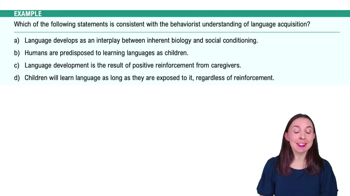
What processes are involved in learning language?
Learning language involves both biological predispositions and social interactions, including exposure to language, reinforcement, and innate grammatical abilities.
What are the basic stages in the development of language?
The basic stages are cooing, babbling, first words, telegraphic speech, longer sentences, and mastery of complex grammar.
What does the phonological processor allow us to do?
The phonological processor allows us to recognize, differentiate, and manipulate the sounds of language (phonemes).
What is the earliest stage of speech development called?
The earliest stage of speech development is called the cooing stage.
How is the vocalization known as babbling described?
Babbling is the repetitive combination of consonant and vowel sounds, such as 'ba ba ba' or 'da da da,' without attached meaning.
Which theorist believed that children learn language in specific contexts and through interaction?
Jerome Bruner believed that children learn language in specific contexts and through social interaction.
Why does overregularization occur in children's language development?
Overregularization occurs because children apply regular grammatical rules to irregular words, demonstrating their understanding of grammar.
A child's ability to understand the rules of language demonstrates better use of what?
A child's ability to understand the rules of language demonstrates better use of grammar.
Joint attention enables children to use which skills to acquire language?
Joint attention enables children to use their social and cognitive skills to acquire language.
Why do children make overregularization errors?
Children make overregularization errors because they are applying learned grammatical rules too broadly, even to irregular forms.
At what point does language comprehension become more important to reading success?
Language comprehension becomes increasingly important to reading success as children progress beyond basic decoding and need to understand the meaning of text.
How does language help to shape our sense of reality?
Language shapes our sense of reality by influencing how we categorize, interpret, and communicate our experiences.
What is the term for the meaningless speechlike sounds uttered by infants, such as 'dadada'?
The term for these meaningless speechlike sounds is babbling.
Language is intimately tied to which issues?
Language is intimately tied to issues of identity, culture, and social interaction.
How can a language deficiency be overcome?
A language deficiency can be addressed by providing increased exposure to language and supportive social interactions.
How many morphemes are in the word 'teleprompter'?
There are two morphemes in 'teleprompter': 'tele' (meaning distant) and 'prompter' (one who prompts).
What is code-switching in speech?
Code-switching is the practice of alternating between two or more languages or language varieties in conversation.
 Back
Back
 01:15
01:15