What is a primary function performed by the central nervous system (CNS)?
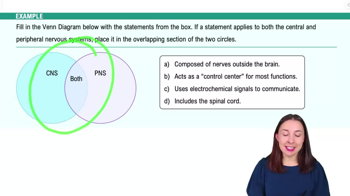
The central nervous system functions as the control center for the body, processing sensory information, generating thoughts, emotions, memories, perceptions, and issuing motor commands.
What is the central nervous system (CNS) responsible for?
The CNS is responsible for processing sensory information, generating thoughts and emotions, forming memories, creating perceptions, and controlling voluntary and involuntary movements.
Which division of the nervous system works antagonistically to the sympathetic nervous system?
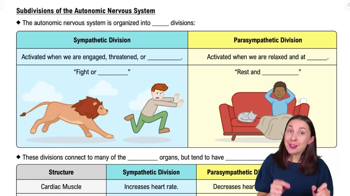
The parasympathetic division of the autonomic nervous system works antagonistically to the sympathetic nervous system.
What are the two main divisions of the nervous system called?
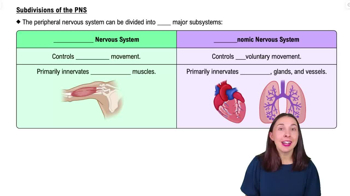
The two main divisions are the central nervous system (CNS) and the peripheral nervous system (PNS).
In what way are the somatic and autonomic nervous systems similar?
Both the somatic and autonomic nervous systems are subdivisions of the peripheral nervous system and involve the transmission of signals between the CNS and the body.
Which regions of the central nervous system play a role in regulating the autonomic nervous system?
The brain and spinal cord, which make up the central nervous system, play a role in regulating the autonomic nervous system.
What are the two main parts of the nervous system?
The two main parts are the central nervous system (CNS) and the peripheral nervous system (PNS).
Which role in a school is most similar to the central nervous system’s function in the human body?
The principal or head administrator, who coordinates and directs activities, is most similar to the CNS, which acts as the control center for the body.
What are the three main components involved in the flow of information in the nervous system?
The three main components are sensory input, integration (processing), and motor output.
Which phrase best describes the entire nervous system?
The nervous system is a complex network of neurons that conveys electrochemical information throughout the body.
What type of synapse is most common in the nervous system?
The most common type of synapse in the nervous system is the chemical synapse.
What is the term for a specialist in the study of the nervous system?
A neurologist is a specialist in the study of the nervous system.
Which philosopher proposed that nerve pathways allowed for reflexes?
René Descartes proposed that nerve pathways allowed for reflexes.
What is the function of an axon in the nervous system?
An axon transmits electrical impulses away from the neuron's cell body to other neurons, muscles, or glands.
What structures make up the central nervous system in psychology?
The central nervous system is made up of the brain and spinal cord.
How does gray matter differ from white matter in the nervous system?
Gray matter consists mainly of neuron cell bodies and dendrites, while white matter is composed primarily of myelinated axons.
What is the somatic nervous system responsible for in psychology?
The somatic nervous system controls voluntary movements by innervating skeletal muscles.
If someone is recording sympathetic nervous system arousal, what are they likely trying to measure?
They are likely trying to measure physiological responses to stress or threat, such as increased heart rate or pupil dilation.
What is the function of the semicircular canals in psychology?
The semicircular canals are involved in maintaining balance and detecting rotational movements of the head.
How are neurons organized in the nervous system?
Neurons are organized into networks or pools that process and integrate information.
What part of a neuron receives incoming signals from other neurons?
The dendrites receive incoming signals from other neurons.
What is a ganglion cell in the context of psychology?
A ganglion cell is a type of neuron found in the peripheral nervous system, often involved in transmitting sensory information.
Which part of the nervous system is responsible for integrating sensory information and neural functions?
The central nervous system is responsible for integrating sensory information and neural functions.
What does the term 'plasticity' refer to in the context of the nervous system?
Plasticity refers to the nervous system's ability to change and adapt in response to experience or injury.
Which subdivision of the nervous system interprets incoming information and issues orders?
The central nervous system interprets incoming information and issues orders.
What is the main function of the somatic nervous system?
The main function of the somatic nervous system is to control voluntary movements of skeletal muscles.
What is the definition of the semicircular canals in psychology?
The semicircular canals are structures in the inner ear that detect rotational movements and help maintain balance.
What characteristic of the nervous system does plasticity best reflect?
Plasticity best reflects the nervous system's ability to adapt and reorganize itself.
With which activities are sensory and motor neurons of the nervous system traditionally associated?
Sensory neurons are associated with transmitting sensory information to the CNS, while motor neurons are associated with carrying commands from the CNS to muscles and glands.
What is the primary role of the peripheral nervous system?
The primary role of the peripheral nervous system is to connect the body to the central nervous system and facilitate communication between them.
 Back
Back
 01:06
01:06