What are the main perspectives on psychological disorders discussed in the course materials?
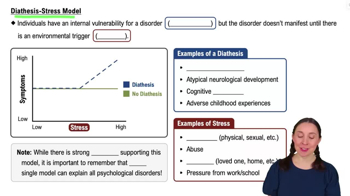
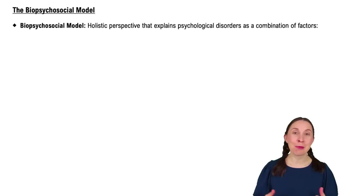
The main perspectives on psychological disorders discussed are the diathesis-stress model, which explains disorders as resulting from an internal vulnerability combined with environmental stressors, and the biopsychosocial model, which integrates biological, psychological, and social factors in understanding and treating disorders.
What is a disadvantage associated with psychoanalysis as a treatment for psychological disorders?
The provided materials do not discuss psychoanalysis or its disadvantages, so this question cannot be answered based on the supplied content.
Which approach to psychological disorders attributes disorders to organic, internal causes?
The biological perspective attributes psychological disorders to organic, internal causes such as genetic predispositions, hormone or neurotransmitter levels, and brain anatomy or development.
How does the biopsychosocial model address the idea that mental health disorders are not really diseases?
The biopsychosocial model recognizes that mental health disorders can arise from a combination of biological, psychological, and social factors, rather than being solely 'diseases' in the traditional medical sense. This model emphasizes that disorders are complex and multifaceted, and not always attributable to a single disease process.
What are some psychological factors that can influence consumer buying behavior, according to the perspectives on psychological disorders?
Psychological factors that can influence behavior include cognitions, emotions, perception, learning, and memory. These factors are considered in the biopsychosocial model as contributing to psychological disorders and can also influence consumer buying behavior.
What does the Greek origin of the word 'diathesis' suggest about its meaning in psychology?
The Greek origin loosely translates to 'arrangement,' referring to a constellation of internal traits or vulnerabilities. In psychology, it means an individual's internal predisposition to developing a disorder.
How does the diathesis-stress model explain the difference in disorder manifestation between individuals with and without a diathesis under high stress?
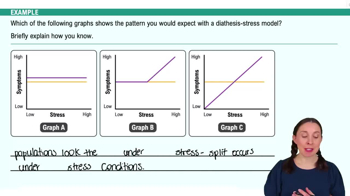
Individuals with a diathesis show increased symptoms when stress is high, while those without a diathesis remain relatively stable. This model illustrates that vulnerability combined with stress leads to higher risk of disorder development.
What are some examples of stressors that can trigger psychological disorders according to the diathesis-stress model?
Examples include trauma, abuse, loss, and pressure from work or school. These stressors can interact with internal vulnerabilities to manifest psychological disorders.
Why is it important to have diverse treatment approaches for psychological disorders according to the biopsychosocial model?
Different individuals may have disorders driven by biological, psychological, or social factors. Diverse treatments ensure that therapy is tailored to the specific causes affecting each person.
How does the biopsychosocial model account for the same disorder having different causes in different people?
It integrates biological, psychological, and social factors, showing that one person's disorder may be mainly biological while another's may be psychological or social. This explains variability in causes and treatment responses among individuals.