During which stage of sleep do sleep spindles occur?
Sleep spindles occur during stage 2 of non-REM sleep.
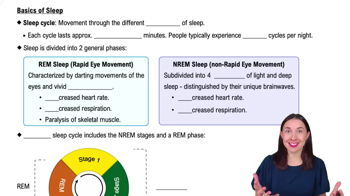
How many stages of sleep are there, including REM sleep?
There are five stages of sleep: four non-REM stages (stages 1-4) and one REM stage.
Sleep is divided into which two broad categories?
Sleep is divided into REM (rapid eye movement) sleep and non-REM (NREM) sleep.
What effect does sleep deprivation have on growth hormone and cortisol levels?
Sleep deprivation can decrease growth hormone levels and increase cortisol (stress hormone) levels.
What are some purposes of sleep as speculated by scientists?
Purposes of sleep include restoration of the body, memory consolidation, and regulation of mood and cognitive function.
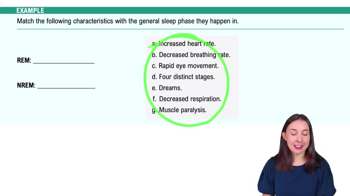
What are some characteristics of REM sleep?
REM sleep is characterized by rapid eye movements, vivid dreaming, increased heart rate and respiration, and paralysis of skeletal muscles.
Which part of the brain is influential in determining when to sleep?
The suprachiasmatic nucleus (SCN) in the hypothalamus is influential in determining when to sleep.
Which part of the brain regulates sleep?
The suprachiasmatic nucleus (SCN) in the hypothalamus regulates sleep.
What is a true statement about the relationship between sleep and health problems?
Sleep plays a large role in many health problems, including those related to physical and mental health.
How does sleep play a role in health problems?
Sleep is involved in many health problems, as inadequate sleep can contribute to both physical and mental health issues.
Which statements about sleep are accurate?
Sleep is essential for health, occurs in cycles, and involves both REM and non-REM stages.
What function does getting good light exposure in the hours after waking serve?
Good light exposure after waking helps regulate the circadian rhythm by signaling the SCN to suppress melatonin production.
What is the primary cause of the physiological tendency to sleep?
The primary cause is the regulation of circadian rhythms by the SCN in response to light and internal cues.
What is not a stage of sleep?
Wakefulness is not a stage of sleep.
What is true about sleep?
Sleep consists of multiple stages, including both REM and non-REM phases, and is essential for health.
What is an example of wakefulness?
An example of wakefulness is being fully conscious and alert, characterized by beta brain waves.
What is a unique characteristic of stage 2 of non-REM sleep?
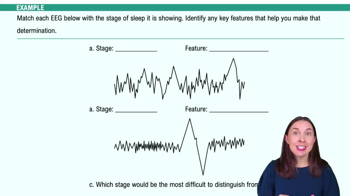
Stage 2 of non-REM sleep is uniquely characterized by the presence of sleep spindles and K-complexes.
How do brain waves change as a sleeper progresses from stage 1 sleep to REM sleep?
Brain waves slow and increase in amplitude from stage 1 to deep non-REM sleep, then become faster and lower in amplitude during REM sleep, resembling wakefulness.
Which stage of sleep is characterized by relatively rapid, low-amplitude brain waves?
REM sleep is characterized by relatively rapid, low-amplitude brain waves.
At what time in the sleep cycle does somnambulism (sleepwalking) typically occur?
Somnambulism typically occurs during deep non-REM sleep, especially in stages 3 and 4.
What are common symptoms of insomnia?
Common symptoms of insomnia include difficulty falling asleep, staying asleep, or waking up too early and not being able to return to sleep.
What is true about a typical night's sleep?
A typical night's sleep consists of multiple cycles, with deep non-REM sleep decreasing and REM sleep increasing as the night progresses.
Sleep relates most directly to which level of need?
Sleep relates most directly to physiological needs.
What is an aftereffect of increased sleep debt?
An aftereffect of increased sleep debt is impaired cognitive performance and increased daytime sleepiness.
What is the most common change in the sleep patterns of adults during middle age?
The most common change is a decrease in deep non-REM sleep and more frequent awakenings.
What is a long-term effect of sleep deprivation?
Long-term sleep deprivation can lead to chronic health problems, such as increased risk for cardiovascular disease and impaired immune function.
What is a social benefit of healthy sleep?
A social benefit of healthy sleep is improved mood and better interpersonal relationships.
What is not an effect of sleep deprivation?
Increased alertness is not an effect of sleep deprivation.
What is not a recognized theory regarding the need for sleep?
A theory that sleep serves no biological purpose is not a recognized theory regarding the need for sleep.
What is an adaptive theory of why we sleep?
An adaptive theory suggests that sleep evolved to keep organisms safe during periods of vulnerability.
What is true according to the activation-synthesis theory?
According to the activation-synthesis theory, dreams result from the brain's attempt to make sense of random neural activity during sleep.
What is a true statement about the stages of sleep?
Each sleep cycle includes both non-REM and REM stages, and the proportion of REM sleep increases as the night progresses.
What are accurate statements about sleep as people age?
As people age, deep non-REM sleep decreases and sleep becomes more fragmented.
What factors have been linked to infant sleep problems?
Factors such as irregular sleep schedules and environmental disturbances have been linked to infant sleep problems.
What is the best description of the sleep pattern for a normal adult?
A normal adult cycles through non-REM and REM sleep every 90-120 minutes, with deep sleep decreasing and REM sleep increasing as the night progresses.
What is a recommended solution if one has trouble sleeping?
Recommended solutions include maintaining a regular sleep schedule, avoiding caffeine before bed, and creating a comfortable sleep environment.
 Back
Back
 00:11
00:11