Skip to main content
Introduction to Psychology
My Course
Learn
Exam Prep
AI Tutor
Study Guides
Flashcards
Explore
Try the app
My Course
Learn
Exam Prep
AI Tutor
Study Guides
Flashcards
Explore
Try the app
Back
Sleep quiz #2
You can tap to flip the card.
For what functions is sleep essential in the human body?
You can tap to flip the card.
👆
For what functions is sleep essential in the human body?
Sleep is essential for physical restoration, memory consolidation, and emotional regulation.
Track progress
Control buttons has been changed to "navigation" mode.
1/40
Related flashcards
Related practice
Recommended videos
Sleep quiz #1
Sleep
38 Terms
Sleep quiz #3
Sleep
22 Terms
Sleep definitions
Sleep
15 Terms
Sleep
5. Consciousness and Sleep
7 problems
Topic
Nicole
5. Consciousness and Sleep
1 topic
3 problems
Chapter
Nicole
Guided course
00:11
Sleep Example 4
932
views
12
rank
Guided course
01:28
Sleep Example 2
1236
views
11
rank
Guided course
03:58
Basics of Sleep
1114
views
14
rank
Terms in this set (40)
Hide definitions
For what functions is sleep essential in the human body?
Sleep is essential for physical restoration, memory consolidation, and emotional regulation.
What have recent studies of sleep and depression found?
Recent studies have found that sleep disturbances are commonly associated with depression.
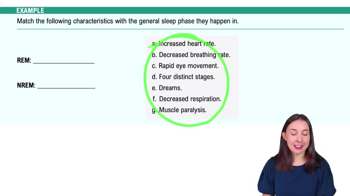
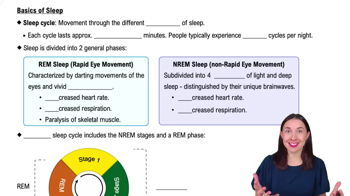
What is most likely happening when a person is in the midst of REM sleep?
During REM sleep, the person is likely experiencing vivid dreams and muscle paralysis.
What is the relationship between sleep and pain?
Poor sleep can increase sensitivity to pain, while adequate sleep can help reduce pain perception.
What kind of drug helps promote sleep?
A hypnotic or sedative drug helps promote sleep.
What are the adaptive functions of sleep?
Adaptive functions of sleep include energy conservation and protection from predators during periods of vulnerability.
What is a long-term effect of sleep deprivation?
A long-term effect of sleep deprivation is increased risk for chronic diseases such as diabetes and cardiovascular disease.
Which aspect of functioning does sleep not affect?
Sleep affects nearly all aspects of functioning, including physical, cognitive, and emotional health.
What best describes the relationship between sleep problems and psychological adjustment?
Sleep problems are closely linked to difficulties in psychological adjustment and mental health.
What is true about insomnia?
Insomnia involves difficulty falling or staying asleep and can negatively impact daytime functioning.
Symptoms of which disorder may be improved by REM deprivation?
Symptoms of depression may be improved by REM deprivation.
Which brain structure plays a role in controlling slow-wave sleep?
The suprachiasmatic nucleus (SCN) plays a role in controlling slow-wave sleep.
How could sleep be best described?
Sleep could be best described as a dynamic, cyclical process involving multiple stages.
For which clients should a nurse obtain a sleep history as a protocol?
A sleep history should be obtained for all clients as part of a comprehensive health assessment.
What is the role of the suprachiasmatic nucleus in the sleep-wake cycle?
The suprachiasmatic nucleus (SCN) is the master clock that sets and controls the sleep-wake cycle.
Sleepwalking is most likely to be associated with which stage of sleep?
Sleepwalking is most likely to be associated with deep non-REM sleep, especially stages 3 and 4.
The average person spends about what portion of their life dreaming?
The average person spends about one-third of their life sleeping, with a significant portion of that time spent dreaming during REM sleep.
What is melatonin and what is its role in sleep?
Melatonin is a hormone released by the pineal gland that promotes drowsiness and helps regulate the sleep-wake cycle.
Which part of the brain ultimately controls the sleep-wake cycle?
The suprachiasmatic nucleus (SCN) in the hypothalamus ultimately controls the sleep-wake cycle.
In middle adulthood, what sleep changes typically occur?
In middle adulthood, individuals typically experience less deep non-REM sleep and more frequent awakenings.
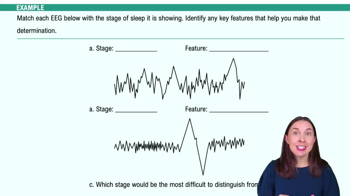
Which terms are associated with an EEG?
Terms associated with an EEG include frequency, amplitude, beta waves, theta waves, delta waves, sleep spindles, and K-complexes.
What term describes the situation in which a sleep medication is taken with alcohol?
The term for combining a sleep medication with alcohol is 'potentiation,' which can increase sedative effects and risk.
What is the ability to respond with little penalty in time?
The ability to respond with little penalty in time refers to alertness or reaction time, which is impaired by sleep deprivation.
Sleepwalking, night terrors, and restless leg syndrome are all examples of what?
They are all examples of sleep disorders or parasomnias.
What does it mean to have a large sleep debt?
Having a large sleep debt means accumulating a significant amount of lost sleep that needs to be recovered.
What is a false statement about sleep deprivation?
A false statement is that sleep deprivation has no effect on health; in reality, it has many negative effects.
What is sleep apnea?
Sleep apnea is a sleep disorder characterized by repeated interruptions in breathing during sleep.
What steps can you take if you have difficulty falling asleep?
Steps include maintaining a regular sleep schedule, avoiding caffeine and screens before bed, and creating a comfortable sleep environment.
What is the definition of circadian rhythm in psychology?
A circadian rhythm is a roughly 24-hour cycle in physiological processes, such as the sleep-wake cycle, regulated by the SCN.
Is going without sleep actively harmful for creatures that need sleep?
Yes, going without sleep is actively harmful for every creature that needs sleep.
What has sleep deprivation been shown to do?
Sleep deprivation has been shown to impair cognitive function, mood, and physical health.
Staying up especially late on weekends is most likely to influence what?
Staying up late on weekends can disrupt the circadian rhythm and make it harder to maintain a regular sleep schedule.
Stage 1 sleep is characterized by a predominance of which type of brain wave activity?
Stage 1 sleep is characterized by a predominance of theta wave activity.
Is getting adequate sleep an important part of physical health?
Yes, getting adequate sleep is an important part of physical health.
What does it mean if someone has accumulated a large sleep debt?
It means they have missed a significant amount of sleep and need to recover it.
If a client begins snoring and is sleeping lightly, what stage of sleep are they likely in?
They are likely in stage 2 of non-REM sleep.
Do the longest dreams occur just as we are falling asleep?
No, the longest dreams occur during later REM periods, not just as we are falling asleep.
What is melatonin in the context of psychology?
Melatonin is a hormone that helps regulate the sleep-wake cycle by promoting drowsiness.
What is a dulled, drowsy, trance-like condition while driving called?
This condition is known as 'highway hypnosis' or 'microsleep.'
Are sleep-related crashes most common in older people, especially women with grandchildren?
No, sleep-related crashes are more common in young adults and shift workers.
 BackBack
 00:11
00:11