Skip to main content
Introduction to Psychology
My Course
Learn
Exam Prep
AI Tutor
Study Guides
Flashcards
Explore
Try the app
My Course
Learn
Exam Prep
AI Tutor
Study Guides
Flashcards
Explore
Try the app
Back
Stress Physiology definitions
You can tap to flip the card.
Sympathetic Nervous System
You can tap to flip the card.
👆
Sympathetic Nervous System
Branch of the autonomic system that mobilizes energy and resources for immediate fight-or-flight reactions during stress.
Track progress
Control buttons has been changed to "navigation" mode.
1/13
Related flashcards
Related practice
Recommended videos
Stress Physiology quiz #1
Stress Physiology
10 Terms
Stress Physiology
13. Stress and Health
7 problems
Topic
Nicole
General Adaptation Syndrome
13. Stress and Health
7 problems
Topic
Nicole
13. Stress and Health
4 topics
12 problems
Chapter
Nicole
Guided course
07:46
Stress Physiology
552
views
4
rank
Guided course
02:34
Example 1
451
views
3
rank
Terms in this set (13)
Hide definitions
Sympathetic Nervous System
Branch of the autonomic system that mobilizes energy and resources for immediate fight-or-flight reactions during stress.
Autonomic Nervous System
Peripheral system division that regulates involuntary functions of organs, vessels, and glands, including stress responses.
Hypothalamus
Brain structure initiating both immediate and prolonged stress responses by signaling other systems and glands.
Adrenal Glands
Paired structures atop the kidneys that release key stress hormones, each from a distinct internal region.
Adrenal Medulla
Inner region of a gland that secretes adrenaline for rapid energy and heightened alertness during acute stress.
Adrenal Cortex
Outer layer of a gland responsible for releasing cortisol, supporting sustained adaptation to ongoing stress.
Pituitary Gland
Master endocrine organ in the brain that directs other glands, especially during prolonged stress via hormone release.
Adrenaline
Hormone that triggers immediate physiological changes like increased heart rate and muscle blood flow in emergencies.
Cortisol
Hormone that maintains prolonged stress responses, affecting glucose levels, digestion, and immune activity.
HPA Axis
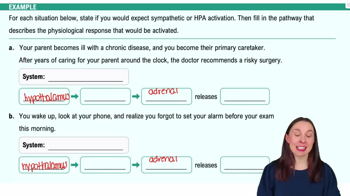
Three-part system involving the hypothalamus, pituitary, and adrenal cortex, coordinating long-term stress adaptation.
Fight or Flight Response
Acute physiological reaction preparing the body for immediate action in the face of perceived danger.
Peripheral Nervous System
Network outside the brain and spinal cord, including branches that regulate automatic stress responses.
Hormones
Chemical messengers released by glands into the bloodstream, orchestrating body-wide responses to stress.
 BackBack

 07:46
07:46