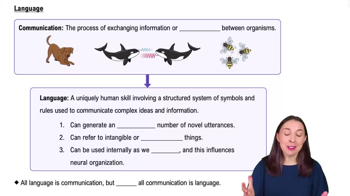
True. Language is symbolic, using symbols such as words to represent ideas and concepts.
Which statement accurately describes the use of spoken language?
Spoken language allows humans to express complex ideas, refer to abstract concepts, and generate infinite novel sentences using structured symbols and rules.
True or false: Cooperation is a principle of language.
False. Cooperation is not listed as a principle of language; language is defined by its structured symbols and rules.
What occurs when a person's brain processes sound in the context of language?
The brain processes sound by identifying phonemes, which are the smallest sound units of language, and then interprets them as meaningful language.
The phrases 'blow off steam' and 'rude awakening' are examples of which kind of language?
These phrases are examples of figurative language, where meaning goes beyond the literal interpretation of the words.
The basic rules that govern language apply to which aspects of language?
The basic rules, such as syntax and grammar, govern the combination and order of words, phrases, and sentences in language.
Which use of language separates humans from other species?
The ability to refer to abstract concepts and generate infinite novel sentences separates human language from other forms of communication.
Language has an impact on which aspects of human experience?
Language impacts thought processes, communication, and neural organization.
Which structure in the brain allows you to read written language and translate it into auditory form?
The brain's language centers, such as the auditory cortex and related regions, allow for the translation of written language into auditory form.
How can the term 'language' be defined?
Language is a structured system of symbols and rules unique to humans, used to express complex ideas and communicate.
What is the encoding of sounds in the context of language called?
The encoding of sounds is called acoustic encoding.
What is a true statement about the relationship between language and the brain?
Language use influences neural organization and is supported by biological evidence.
What is encoding on a basic level based on the structure or appearance of words called?
Encoding based on the structure or appearance of words is called structural encoding.
How can language be defined?
Language is a structured system of symbols and rules that allows humans to communicate complex ideas.
What is the definition of 'oval window' in the context of psychology?
The oval window is a structure in the ear that transmits sound vibrations from the middle ear to the inner ear, but it is not directly related to language structure.
What is the correct order for the three stages of memory?
The correct order is encoding, storage, and retrieval.
What is the hypothesis that one's language determines the nature of one's thought called?
This is called the linguistic relativity hypothesis.
What are the structures, rules, and techniques used to communicate meaning in language called?
They are called grammar and syntax.
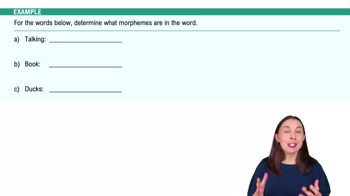
What do the rules of morphology describe in language?
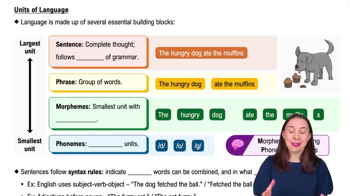
Morphology rules describe how meaningful units (morphemes) can be combined in words.
According to the Atkinson-Shiffrin model, what are the stages of memory?
The stages are sensory memory, short-term memory, and long-term memory.
What is the encoding of words and their meaning known as?
It is known as semantic encoding.
What is paraphrasing to summarize the meaning of what has been communicated called?
Paraphrasing is called summarizing or restating the meaning in one's own words.
What is the ability to derive meaning from spoken language called?
This ability is called comprehension.
What do the stress, accent, rhythm, and pitch in the sound of words and sentences refer to?
These refer to prosody in language.
What is speech segmentation?
Speech segmentation is the process of identifying the boundaries between words, phrases, or phonemes in spoken language.
What is the definition of syntax in psychology?
Syntax refers to the rules that govern how words are combined to form sentences in a language.
Why must information be encoded in order to be retrieved later?
Encoding is necessary because it transforms information into a form that can be stored and later retrieved from memory.
What is the study of meaningful units in a language and how the units are combined in word formation called?
This is called morphology.
What is the speaking of each syllable of a word clearly and separately called?
This is called articulation.
What is the use of language to create certain effects when read or spoken aloud called?
This is called rhetoric or literary devices.
Language is an important component of which aspect of human life?
Language is an important component of communication and thought.
What is the smallest distinctive sound unit of language called?
It is called a phoneme.
What is the process of sending and receiving messages with words called?
This process is called verbal communication or language use.
What does the root 'voc' mean in the word 'vocalize'?
The root 'voc' means 'voice' or 'to call.'
How has the foundation of memory been explained?
The foundation of memory is explained as a process involving encoding, storage, and retrieval.
Identify accurate statements about language change.
Language changes over time as new words, rules, and meanings are introduced and adopted by speakers.
Which term refers to the process by which we derive meaning from morphemes and words?
This process is called semantics.
Which process involves the initial formation of a memory code?
Encoding involves the initial formation of a memory code.
 Back
Back
 04:00
04:00