Chunking improves short-term memory by grouping information into larger, meaningful units, making it easier to remember.
What is the manipulating and transforming of information in memory called?
This is called working memory or cognitive processing.
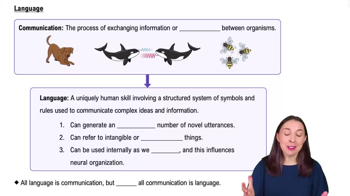
What distinguishes language from general animal communication?
Language uses structured symbols and rules to express complex ideas, while animal communication can be vocal, body language, or chemical signals. Only humans use language to generate infinite novel utterances and refer to abstract concepts.
How does human language allow for internal thought processes?
Humans use language for internal monologues and reflection, which can influence neural organization. This ability is supported by biological evidence.
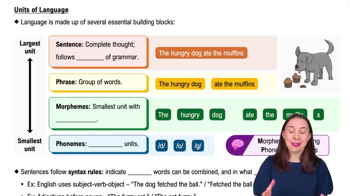
What is a phrase in the context of language units?
A phrase is a group of words that fit together but do not form a complete sentence. Phrases often lack a subject, verb, or object.
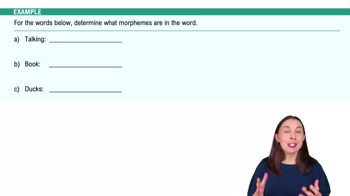
How can the word 'muffins' be broken down into morphemes?
The word 'muffins' consists of two morphemes: 'muffin' and the plural 's.' The 's' adds plurality, giving it meaning.
Why are phonemes not always equivalent to letters in English?
Phonemes are sound units, and some letters can represent multiple sounds, especially vowels. Letter combinations like 'ch' also create unique phonemes.
What is the syntax rule for adjective placement in English?
In English, adjectives are placed before the noun they modify. For example, 'the fuzzy cat' is correct, while 'the cat fuzzy' is not.
Why do we not consider animal communication to be language?
Animal communication lacks the unique features of human language, such as infinite novel utterances and reference to abstract concepts. These features are only found in humans.
What is the universal aspect of language units across human languages?
All human languages use sentences, phrases, morphemes, and phonemes as basic units. However, the specific syntax rules for combining these units differ by language.
 Back
Back
 04:00
04:00