Skip to main content
Introduction to Psychology
My Course
Learn
Exam Prep
AI Tutor
Study Guides
Flashcards
Explore
Try the app
My Course
Learn
Exam Prep
AI Tutor
Study Guides
Flashcards
Explore
Try the app
Back
The Subcortical Forebrain definitions
You can tap to flip the card.
Basal Ganglia
You can tap to flip the card.
👆
Basal Ganglia
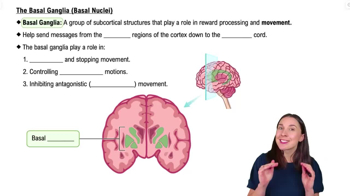
Group of deep brain structures acting as a bridge for motor signals, crucial for starting, stopping, and controlling voluntary movement.
Track progress
Control buttons has been changed to "navigation" mode.
1/15
Related flashcards
Related practice
Recommended videos
The Subcortical Forebrain quiz
The Subcortical Forebrain
15 Terms
The Subcortical Forebrain
3. Biological Psychology
7 problems
Topic
Nicole
Summary of Important Brain Regions
3. Biological Psychology
7 problems
Topic
Nicole
3. Biological Psychology - Part 1 of 2
5 topics
14 problems
Chapter
Nicole
3. Biological Psychology - Part 2 of 2
5 topics
12 problems
Chapter
Nicole
Guided course
03:01
The Basal Ganglia (Basal Nuclei)
951
views
10
rank
Guided course
01:18
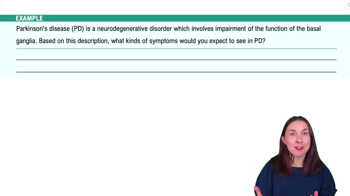
The Subcortical Forebrain Example 1
742
views
13
rank
Guided course
01:21
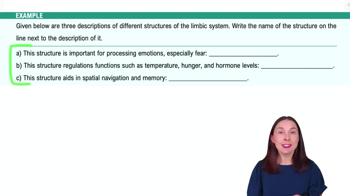
The Subcortical Forebrain Example 2
781
views
8
rank
Terms in this set (15)
Hide definitions
Basal Ganglia
Group of deep brain structures acting as a bridge for motor signals, crucial for starting, stopping, and controlling voluntary movement.
Basal Nuclei
Alternate term for a cluster of subcortical structures involved in movement regulation; used interchangeably with another name.
Primary Motor Cortex
Cortical region responsible for generating voluntary movement commands sent to deeper brain structures.
Spinal Cord
Neural pathway transmitting motor commands from the brain to muscles and sensory information back to the brain.
Thalamus
Central relay station for most sensory signals, directing them to the cortex and regulating consciousness and sleep.
Limbic System
Network of interconnected subcortical structures essential for emotion, motivation, and memory processing.
Hypothalamus
Subcortical structure regulating survival-related drives like hunger, thirst, temperature, and fight-or-flight responses.
Amygdala
Small limbic structure critical for processing emotions, especially fear and aggression.
Hippocampus
Curved limbic structure essential for forming new memories and supporting spatial navigation.
Cerebral Cortex
Outer brain layer receiving sensory input from subcortical relay stations and involved in higher cognitive functions.
Somatosensory Cortex
Cortical area receiving and processing sensory information relayed from the thalamus.
Fight or Flight Response
Survival mechanism involving physiological changes triggered by perceived threats, regulated by a subcortical structure.
Emotion Processing
Neural activity within limbic structures that interprets and regulates feelings such as fear and aggression.
Memory Formation
Process occurring in a specific limbic structure, enabling the creation and storage of new experiences.
Spatial Navigation
Ability to orient and move through environments, supported by a limbic structure involved in memory.
 BackBack
 03:01
03:01