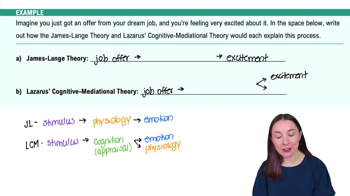
How does the James-Lange theory explain the experience of sadness after a loss?
It explains that the loss causes specific physiological arousal, which is then interpreted as sadness.
Which theory of emotion would best explain feeling an emotion before noticing any physiological changes?
Lazarus's cognitive mediational theory would best explain this sequence.
What is the main difference between the Cannon-Bard and James-Lange theories of emotion?
The Cannon-Bard theory posits simultaneous but independent arousal and emotion, while the James-Lange theory posits that arousal precedes emotion.
How does the Schachter-Singer two-factor theory explain the labeling of emotions?
It explains that emotions are labeled based on cognitive appraisal of the context in which physiological arousal occurs.
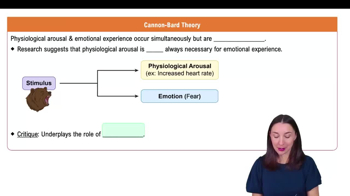
Which theory of emotion would best explain feeling fear and increased heart rate at the same time after seeing a threat?
The Cannon-Bard theory would best explain this simultaneous occurrence.
What is the main focus of the James-Lange theory in the emotional process?
The main focus is on specific physiological arousal preceding and causing the emotional experience.
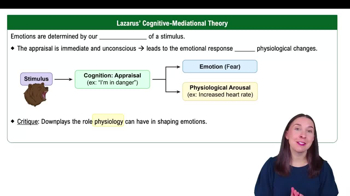
How does Lazarus's cognitive mediational theory explain the role of appraisal in emotion?
It explains that appraisal of a stimulus determines both the emotional experience and physiological arousal.
Which theory of emotion is most consistent with the idea that emotion can occur without physiological arousal?
The Cannon-Bard theory is most consistent with this idea.
What is the main contribution of Lazarus's cognitive mediational theory to emotion research?
It emphasizes the central role of cognitive appraisal in determining emotional experience.
How does the Schachter-Singer two-factor theory explain the experience of different emotions with similar physiological arousal?
It explains that cognitive appraisal of the situation determines which emotion is experienced from similar arousal.
What is the main sequence of events in the Cannon-Bard theory of emotion?
Stimulus → simultaneous physiological arousal and emotional experience.
Which theory of emotion would best explain feeling happy because you are smiling?
The James-Lange theory would best explain this, as it posits that physiological arousal (smiling) leads to emotion (happiness).
How does the James-Lange theory explain the relationship between physiological arousal and emotion?
It explains that specific physiological arousal causes the emotional experience.
Which theory of emotion would best explain feeling fear after appraising a situation as dangerous?
Lazarus's cognitive mediational theory would best explain this sequence.
What is the main difference between the James-Lange and Schachter-Singer two-factor theories?
The James-Lange theory attributes emotion to specific physiological arousal, while the Schachter-Singer theory requires both general arousal and cognitive appraisal.
How does the Cannon-Bard theory explain the experience of emotion in people with impaired physiological feedback?
It explains that emotion can occur independently of physiological feedback, as both are triggered simultaneously by a stimulus.
Which theory of emotion is most consistent with the idea that cognitive appraisal can occur unconsciously?
Lazarus's cognitive mediational theory is most consistent with this idea.
What is the main sequence of events in the Schachter-Singer two-factor theory?
How does the James-Lange theory explain the experience of sadness after a loss?
It explains that the loss causes specific physiological arousal, which is then interpreted as sadness.
Which theory of emotion would best explain feeling an emotion before noticing any physiological changes?
Lazarus's cognitive mediational theory would best explain this sequence.
What is the main difference between the Cannon-Bard and James-Lange theories of emotion?
The Cannon-Bard theory posits simultaneous but independent arousal and emotion, while the James-Lange theory posits that arousal precedes emotion.
How does the Schachter-Singer two-factor theory explain the labeling of emotions?
It explains that emotions are labeled based on cognitive appraisal of the context in which physiological arousal occurs.
Which theory of emotion would best explain feeling fear and increased heart rate at the same time after seeing a threat?
The Cannon-Bard theory would best explain this simultaneous occurrence.
What is the main focus of the James-Lange theory in the emotional process?
The main focus is on specific physiological arousal preceding and causing the emotional experience.
How does Lazarus's cognitive mediational theory explain the role of appraisal in emotion?
It explains that appraisal of a stimulus determines both the emotional experience and physiological arousal.
Which theory of emotion is most consistent with the idea that emotion can occur without physiological arousal?
The Cannon-Bard theory is most consistent with this idea.
What is the main contribution of Lazarus's cognitive mediational theory to emotion research?
It emphasizes the central role of cognitive appraisal in determining emotional experience.
How does the Schachter-Singer two-factor theory explain the experience of different emotions with similar physiological arousal?
It explains that cognitive appraisal of the situation determines which emotion is experienced from similar arousal.
What is the main sequence of events in the Cannon-Bard theory of emotion?
Stimulus → simultaneous physiological arousal and emotional experience.
Which theory of emotion would best explain feeling happy because you are smiling?
The James-Lange theory would best explain this, as it posits that physiological arousal (smiling) leads to emotion (happiness).
How does the James-Lange theory explain the relationship between physiological arousal and emotion?
It explains that specific physiological arousal causes the emotional experience.
Which theory of emotion would best explain feeling fear after appraising a situation as dangerous?
Lazarus's cognitive mediational theory would best explain this sequence.
What is the main difference between the James-Lange and Schachter-Singer two-factor theories?
The James-Lange theory attributes emotion to specific physiological arousal, while the Schachter-Singer theory requires both general arousal and cognitive appraisal.
How does the Cannon-Bard theory explain the experience of emotion in people with impaired physiological feedback?
It explains that emotion can occur independently of physiological feedback, as both are triggered simultaneously by a stimulus.
Which theory of emotion is most consistent with the idea that cognitive appraisal can occur unconsciously?
Lazarus's cognitive mediational theory is most consistent with this idea.
What is the main sequence of events in the Schachter-Singer two-factor theory?
 Back
Back
 02:28
02:28