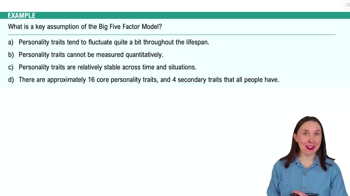
The Big Five personality factors are based on which psychological perspective?
The Big Five personality factors are based on the trait perspective in psychology.
What conclusions can be drawn from trait theory regarding personality?
Trait theory concludes that personality consists of stable, consistent characteristics (traits) that define how individuals think, feel, and behave across different contexts.
Which traits are included in the Five-Factor Model of personality?
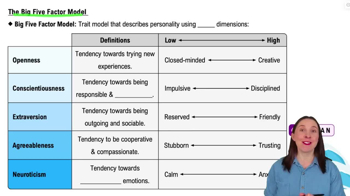
The Five-Factor Model includes openness, conscientiousness, extraversion, agreeableness, and neuroticism.
What is a common misconception about trait theory of personality?
A common misconception is that trait theory explains the causes of personality traits; in reality, it primarily describes and categorizes traits rather than explaining their origins.
According to Cattell, how are personality traits identified?
Raymond Cattell identified personality traits using factor analysis, resulting in 16 main personality traits.
What is a strong advantage of the trait approach to personality?
A strong advantage of the trait approach is its ability to reliably measure and describe stable personality characteristics across individuals and contexts.
If someone is shy and keeps to themselves most of the time, on which Big Five trait would they likely score low?
They would likely score low on extraversion.
Which of the Big Five personality traits has the greatest effect on typical performance?
Conscientiousness has the greatest effect on typical performance, as it relates to reliability, responsibility, and discipline.
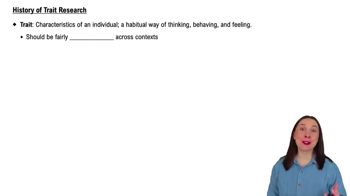
What can most appropriately be said of a personality trait?
A personality trait is a consistent, habitual way of thinking, feeling, or behaving that is stable across different contexts.
Which is not one of the Big Five personality traits?
Concertedness is not one of the Big Five; the correct traits are openness, conscientiousness, extraversion, agreeableness, and neuroticism.
According to the Big Five personality traits, how is personality described?
Personality is described as a combination of scores along five dimensions: openness, conscientiousness, extraversion, agreeableness, and neuroticism.
What statement best describes the assumptions of early trait theories?
Early trait theories assumed that individuals possess stable, consistent traits that define their core personality and influence behavior across situations.
According to Allport's trait theory, how are central and secondary traits defined?
Central traits are core, stable characteristics that define a person's personality, while secondary traits are more context-dependent and situational.
Which is not a Big Five trait: agreeableness, concertedness, openness, neuroticism?
Concertedness is not a Big Five trait.
What did Raymond Cattell call the traits that underlie surface traits?
Raymond Cattell called these underlying traits 'source traits.'
What does personality trait theory propose about traits?
Personality trait theory posits that traits are stable, measurable characteristics that can be used to describe and compare individuals.
Why is the typological approach to personality traits considered less valid than trait-based approaches?
The typological approach is less valid because it oversimplifies personality by categorizing people into types, whereas trait-based approaches recognize the complexity and variability of traits across individuals.
What assumption underlies the trait approach to personality?
The trait approach assumes that personality traits are stable, consistent, and measurable characteristics that differ among individuals.
What is true about personal characteristics called traits?
Traits are consistent patterns of thought, feeling, or behavior that are stable across time and situations.
Which criterion is not listed by Eysenck for identifying a personality factor?
Eysenck did not list cultural popularity as a criterion; his criteria focused on reliability, stability, and biological basis.
How do trait theories of personality differ from psychodynamic and humanistic approaches?
Trait theories focus on describing and measuring stable personality characteristics, while psychodynamic and humanistic approaches emphasize unconscious processes and personal growth.
Which trait describes someone who scores low on an openness to experience assessment?
Someone who scores low on openness to experience is likely to be closed-minded and resistant to new experiences.
 Back
Back
 05:13
05:13