What is the function of the retina in the eye, and what types of cells does it contain?
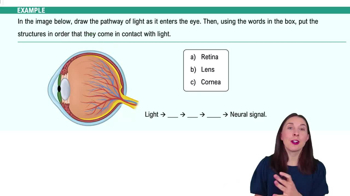
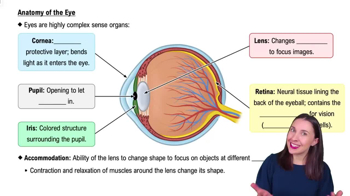
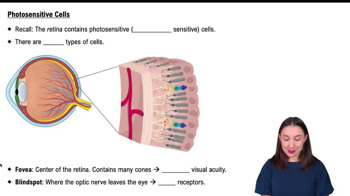
The retina is the neural tissue lining the back of the eye that contains photosensitive cells called rods and cones. Rods enable monochromatic vision in dim light and are abundant in the periphery, while cones are responsible for color vision and are concentrated in the fovea at the center of the retina.
Why do we have a blind spot in our vision, and why are we usually unaware of it?
We have a blind spot because the optic nerve exits the eye at a location (the optic disc) where there are no rods or cones, so no visual information is detected there. We are usually unaware of this blind spot because the brain compensates for the missing information.
What are the main parts of the eye involved in vision, and what are their primary functions?
The main parts of the eye involved in vision are the cornea (protects and bends light), pupil (opening that allows light in), iris (controls pupil size to regulate light entry), lens (changes shape to focus images through accommodation), and retina (contains rods and cones to detect light and color).
What is the process called that allows the lens to change shape for focusing on objects at different distances?
The process is called accommodation. It involves muscles around the lens contracting or relaxing to alter its shape for proper focus.
How does the lens change when focusing on objects that are far away versus those that are close?
When focusing on distant objects, the lens flattens. For nearby objects, the lens bends to increase its curvature.
Where are rods primarily located in the retina, and how numerous are they compared to cones?
Rods are mainly located along the periphery of the retina. Each eye contains between 80 to 120 million rods, making them much more numerous than cones.
What is the main function of cones, and where are they most densely packed in the retina?
Cones are responsible for color vision and function best in bright light. They are most densely packed in the center of the retina, especially in the fovea.
What is the fovea, and why is it important for vision?
The fovea is the central region of the retina with a high concentration of cones. It is important because it provides the sharpest visual acuity.
What causes nearsightedness or farsightedness in relation to the lens?
Nearsightedness or farsightedness often results from problems with the lens's ability to accommodate. If the lens does not change shape correctly, it cannot focus images properly on the retina.
How does the brain compensate for the blind spot created by the optic nerve?
The brain fills in the missing visual information from the blind spot using surrounding visual cues. This compensation makes us generally unaware of the blind spot in everyday vision.