 Back
BackBiological Perspective in Psychology
 01:12
01:12
Terms in this set (26)
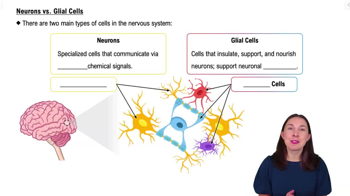
The basic cell of the nervous system that receives and sends messages within the system.
Dendrites: receive messages; Soma: cell body maintaining life; Axon: carries messages to other cells.
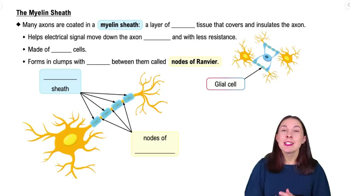
Support neurons by providing nutrients, producing myelin, and cleaning up waste.
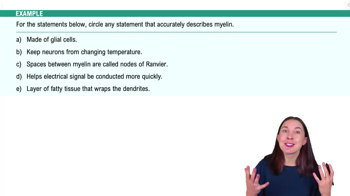
Fatty substance coating axons to insulate, protect, and speed up neural impulses.
State of a neuron when not firing; inside is negatively charged, outside positively charged.
Neural impulse caused by reversal of electrical charge allowing positive sodium ions to enter the axon.
A neuron either fires completely or does not fire at all.
Microscopic fluid-filled gap between axon terminals of one neuron and dendrites of another.
Chemical in synaptic vesicles that transmits signals across the synapse to receptor sites.
Excitatory causes the receiving neuron to fire; inhibitory causes it to stop firing.
Agonists mimic/enhance neurotransmitters; antagonists block or reduce their effects.
Involved in arousal, attention, memory, and muscle contractions; can be excitatory or inhibitory.
Consists of the brain and spinal cord; processes information and controls reflexes.
All nerves outside the CNS; divided into somatic and autonomic nervous systems.
Controls voluntary muscles and carries sensory information to the CNS.
Controls involuntary muscles, organs, and glands; includes sympathetic and parasympathetic divisions.
Part of ANS that prepares the body for stress or emergency ('fight or flight').
Part of ANS that restores the body to normal after arousal and maintains day-to-day functions.
Glands that secrete hormones directly into the bloodstream affecting behavior and bodily functions.
Three stages of physiological response to stress: alarm, resistance, and exhaustion.
The brain's ability to change structure and function in response to experience or trauma.
Damage to Broca's area causing difficulty in producing fluent speech.
Damage to Wernicke's area causing difficulty in understanding or producing meaningful language.
Studies patients with severed corpus callosum to show specialization of left and right brain hemispheres.
Controls language, writing, logical thought, and mathematical abilities.
Controls emotional expression, spatial perception, facial recognition, and music processing.