 Back
Chapter 7
 04:00

Terms in this set (22)
A concept is a fundamental unit of cognition that classifies entities and encodes shared features.
Feature-based, Goal-based, and Relationship-based concepts.
Concepts defined by similar features or characteristics, e.g., all birds have feathers and lay eggs.
Concepts grouped by having the same goal or purpose, e.g., tools used for gardening.
Items connected by the same relationship or linkage, e.g., teacher-student or predator-prey.
The process of identifying a challenge and creating a solution, involving understanding the problem, generating solutions, and evaluating outcomes.
Choosing an option from multiple possibilities by weighing benefits and consequences.
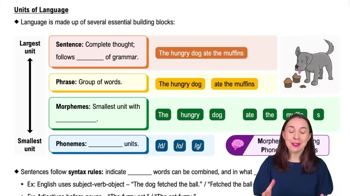
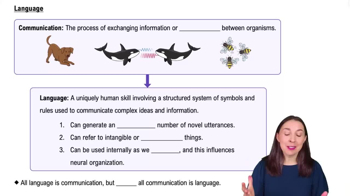
A structured system of communication using symbols, sounds, or gestures.
Proposed by Noam Chomsky; humans are born with an innate ability for language, supported by the Language Acquisition Device (LAD).
Language is learned by applying rules to create meaning, focusing on grammar, syntax, and structure.
Language develops through social interaction; communication needs and context drive learning.
The idea that the language we speak influences how we think and perceive the world.
Yes, language shapes how we categorize and interpret experiences, though basic cognition exists independently.
Intelligence has a general factor (g) underlying all cognitive abilities, with specific abilities (s) branching out.
The core cognitive ability influencing all tasks requiring intelligence.
Individual abilities like mathematical reasoning, verbal skills, and spatial awareness.
Linguistic, logical-mathematical, spatial, bodily-kinesthetic, musical, interpersonal, intrapersonal, and naturalistic intelligences.
The ability to perceive, understand, manage, and regulate emotions in oneself and others.
Nature refers to genetic factors; nurture refers to environmental influences like education and culture.
Identifying giftedness, detecting specific learning disorders, and diagnosing intellectual disabilities.
Culture-fair tests aim to minimize language and cultural influences to provide unbiased intelligence measurement.
The risk of confirming negative stereotypes about one’s group can reduce test performance and affect education and employment outcomes.