 Back
BackClassical Conditioning in Psychology
 06:45
06:45
Terms in this set (20)
Learning is a relatively enduring change in behavior, thought, or knowledge as a result of past experience.
Conditioning is a form of learning involving associations between environmental stimuli and an organism's responses.
Classical conditioning is the process of pairing a neutral stimulus with a bodily response until the neutral stimulus elicits that response.
Ivan Pavlov discovered classical conditioning by studying dogs' salivation responses to environmental cues associated with food.
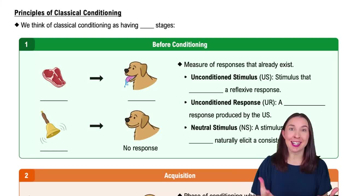
An unconditioned stimulus (US) is a stimulus that naturally and reflexively triggers a response.
An unconditioned response (UR) is the natural, reflexive reaction produced by the unconditioned stimulus.
A neutral stimulus (NS) is a stimulus that does not naturally elicit a consistent response before conditioning.
A conditioned stimulus (CS) is a previously neutral stimulus that, after association with the US, elicits a conditioned response.
A conditioned response (CR) is a learned reaction similar or identical to the unconditioned response, triggered by the conditioned stimulus.
Acquisition is the phase where the neutral stimulus and unconditioned stimulus are paired, leading to the neutral stimulus eliciting the response.
Second-order conditioning occurs when a conditioned stimulus is paired with a new neutral stimulus, which then also elicits the conditioned response.
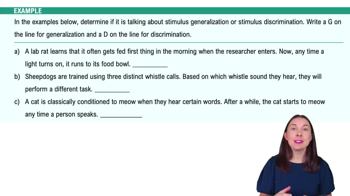
Stimulus generalization is the tendency for stimuli similar to the conditioned stimulus to elicit the conditioned response.
Stimulus discrimination is the ability to distinguish between similar stimuli, responding only to the conditioned stimulus.
As stimulus discrimination increases, stimulus generalization decreases, and vice versa.
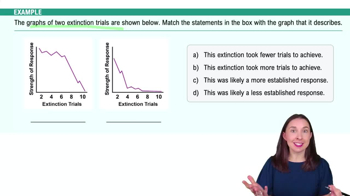
Extinction is the elimination of a learned response when the conditioned stimulus is repeatedly presented without the unconditioned stimulus.
Spontaneous recovery is the reappearance of a conditioned response after a rest period following extinction.
Contrary to misconception, during acquisition the neutral stimulus should precede the unconditioned stimulus for stronger conditioning.
In classical conditioning, the conditioned stimulus signals or predicts the unconditioned stimulus.
During extinction trials, the conditioned stimulus is presented alone repeatedly, leading to a decrease in the conditioned response.
Biological preparedness can make some conditioned responses, like conditioned fear, harder to extinguish.