 Back
Introduction to Psychology: Emotion and Motivation
 03:15

Terms in this set (21)
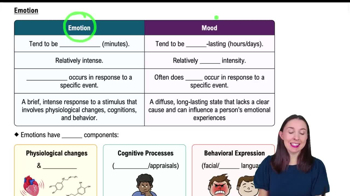
Emotion is a temporary response to something personally meaningful, involving subjective experience, physiological activity, and readiness to act .
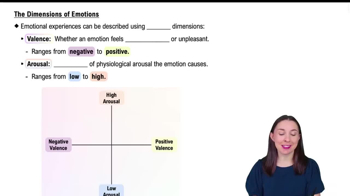
Valence (pleasantness) and arousal (physiological activation level).
Appraisal is the conscious or unconscious evaluation of what a situation means, influencing the emotion experienced.
Emotions prepare us to respond in specific ways, e.g., anger prepares to confront, fear prepares to escape.
A stimulus produces a physiological response first; perception of this bodily change creates the emotional experience.
A stimulus produces physiological arousal and emotional experience simultaneously, independently.
Emotion involves physiological arousal plus a cognitive label interpreting that arousal based on context.
The amygdala rapidly evaluates emotional significance, especially threats, and initiates physiological and behavioral responses.
Fast pathway: thalamus to amygdala for rapid response; Slow pathway: thalamus to cortex to amygdala for detailed evaluation.
Some emotional expressions have similar meanings across cultures due to evolutionary functions.
Anger, disgust, fear, happiness, and sadness.
What are display rules in emotional expression? /
Cultural norms that influence when, where, and how emotions are expressed, including intensification, masking, and neutralizing.
Forming a facial expression can influence the emotion we experience.
Features like morphology (hard-to-control muscles), symmetry, duration (0.5–5 seconds), and smooth timing help distinguish sincerity.
Motivation refers to internal processes that initiate, direct, and sustain purposeful behavior.
Physiological needs create drives that motivate behavior to restore homeostasis.
A pyramid organizing human needs from physiological, safety, belonging, esteem, to self-actualization.
The hypothalamus integrates signals like ghrelin (stimulates hunger) and leptin (reduces hunger) to regulate eating.
Genetics, appetite regulation, energy balance, environment, sleep, medications, and evolutionary mismatch.
Intrinsic motivation is doing something for its own enjoyment; extrinsic motivation is doing something for external rewards or to avoid punishment.
People tend to care more about avoiding losses than achieving equivalent gains, influencing behavior strongly.