 Back
Introduction to Psychology: Language and Thought
 04:00

Terms in this set (28)
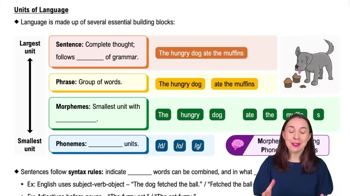
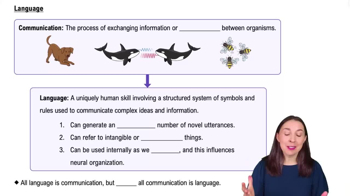
Language is a system of symbols and rules used to communicate meaning, allowing humans to express abstract, imagined, or non-present concepts.
Phonemes are the smallest speech sounds that can distinguish meaning, such as /b/ and /p/ in "bat" and "pat".
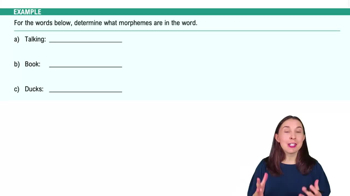
Morphemes are the smallest meaningful units of language, like "dog" or the parts of "unhelpfulness" (un + help + ful + ness).
Phonological rules govern how speech sounds can be combined in a language.
Morphological rules govern how meaningful units combine to form words.
Syntax refers to the rules for arranging words to form meaningful phrases and sentences.
Deep structure is the meaning of a sentence, while surface structure is how the sentence is worded.
Infants show discrimination by switching attention when speech sounds change, indicating they can distinguish different phonemes.
Babbling is rhythmic vocal or hand movements in infants, reflecting readiness for language in both spoken and signed languages.
Fast mapping is when children connect a new word with its meaning after very limited exposure.
Overgeneralization occurs when children apply grammatical rules too broadly, e.g., saying "goed" instead of "went".
Children learn language by imitating speech and receiving reinforcement, emphasizing exposure and feedback.
Humans have an inborn biological capacity for language, including a universal grammar that guides acquisition.
Language develops through biological readiness combined with social interaction, exposure, and feedback.
Broca's aphasia causes slow, effortful speech with better preserved comprehension, linked to left frontal cortex damage.
Wernicke's aphasia results in fluent but meaningless speech and impaired comprehension, linked to left temporal cortex damage.
Bilingualism relates to experience and proficiency, with some brain structure changes but inconsistent evidence for cognitive advantages.
Linguistic relativity suggests language influences how we attend to, categorize, and remember information.
Linguistic determinism is the stronger claim that language determines or limits thought, which research does not fully support.
A concept is a mental representation of a class of objects or ideas; a category groups those objects or ideas together.
Prototype theory categorizes by comparing items to a mental representation of a typical category member.
Exemplar theory categorizes by comparing items to specific examples stored in memory.
A mental shortcut judging likelihood by similarity to a stereotype, which can lead to ignoring actual probabilities.
Judging frequency or likelihood based on how easily examples come to mind.
Framing effects occur when different presentations of the same information change judgments.
Allowing past unrecoverable investments to influence current decisions, even when it is irrational.
Loss aversion means losses have a greater psychological impact than equivalent gains.
It impairs using past consequences to guide choices, leading to preference for immediate rewards despite poor long-term outcomes.