 Back
Introduction to Psychology: Memory Concepts
 01:41

Terms in this set (32)
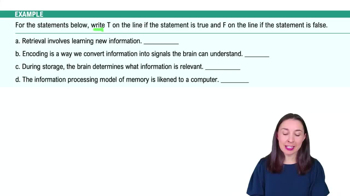
Memory is both a place where information is stored and a process by which information is encoded, stored, and retrieved.
Studying memory helps us understand how information is processed, retained, and recalled, which is essential for learning and behavior.
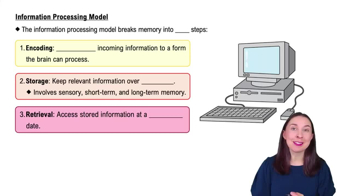
Encoding, Storage, and Retrieval are the three fundamental processes common to different memory models.
Proposed by Atkinson & Shiffrin (1968), it compares memory to computer functions with three systems: sensory memory, short-term memory, and long-term memory.
Sensory memory briefly holds sensory information; includes iconic (visual), echoic (auditory), and haptic (touch) memory with very short duration and large capacity.
Iconic memory is visual sensory memory, echoic memory is auditory sensory memory, and haptic memory is touch sensory memory.
Decay is the fading of sensory information over time if it is not attended to or processed further.
Masking occurs when new sensory information replaces or interferes with old sensory information before it is encoded.
Eidetic imagery is the rare ability to vividly recall visual images with high precision for a few minutes after seeing them.
Short-term memory temporarily holds limited information for about 20 seconds and has a small capacity, typically 7 ± 2 items.
Selective attention is the process of focusing on a specific stimulus while ignoring others, crucial for transferring information from sensory to short-term memory.
Working memory is an active system for temporarily storing and manipulating information, consisting of the central executive, visuospatial sketchpad, and phonological loop.
The central executive controls attention, the visuospatial sketchpad handles visual info, and the phonological loop processes auditory info.
Chunking is grouping information into meaningful units to increase short-term memory capacity.
With maintenance rehearsal, short-term memory can last indefinitely by repeating information.
Long-term memory stores information indefinitely with potentially unlimited capacity and duration.
Maintenance rehearsal is rote repetition, while elaborative rehearsal involves linking new info to existing knowledge for deeper encoding.
Nondeclarative memory is unconscious memory including procedural memory and is affected in anterograde amnesia.
Declarative memory is conscious memory, including semantic memory (facts) and episodic memory (personal events).
A retrieval cue is a stimulus that helps access information stored in long-term memory.
Recall is retrieving information without cues; recognition is identifying previously learned information with cues.
Retrieval failure occurs when stored information cannot be accessed, often due to lack of effective cues.
The serial position effect is the tendency to remember items at the beginning (primacy effect) and end (recency effect) of a list better than middle items.
A false positive is mistakenly recognizing or recalling something that did not actually occur.
Automatic encoding is the unconscious and effortless encoding of incidental information, like space or time.
Flashbulb memories are vivid, detailed memories of emotionally significant events.
Constructive processing is the idea that memories are actively reconstructed, not exact copies of events.
Hindsight bias is the tendency to believe, after an event, that one predicted or knew the outcome beforehand.
The misinformation effect occurs when misleading information alters a person's memory of an event.
False memory syndrome is when a person recalls events that never happened, often influenced by suggestion or misinformation.
Hyperthymesia is an extremely rare condition involving an extraordinary ability to recall personal life events in detail.
Adaptive forgetting is the process of intentionally or naturally forgetting information to reduce cognitive overload and improve mental efficiency.