Skip to main content
Introduction to Psychology
My Course
Learn
Exam Prep
AI Tutor
Study Guides
Flashcards
Explore
Try the app
My Course
Learn
Exam Prep
AI Tutor
Study Guides
Flashcards
Explore
Try the app
Back
Memory and Information Processing Model in Psychology
You can tap to flip the card.
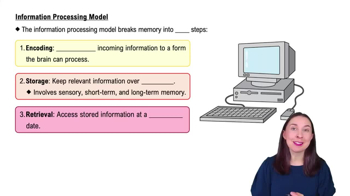
What are the three steps of the Information Processing Model of memory?
You can tap to flip the card.
👆
What are the three steps of the Information Processing Model of memory?
Encoding
,
Storage
, and
Retrieval
.
Track progress
Control buttons has been changed to "navigation" mode.
1/21
Recommended videos
Guided course
01:41
Information Processing Model Example 1
1022
views
13
rank
Guided course
01:49
Information Processing Model
1529
views
32
rank
Terms in this set (21)
Hide definitions
What are the three steps of the Information Processing Model of memory?
Encoding
,
Storage
, and
Retrieval
.
What is encoding in the Information Processing Model?
Encoding is the process of converting incoming information into a form the brain can process.
What does storage involve in the Information Processing Model?
Storage involves keeping relevant information over time in sensory, short-term, and long-term memory.
What is retrieval in the Information Processing Model?
Retrieval is accessing stored information at a later date.
What is the Three-Box Model of Memory?
A model that describes memory storage in three sequential stages: sensory memory, short-term memory, and long-term memory.
What is sensory memory?
The stage of memory that holds incoming sensory stimuli for a very brief time, less than a few seconds.
How long does sensory memory retain visual and auditory stimuli?
Visual stimuli are retained for about 1 second; auditory stimuli for less than a few seconds.
What happens to unattended information in sensory memory?
Unattended information is quickly forgotten or lost.
What is short-term memory?
Temporary storage that holds information for about 20 seconds.
How is working memory different from short-term memory?
Working memory involves the active manipulation of information held in short-term memory.
What is the typical capacity of short-term memory?
Historically 7 ± 2 items; more recent research suggests 4 ± 1 chunks of information.
Name three strategies to increase short-term/working memory capacity.
Rehearsal
,
Serial Position Effect
, and
Chunking
.
How does expertise affect working memory capacity?
Expertise in a subject can increase working memory capacity.
What is long-term memory?
Storage of information over long periods with near-limitless capacity.
What are the two main types of long-term memory?
Implicit (non-declarative)
and
Explicit (declarative)
memory.
What is implicit memory?
Memory that influences thoughts and behaviors without conscious awareness.
What is explicit memory?
Memories that can be consciously retrieved.
What are examples of implicit memory?
Priming, procedural memory, and conditioned responses.
What are examples of explicit memory?
Semantic memory (facts) and episodic memory (personal experiences).
What are associative (semantic) networks in long-term memory?
Networks of nodes representing interrelated concepts, where activating one node makes related nodes easier to retrieve.
How does frequency of association affect links in semantic networks?
More frequent associations create stronger links between concepts.
 BackBack
 01:41
01:41