 Back
BackPsychology - Sleep and Consciousness
 00:11
00:11
Terms in this set (20)
A circadian rhythm is the 24-hour sleep-wake cycle in humans that regulates many body processes.
The suprachiasmatic nucleus (SCN) in the hypothalamus controls the circadian rhythm.
The SCN mainly responds to light as an external cue.
The SCN triggers the pineal gland to release melatonin.
Melatonin is the hormone released by the pineal gland to promote sleep.
Circadian rhythms can become dysregulated, causing sleep problems.
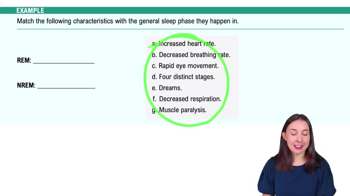
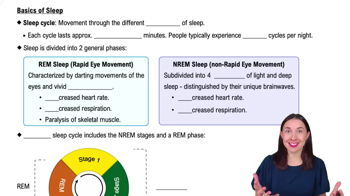
Sleep is divided into REM (Rapid Eye Movement) and NREM (Non-REM) phases.
Each sleep cycle lasts about 90-120 minutes, with typically 4-6 cycles per night.
REM sleep features rapid eye movements, vivid dreams, increased heart rate, increased respiration, and muscle paralysis.
NREM sleep has four stages of light to deep sleep, with decreased heart rate and respiration.
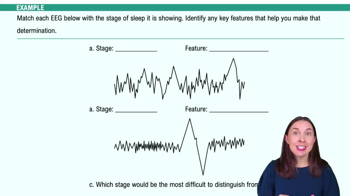
An EEG (electroencephalogram) measures electrical activity in the brain to visualize brainwaves.
Frequency (cycles per second) and amplitude (height) of brainwaves indicate brain activity levels.
Awake EEG shows beta waves: high frequency and low amplitude.
Stage 1 sleep shows theta waves, which have lower frequency than beta waves.
Stage 2 sleep has sleep spindles (high frequency bursts) and K complexes (high amplitude waves).
Stages 3 & 4 show delta waves, which have the lowest frequency and highest amplitude, indicating deep sleep.
REM sleep EEG resembles awake EEG with beta-like waves, despite muscle paralysis.
The amount of deep sleep decreases as the night goes on.
REM sleep duration increases as the night progresses.
People typically re-enter Stage 1 sleep after waking up during the night.