Skip to main content
Introduction to Psychology
My Course
Learn
Exam Prep
AI Tutor
Study Guides
Flashcards
Explore
Try the app
My Course
Learn
Exam Prep
AI Tutor
Study Guides
Flashcards
Explore
Try the app
Back
Sleep Stages and Brain Waves in Psychology
You can tap to flip the card.
Normal waking state
You can tap to flip the card.
👆
Normal waking state
Characterized by
Beta waves
, which indicate active, alert brain activity.
Track progress
Control buttons has been changed to "navigation" mode.
1/12
Recommended videos
Guided course
00:11
Sleep Example 4
933
views
12
rank
Guided course
01:28
Sleep Example 2
1244
views
11
rank
Guided course
03:58
Basics of Sleep
1117
views
14
rank
Terms in this set (12)
Hide definitions
Normal waking state
Characterized by
Beta waves
, which indicate active, alert brain activity.
Brain waves just before sleep
Dominated by
Alpha waves
, indicating a relaxed, calm state before sleep.
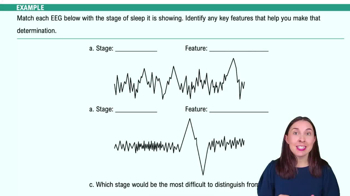
Stage N1 sleep
The first stage of sleep marked by
Theta waves
, representing light sleep.
Stage N2 sleep
Characterized by
Sleep spindles
and
K-complexes
, which are brief bursts of brain activity important for memory consolidation.
Stage N3 sleep (Slow-wave sleep)
Deep sleep stage dominated by
Delta waves
, associated with restorative sleep.
Stage R (REM) sleep
Marked by
Beta waves
similar to waking state, associated with vivid dreaming and brain activity.
Sleep spindles
Brief bursts of rapid brain activity during Stage N2 sleep, important for memory and learning.
K-complex
A large wave that occurs during Stage N2 sleep, thought to help suppress cortical arousal and aid memory consolidation.
Theta waves
Brain waves seen in Stage N1 sleep, indicating light sleep and transition from wakefulness.
Delta waves
Slow brain waves characteristic of deep Stage N3 sleep, important for physical and mental restoration.
Beta waves
Fast brain waves associated with active thinking and REM sleep.
Alpha waves
Brain waves indicating a relaxed, calm state, often seen just before sleep.
 BackBack
 00:11