 Back
BackAP Psychology Unit 2: Cognition, Perception, Memory, and Intelligence Study Guide
Study Guide - Smart Notes
 Tailored notes based on your materials, expanded with key definitions, examples, and context.
Cognition, Perception, Memory, and Intelligence
Perception
Perception is the process of organizing and interpreting sensory information to create meaningful experiences. It involves both basic sensory input and higher-level cognitive processes, allowing us to make sense of the world.
Bottom-up Processing: Begins with sensory input and builds up to complex perception. Example: assembling a jigsaw puzzle.
Top-down Processing: Uses prior knowledge, expectations, and context to interpret sensory information. Example: reading messy handwriting using language knowledge.
Gestalt Principles
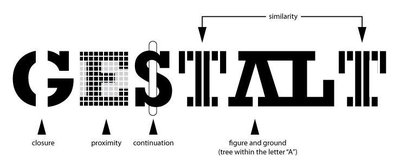
Gestalt principles explain how we organize visual information into meaningful patterns and groups.
Similarity: Elements that are visually similar are grouped together.
Proximity: Elements close to each other are perceived as a group.
Closure: We fill in gaps to perceive complete shapes.
Continuity: We perceive smooth, continuous lines or patterns.
Figure-Ground: We distinguish objects (figures) from their background (ground).
Example: The word "GESTALT" can be visually analyzed using Gestalt principles, such as closure, proximity, continuation, similarity, and figure-ground.
Depth Perception
Depth perception allows us to see the world in three dimensions and judge distances.
Binocular Cues: Require both eyes. Includes retinal disparity (difference in images between eyes) and convergence (inward turning of eyes).
Monocular Cues: Can be perceived with one eye. Includes relative clarity, relative size, texture gradient, linear perspective, and interposition.
Perceptual Constancy
Perceptual constancy is the tendency to perceive objects as stable despite changes in sensory input.
Size Constancy: Objects are perceived as having a constant size.
Shape Constancy: Objects maintain their shape from different angles.
Color Constancy: Objects retain their color under varying lighting.
Apparent Movement
Stroboscopic Movement: Illusion of motion from rapid series of images (e.g., movies).
Phi Phenomenon: Illusion of movement from blinking lights in succession.
Perceptual Set and Attention
Perceptual set is a mental predisposition to perceive information in a particular way, shaped by schemas and experience. Selective attention focuses awareness on specific stimuli, sometimes causing inattentional or change blindness.
Example: Different cultural backgrounds can lead to different interpretations of social behavior.
Inattentional Blindness: Failure to notice visible objects when attention is elsewhere.
Change Blindness: Failure to notice changes in the environment.
Cocktail Party Effect: Ability to focus on one voice among many.
Thinking, Problem-Solving, Judgments, and Decision-Making
Thinking involves manipulating information to form concepts, solve problems, make decisions, and judgments.
Assimilation: Integrating new information into existing schemas.
Accommodation: Modifying schemas to fit new information.
Prototype: Most typical example of a concept.
Problem-Solving Strategies
Algorithms: Step-by-step procedures guaranteeing a solution.
Heuristics: Mental shortcuts for quick solutions, but prone to error.
Obstacles: Mental set, functional fixedness, confirmation bias.
Judgment and Decision-Making
Framing: Presentation of information affects decisions.
Priming: Exposure to a stimulus influences response to another.
Overconfidence: Overestimating one's abilities or knowledge.
Belief Bias & Perseverance: Distortion of reasoning and clinging to beliefs.
Cognitive Biases
Gambler's Fallacy: Belief that random events are influenced by previous outcomes.
Sunk-Cost Fallacy: Continuing investment due to prior investment.
Convergent vs. Divergent Thinking
Convergent Thinking: Finding a single correct solution.
Divergent Thinking: Generating multiple creative solutions.
Introduction to Memory
Memory is the process of encoding, storing, and retrieving information. It is essential for learning and adapting to new situations.
Declarative (Explicit) Memory: Conscious recall of facts (semantic) and events (episodic).
Procedural (Implicit) Memory: Unconscious recall of skills and procedures.
Retrospective Memory: Memory for past events.
Prospective Memory: Memory for future actions.
Memory Processes
Encoding: Transforming sensory input into memory.
Storage: Retaining information over time.
Retrieval: Accessing stored information.
Memory Models
Multi-Store Model: Sensory memory, short-term memory (STM), long-term memory (LTM).
Information Processing Model: Compares memory to computer operations.
Levels of Processing Theory: Deeper processing leads to better retention.
Brain Regions Involved in Memory
Hippocampus: Formation of new explicit memories.
Frontal Lobes: Working memory, encoding, retrieval.
Temporal Lobes: Auditory processing, long-term memory.
Parietal Lobes: Spatial processing, integration.
Cerebellum: Implicit memory, motor skills.
Amygdala: Emotional memory.
Long-Term Potentiation (LTP)
LTP: Strengthening of synaptic connections, crucial for long-term memory formation.
Encoding Memories
Encoding is the process of getting information into memory, influenced by depth and strategies used.
Automatic Processing: Encoding without conscious effort.
Effortful Processing: Requires attention and effort.
Shallow Processing: Focuses on appearance or sound.
Deep Processing: Focuses on meaning, leading to better retention.
Self-reference Effect: Processing personally relevant information more deeply.
Encoding Strategies
Mnemonic Devices: Memory aids (e.g., method of loci, peg word system).
Chunking: Grouping information into meaningful units.
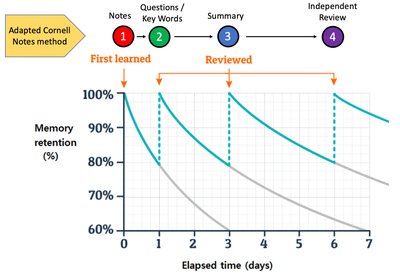
Spacing Effect: Distributed practice is more effective than massed practice.
Serial Position Effect: Primacy and recency effects in memorability.
Storing Memories
Memory storage involves maintaining information in sensory, short-term, and long-term memory systems.
Sensory Memory: Briefly holds sensory information (iconic for visual, echoic for auditory).
Short-Term Memory (STM): Holds limited information for 20-30 seconds (about 7 items).
Working Memory: Active processing and linking of new and old information.
Long-Term Memory (LTM): Stores information for extended periods; unlimited capacity.
Explicit Memory: Conscious recall of facts and experiences.
Implicit Memory: Unconscious recall of skills and procedures.
Prospective Memory: Remembering to perform future actions.
Memory in the Brain
Frontal Lobe: Semantic and episodic memories.
Prefrontal Cortex: Short-term memory storage.
Temporal Lobe: Long-term memory formation.
Hippocampus: Formation of new long-term memories.
Motor Cortex, Basal Ganglia, Cerebellum: Procedural memories.
Amygdala: Emotional memories.
Amnesia and Impairments
Retrograde Amnesia: Inability to recall past information.
Anterograde Amnesia: Inability to form new memories.
Infantile Amnesia: Inability to recall early childhood events.
Alzheimer's Disease: Progressive loss of memory and cognitive function.
Retrieving Memories
Retrieval is the process of accessing stored information, influenced by cues and context.
Recall: Retrieving information without cues.
Recognition: Identifying information with cues.
Retrieval Cues: Stimuli that trigger memory retrieval.
Priming: Activation of associations in memory.
Context-dependent, Mood-congruent, State-dependent Memory: Retrieval is enhanced when context, mood, or state matches encoding.
Testing Effect: Practice tests improve retrieval.
Metacognition: Thinking about one's own thinking.
Reconstruction: Retrieval can be distorted by adding or changing details.
Interleaving: Mixing study subjects improves retention.
Forgetting and Other Memory Challenges
Forgetting is a natural process influenced by time, interference, and retrieval failures. Memory is constructive and subject to distortion.
The Forgetting Curve: Rapid loss of information after learning, then levels off.
Encoding Failure: Information not encoded is not remembered.
Interference: Proactive (old blocks new) and retroactive (new blocks old) interference.
Inadequate Retrieval: Lack of cues leads to retrieval failure (tip-of-the-tongue).
Decay: Memory traces fade over time.
Repression: Forgetting to protect the ego from distress.
Misinformation Effect: False memories created by misleading information.
Source Amnesia: Forgetting the origin of information.
Constructive Memory: Memories are reconstructed, not fixed.
False Memories: Recollections of events that never occurred.
Eyewitness Testimony: Vulnerable to distortion and error.
Example: Reviewing notes and practicing retrieval can improve memory retention and counteract forgetting.
Intelligence and Achievement
Intelligence is the ability to learn, solve problems, and adapt. It is measured and understood in various ways.
General Intelligence (g): Overall cognitive ability.
Multiple Intelligences: Distinct abilities (Gardner's theory).
IQ: Intelligence quotient, originally mental age/chronological age; now deviation IQ (mean=100, SD=15).
Psychometric Principles: Standardization, validity, reliability.
Achievement Tests: Measure knowledge.
Aptitude Tests: Predict future performance.
Mindset: Fixed vs. growth mindset affects achievement.
Fluid Intelligence: Reasoning and abstract thinking; decreases with age.
Crystallized Intelligence: Accumulated knowledge; increases with age.
Flynn Effect: Rising intelligence scores over time.
Stereotype Threat: Risk of confirming negative stereotypes affects performance.
Heritability: Proportion of variation due to genes.
Executive Functions: Planning, organizing, and critical thinking.
Example: Intelligence tests must be reliable, valid, and standardized to be useful in educational and psychological settings.
Additional info: The study notes expand brief points into full academic explanations, add definitions, examples, and context for clarity and completeness. Images are included only where directly relevant to the explanation of Gestalt principles and memory retention.
