 Back
Back3. Behaviorism and Classical Conditioning: Foundations of Learning in Psychology
Study Guide - Smart Notes
 Tailored notes based on your materials, expanded with key definitions, examples, and context.
Behaviorism and Learning
Introduction to Behaviorism
Behaviorism is a foundational school of thought in psychology that emphasizes the study of observable behavior and the processes by which behavior is learned. Early behaviorists, such as John B. Watson, argued that psychology should focus exclusively on behaviors that can be objectively measured, rather than internal mental states.
Behaviorism: The scientific study of observable behavior, with a focus on how behaviors are acquired and modified by environmental stimuli.
Learning: Defined as a change in behavior that results from experience.
Major focus: Understanding the mechanisms of learning, particularly through classical conditioning and operant conditioning.
Classical Conditioning
Key Concepts and Terminology
Classical conditioning is a type of associative learning first systematically described by Ivan Pavlov. It involves learning to associate a neutral stimulus with a stimulus that naturally produces a response, so that the neutral stimulus eventually elicits the response on its own.
Stimulus (S): Any event or object in the environment that elicits a response.
Response (R): The behavior or reaction elicited by a stimulus.
Unconditioned Stimulus (UCS): A stimulus that naturally and automatically triggers a response (e.g., food).
Unconditioned Response (UCR): The unlearned, naturally occurring response to the UCS (e.g., salivation to food).
Neutral Stimulus (NS): A stimulus that does not initially elicit the target response.
Conditioned Stimulus (CS): Originally the NS, after association with the UCS, it triggers a conditioned response.
Conditioned Response (CR): The learned response to the previously neutral stimulus.
Phases of Classical Conditioning
Before Conditioning:
NS → No response
UCS → UCR
During Conditioning:
NS + UCS → UCR
After Conditioning:
CS (was NS) → CR
Examples of Classical Conditioning
Dog Bite Example:
UCS: Dog bite
UCR: Fear/pain
CS: Sight of a large dog
CR: Fear and avoidance
Perfume Example:
UCS: Presence of girlfriend
UCR: Happiness/relaxation
CS: Smell of perfume
CR: Happiness/relaxation
Relationship Between UCR and CR
Often, the CR is very similar to the UCR, but it can sometimes be a muted or even opposite version (e.g., conditioned compensatory response in drug tolerance).
Classical Conditioning Phenomena
Several phenomena are associated with classical conditioning, reflecting the complexity of learned associations:
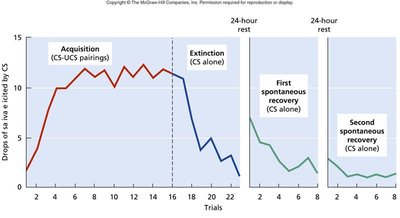
Extinction: The gradual weakening and disappearance of the CR when the CS is repeatedly presented without the UCS.
Spontaneous Recovery: The reappearance of a previously extinguished CR after a rest period.
Stimulus Generalization: The tendency for stimuli similar to the CS to elicit the CR.
Stimulus Discrimination: The learned ability to distinguish between the CS and other irrelevant stimuli.
Applications: Phobias and Exposure Therapy
Phobias: Intense, irrational fears that can often be traced to classical conditioning experiences (e.g., Little Albert experiment by Watson).
Exposure Therapy: A behavioral treatment for phobias that involves repeated exposure to the feared stimulus without any negative outcome, promoting extinction of the fear response.
Distinctive Features of Classical Conditioning
Typically involves reflexive (involuntary) responses.
The UCS and CS are presented independently of the subject's behavior (i.e., the subject does not have to do anything to receive the stimuli).
The UCS and CS precede the subject's response.
Experimental Design and Statistical Significance
Understanding Statistical Significance
Statistical significance refers to the likelihood that an observed effect or difference in an experiment is not due to chance. Larger sample sizes (n) increase the reliability of statistical tests and the likelihood of detecting true effects.
Experiments with larger sample sizes (e.g., n = 1000) are more likely to reveal statistically significant differences compared to those with small sample sizes (e.g., n = 1).
Example: Heroin Overdose Experiment
Rats conditioned to heroin in a specific environment showed different overdose responses depending on whether the test dose was administered in the same or a different environment, illustrating the role of conditioned compensatory responses.
Summary Table: Classical Conditioning Terms
Term | Definition | Example |
|---|---|---|
Unconditioned Stimulus (UCS) | Stimulus that naturally elicits a response | Food, dog bite |
Unconditioned Response (UCR) | Natural, unlearned response to UCS | Salivation, fear |
Neutral Stimulus (NS) | Stimulus that does not elicit the target response | Bell, sight of a dog |
Conditioned Stimulus (CS) | Previously NS, now elicits response after association | Bell, sight of a dog |
Conditioned Response (CR) | Learned response to CS | Salivation, fear |
Practice Question: Experimental Variables
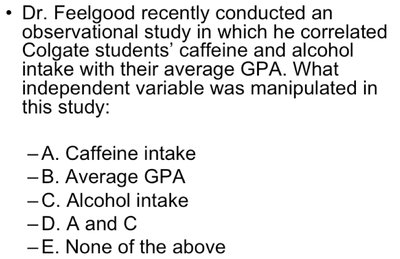
In observational studies, variables are measured but not manipulated. For example, if a study correlates caffeine and alcohol intake with GPA, no independent variable is manipulated.
Correct answer: None of the above (no independent variable was manipulated).
Additional info: Operant conditioning, another major form of learning, is not covered in detail here but is also central to behaviorist theory.
