 Back
BackBiological Psychology: Organization and Function of the Nervous System chapter 3
Study Guide - Smart Notes
 Tailored notes based on your materials, expanded with key definitions, examples, and context.
Chapter 3: The Organization and Function of the Nervous System
Introduction
This chapter explores the structure and function of the nervous system, focusing on the central and peripheral divisions, the organization of the brain, and the roles of various brain regions in behavior and cognition. Understanding these components is essential for comprehending how biological processes underlie psychological phenomena.
The Nervous System
Central vs. Peripheral Nervous System
The nervous system is divided into two main parts: the central nervous system (CNS) and the peripheral nervous system (PNS). The CNS consists of the brain and spinal cord, serving as the primary control center for processing information. The PNS connects the CNS to the rest of the body, facilitating communication between the brain, spinal cord, and peripheral organs.
Central Nervous System (CNS): Brain and spinal cord; responsible for integrating sensory information and responding accordingly.
Peripheral Nervous System (PNS): All neural elements outside the CNS; includes sensory and motor neurons that connect the CNS to limbs and organs.
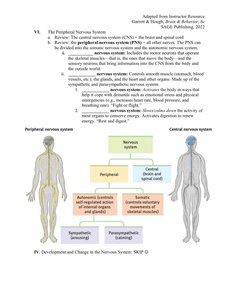
Divisions of the Peripheral Nervous System
The PNS is further divided into the somatic nervous system and the autonomic nervous system. The somatic system controls voluntary movements and transmits sensory information, while the autonomic system regulates involuntary functions such as heart rate and digestion. The autonomic system is subdivided into the sympathetic (activates fight-or-flight responses) and parasympathetic (promotes rest and digestion) branches.
Somatic Nervous System: Controls voluntary muscle movements and transmits sensory information to the CNS.
Autonomic Nervous System: Regulates involuntary bodily functions; includes sympathetic and parasympathetic divisions.
Sympathetic Division: Prepares the body for stressful or emergency situations (increases heart rate, dilates pupils).
Parasympathetic Division: Promotes relaxation and recovery (slows heart rate, stimulates digestion).
Directional Terms and Brain Anatomy
Directional Terms
Understanding directional terms is crucial for describing locations and orientations within the brain. Key terms include:
Dorsal: Toward the back or upper side.
Ventral: Toward the belly or lower side.
Anterior: Toward the front.
Posterior: Toward the back.
Superior: Above.
Inferior: Below.
Lateral: Toward the side.
Medial: Toward the midline.
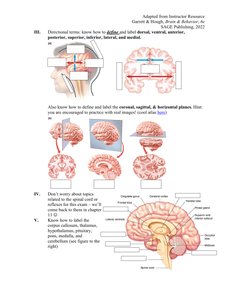
Anatomical Planes of the Brain
The brain can be sectioned along different planes for study and medical imaging:
Coronal Plane: Divides the brain into front and back sections.
Sagittal Plane: Divides the brain into left and right sections.
Horizontal Plane: Divides the brain into upper and lower sections.
Major Brain Regions and Their Functions
Lobes of the Cerebral Cortex
The cerebral cortex is divided into four main lobes, each with distinct functions:
Lobe | Definition | Main Functions |
|---|---|---|
Frontal | Contains the prefrontal cortex | Working memory, decision-making, voluntary movement (primary motor cortex) |
Parietal | Contains the somatosensory cortex | Processing sensory information (touch, spatial awareness) |
Temporal | Contains the auditory cortex | Processing auditory information, memory |
Occipital | Contains the visual cortex | Processing visual information |
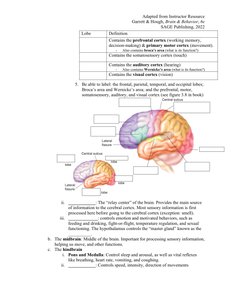
Other Key Brain Structures
Thalamus: Acts as the relay center for sensory information, directing signals to appropriate cortical areas.
Midbrain: Important for processing sensory information and controlling movement.
Medulla: Controls vital autonomic functions such as heart rate, breathing, and reflexes.
Summary Table: Central vs. Peripheral Nervous System
Central Nervous System | Peripheral Nervous System |
|---|---|
Brain and spinal cord | All neural elements outside the CNS |
Processes and integrates information | Transmits information to and from the CNS |
Conclusion
Understanding the organization and function of the nervous system is foundational for studying biological psychology. The CNS and PNS work together to regulate behavior, cognition, and physiological processes, with specialized brain regions contributing to distinct aspects of mental and bodily function.
