 Back
BackBiology of the Mind: Foundations of Biological Psychology
Study Guide - Smart Notes
 Tailored notes based on your materials, expanded with key definitions, examples, and context.
Biological Foundations of Behaviour
Behavioural Genomics and Genetics
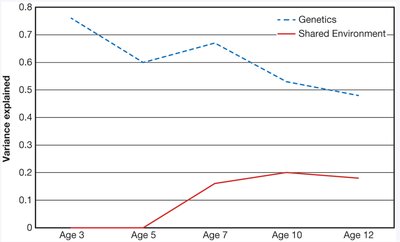
Behavioural genomics and genetics explore how genes and the environment shape behaviour. Twin and adoption studies are key methods for understanding heritability, which quantifies the genetic contribution to individual differences in traits.
Behavioural genomics: Studies DNA and links specific genes to behaviour.
Behavioural genetics: Examines how genes and environment influence behaviour.
Heritability: Statistic (0–1) representing genetic contribution to trait variance in a population.
Twin studies: Compare identical and fraternal twins to estimate heritability.
Adoption studies: Compare adopted children to biological and adoptive parents to separate genetic and environmental effects.
Example: Taste sensitivity varies due to both genetics and childhood diet, resulting in a heritability score between 0 and 1.
Gene Expression, Epigenetics, and Behaviour
Gene expression refers to the process by which genetic information is used to produce proteins, influencing behaviour and brain function. Epigenetics studies changes in gene expression due to experience, without altering the genetic code.
Gene expression: Can be influenced by environment (diet, stress, sleep).
Epigenetics: Experience-driven changes in gene expression.
CRISPR: Technology for editing genetic material, used to study and treat disorders.
Evolutionary Psychology
Evolutionary psychology applies Darwin's theory of natural selection to explain human behaviour based on adaptive functions in our evolutionary history.
Natural selection: Favourable traits are passed to future generations.
Hunter-gatherer theory: Links cognitive abilities to ancestral roles (e.g., spatial memory differences between sexes).
Neural Communication
Structure and Function of Neurons
Neurons are specialized cells responsible for transmitting information and producing behaviour. Their structure is closely related to their function.
Cell body: Contains nucleus and genetic material.
Dendrites: Receive input from other neurons.
Axon: Transmits electrochemical signals.
Axon terminals: Release neurotransmitters.
Types of Neurons and Glial Cells
Sensory neurons: Bring information from senses to the brain.
Motor neurons: Carry messages from brain/spinal cord to muscles.
Glial cells: Support neurons, mount immune responses, remove waste, and form myelin (insulates axons).
Neural Electrical Activity
Neural activity is based on ion concentrations and gradients. The resting potential is maintained by electrostatic and concentration gradients.
Resting potential: millivolts inside neuron.
Depolarization: Na+ enters, membrane potential becomes less negative.
Threshold: ~ mV triggers action potential.
Action potential: Rapid electrical wave, membrane potential changes from ~ mV to ~ mV.
Refractory period: Brief time when neuron cannot fire again.
Synaptic Transmission
Neurotransmitters are released at the synapse, influencing whether the next neuron fires. The all-or-none principle states that neurons fire fully or not at all.
Excitatory response: Increases likelihood of action potential.
Inhibitory response: Decreases likelihood of action potential.
Reuptake: Neurotransmitters are reabsorbed by presynaptic neuron.
Neurotransmitters and Drug Effects
Major Neurotransmitters
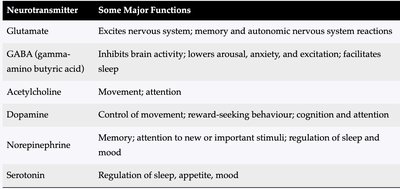
Neurotransmitters are chemicals that transmit signals across synapses. Each has distinct functions in the nervous system.
Neurotransmitter | Some Major Functions |
|---|---|
Glutamate | Excites nervous system; memory and autonomic nervous system reactions |
GABA (gamma-amino butyric acid) | Inhibits brain activity; lowers arousal, anxiety, and excitation; facilitates sleep |
Acetylcholine | Movement; attention |
Dopamine | Control of movement; reward-seeking behaviour; cognition and attention |
Norepinephrine | Memory; attention to new or important stimuli; regulation of sleep and mood |
Serotonin | Regulation of sleep, appetite, mood |
Drug Effects on Neurotransmission
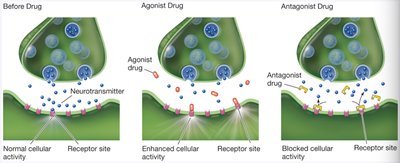
Drugs can act as agonists (enhancing neurotransmitter effects) or antagonists (inhibiting neurotransmitter effects).
Agonists: Mimic or enhance neurotransmitter action (e.g., nicotine for acetylcholine).
Antagonists: Block or inhibit neurotransmitter action.
Direct agonists: Bind to neurotransmitter receptors.
Indirect agonists: Facilitate neurotransmitter effects without binding directly.
Structure and Organization of the Nervous System
Central and Peripheral Nervous Systems
The nervous system is divided into central (brain and spinal cord) and peripheral (somatic and autonomic) systems.
Central nervous system: Brain and spinal cord.
Peripheral nervous system: Somatic (voluntary movement) and autonomic (organs and glands).
Sympathetic: Fight-or-flight response.
Parasympathetic: Maintains homeostasis.
Brain Regions and Functions
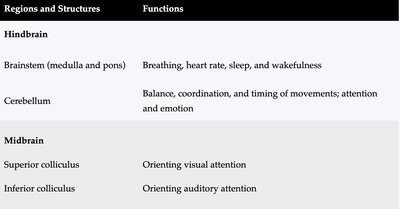
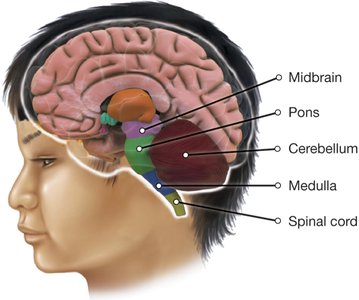
The brain is organized into hindbrain, midbrain, and forebrain, each with specialized structures and functions.
Regions and Structures | Functions |
|---|---|
Hindbrain Brainstem (medulla and pons) Cerebellum | Breathing, heart rate, sleep, wakefulness Balance, coordination, timing of movements, attention, emotion |
Midbrain Superior colliculus Inferior colliculus | Orienting visual attention Orienting auditory attention |
Forebrain and Cerebral Cortex
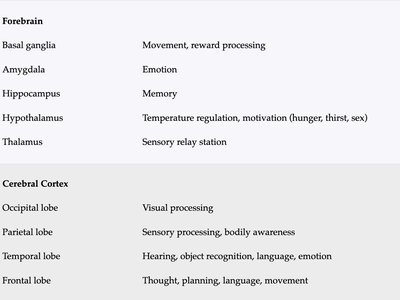
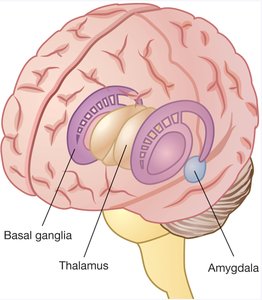
The forebrain contains structures essential for movement, emotion, memory, and sensory processing. The cerebral cortex is responsible for higher cognitive functions.
Forebrain | Functions |
|---|---|
Basal ganglia | Movement, reward processing |
Amygdala | Emotion |
Hippocampus | Memory |
Hypothalamus | Temperature regulation, motivation (hunger, thirst, sex) |
Thalamus | Sensory relay station |
Cerebral Cortex | Functions |
|---|---|
Occipital lobe | Visual processing |
Parietal lobe | Sensory processing, bodily awareness |
Temporal lobe | Hearing, object recognition, language, emotion |
Frontal lobe | Thought, planning, language, movement |
Neuroplasticity and Brain Damage
Neuroplasticity
Neuroplasticity is the brain's ability to change and reorganize itself based on experience. This allows for recovery and adaptation after injury.
Trophic factors: Stimulate growth of new axons and dendrites.
Example: Language function can shift to the right hemisphere after damage to Broca's area.
Insights from Brain Damage and Stimulation
Lesioning: Intentional damage to study behavioural effects.
TMS (Transcranial Magnetic Stimulation): Electromagnetic pulse used to stimulate brain regions, treat depression.
Neuroimaging Techniques
Structural Neuroimaging
Structural neuroimaging produces images of brain anatomy to assess injury or differences.
CT (Computerized Tomography): X-rays create 3D images.
MRI (Magnetic Resonance Imaging): Uses magnetic fields and radio waves for clear images.
DTI (Diffusion Tensor Imaging): Measures white-matter pathways.
Functional Neuroimaging
Functional neuroimaging measures brain activity during tasks, varying in temporal and spatial resolution.
EEG (Electroencephalogram): Measures electrical activity; excellent temporal resolution.
ERP (Event-Related Potentials): Specialized EEG for stimulus response.
MEG (Magnetoencephalography): Measures magnetic fields; fast temporal resolution.
PET (Positron Emission Tomography): Uses radioactive tracers to measure metabolic activity.
fMRI (Functional MRI): Detects oxygen-rich blood flow to active brain areas.
Additional info: Functional imaging is critical for linking brain activity to behaviour, but interpretation requires caution due to indirect measurement of neural firing.
