Back
BackBiopsychology Syllabus and Study Guide
Study Guide - Smart Notes
 Tailored notes based on your materials, expanded with key definitions, examples, and context.
Biopsychology: Course Syllabus and Study Guide
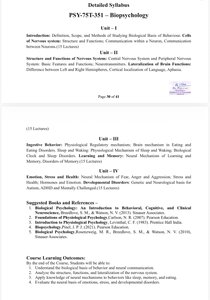
Unit I: Introduction to Biopsychology
Biopsychology explores the biological basis of behavior, focusing on how the brain, nervous system, and physiological processes influence psychological functions.
Definition: Biopsychology is the scientific study of the biological foundations of behavior.
Scope: Includes methods for studying biological bases, such as neuroimaging and electrophysiology.
Cells of Nervous System: Neurons and glial cells; their structure and function.
Communication within and between neurons: Electrical and chemical signaling, synaptic transmission.
Neurotransmitters: Chemical messengers that transmit signals across synapses.
Example: Dopamine is a neurotransmitter involved in reward and motivation.
Unit II: Structure and Function of Nervous System
This unit covers the anatomy and physiology of the central and peripheral nervous systems, including sensory and motor pathways.
Central Nervous System (CNS): Composed of the brain and spinal cord.
Peripheral Nervous System (PNS): Includes all nerves outside the CNS.
Sensory and Motor Pathways: Pathways that transmit sensory information to the brain and motor commands to muscles.
Autonomic Nervous System: Controls involuntary functions (e.g., heart rate, digestion).
Higher Functions: Language, aphasia, and lateralization of brain functions.
Example: The left hemisphere is typically dominant for language in most people.
Unit III: Ingestive Behavior
Examines the physiological regulation of eating and drinking, including the mechanisms that control hunger and thirst.
Physiological Regulation: Homeostatic mechanisms maintain balance in food and water intake.
Brain Mechanisms: Hypothalamus plays a key role in regulating hunger and thirst.
Eating and Drinking Disorders: Includes conditions such as anorexia, bulimia, and polydipsia.
Example: Damage to the lateral hypothalamus can lead to reduced food intake.
Unit IV: Emotion, Stress, and Health
This unit explores the biological basis of emotions, stress, and their impact on health.
Emotion: Neural and hormonal mechanisms underlying emotional responses.
Stress: Physiological and psychological responses to stressors.
Health: Effects of chronic stress on physical and mental health.
Example: Chronic stress can suppress immune function and increase risk of illness.
Suggested Books and References
Pinel, J. P. J. (2019). Biopsychology.
Bear, M. F., Connors, B. W., & Paradiso, M. A. (2016). Neuroscience: Exploring the Brain.
Kalat, J. W. (2018). Biological Psychology.
Course Learning Outcomes
Understand the biological basis of behavior.
Describe the structure and function of the nervous system.
Explain physiological mechanisms of ingestive behavior.
Analyze the biological basis of emotion, stress, and health.
Apply biopsychological concepts to clinical and research settings.