Back
BackChapter 12: Groups – Social Psychology Study Notes
Study Guide - Smart Notes
 Tailored notes based on your materials, expanded with key definitions, examples, and context.
Groups and Group Processes
The Nature and Purpose of Group Living
Groups are fundamental to human social life, providing both psychological and physical benefits. A group is defined as two or more people who interact and are interdependent, meaning their needs and goals cause them to rely on one another. Group membership is a key aspect of human evolution and social structure.
Interdependence: Members rely on each other to achieve goals.
Commonality: Groups are tied together by shared interests, characteristics, or goals.
Dyad: The smallest group, consisting of two people.
Adaptive Qualities: Groups provide emotional support, social connections, protection, and access to resources.




Why People Join Groups: Group membership fulfills basic human needs, helps define identity, and motivates social change. Groups also establish social norms (expected behaviors) and social roles (shared expectations for specific members).
Group Cohesiveness: The qualities that bind members and promote liking; influences participation and recruitment.
Group Diversity: Homogeneous groups are common, but diverse groups often make better decisions due to varied perspectives, though they may face challenges in unity.
What Makes a Group Feel United?
Common identity and frequent interaction
Shared emotional experiences
Dependence on one another and common goals
Common beliefs and values
Group Action: Benefits and Drawbacks
Groups can outperform individuals in solving complex problems (group synergy), but can also suffer from dysfunction if leadership and coordination are lacking.
Group Synergy: The group produces better outcomes than individuals alone.
Group Dysfunction: Poor coordination leads to worse outcomes than individual effort.
Social Facilitation and Social Loafing
Social Facilitation
Social facilitation refers to the effect of the presence of others on an individual's performance. Early research by Norman Triplett found that people perform better on simple tasks when others are present.
Triplett's Study (1898): Cyclists and children performed better when competing against others than when alone.


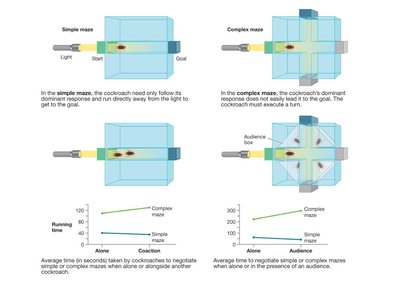
Zajonc's Theory of Mere Presence (1965): The mere presence of others increases arousal, which enhances performance on simple tasks (dominant response) but impairs performance on complex tasks.
Increased arousal leads to more rigid, dominant responses.
Facilitation occurs for simple tasks; inhibition for complex tasks.

Testing Zajonc's Theory: Cockroach Experiments
Experiments with cockroaches running mazes showed that the presence of others facilitated performance on simple mazes but hindered it on complex mazes.

Evaluation Apprehension Hypothesis
This hypothesis suggests that it is not just the presence of others, but the concern about being evaluated, that affects performance. Evaluation apprehension intensifies social facilitation effects.
Social Loafing
Social loafing occurs when individuals put less effort into a task when working in a group compared to working alone. This is the opposite of social facilitation and is more likely when individual contributions are not identifiable.
Group Decision Making
Groupthink
Groupthink is a phenomenon where the desire for consensus in a highly cohesive group leads to poor decision-making and suppression of dissenting viewpoints. Irving Janis identified several antecedents and symptoms of groupthink.
Most likely in cohesive, isolated groups with directive leaders and under high stress.
Leads to self-censorship, illusion of unanimity, and poor critical evaluation.
Preventing Groupthink:
Leaders should avoid stating preferences early.
Seek outside input.
Appoint a devil's advocate to challenge ideas.
Group Polarization
Group polarization is the tendency for group discussion to shift members' opinions toward more extreme positions. This occurs due to exposure to persuasive arguments and the desire for social comparison.
"Risky shift" phenomenon: groups make riskier decisions than individuals.
Polarization is stronger when group members are initially similar.
Power and Social Hierarchy
Social Hierarchy and Power
A social hierarchy ranks individuals or groups by power, status, or influence, shaping resource distribution and roles. Power is the ability to control outcomes for oneself and others, and is inherently relational.
Hierarchies form quickly in many settings (teams, workplaces, etc.).
Power can be gained through virtue (ethical leadership) or vice (manipulation, dominance).
Virtue-Based vs. Vice-Based Approaches
Virtue Ethics: Leadership focused on the common good, transparency, and moral growth (Aristotle's "Golden Mean").
Vice-Based: Leadership driven by personal gain, ego, and manipulation, leading to fear and silence in groups.
Power and Empathy Failures
Research shows that powerful individuals may experience empathy failures, feeling less need to understand others' emotions due to increased resources and independence.
Power and Disinhibited Behavior
Power can lead to disinhibited, sometimes unethical, behavior, as individuals feel less constrained by social norms.
Deindividuation and the Psychology of Mobs
Deindividuation and the Group Mind
Deindividuation is a psychological state where individuals in a group lose self-awareness and feel less accountable for their actions, often leading to impulsive or deviant behavior. This is seen in mob behavior and the bystander effect.
Self-Awareness and Individuation
Increasing self-awareness (e.g., through mirrors or cameras) can reduce deindividuation and promote more normative behavior.
The Spotlight Effect
The spotlight effect is the tendency to overestimate how much others notice our appearance and behavior. Studies show people believe they are being observed more than they actually are.