 Back
BackChapter 4: The Methods and Ethics of Research in Biological Psychology
Study Guide - Smart Notes
 Tailored notes based on your materials, expanded with key definitions, examples, and context.
Chapter 4: The Methods and Ethics of Research
Introduction
This chapter explores the scientific methods used in biological psychology, including experimental design, brain imaging, genetic studies, and ethical considerations. Understanding these methods is essential for interpreting research findings and evaluating the validity of psychological studies.
Scientific Method and Theory
Science, Research, and Theory
Science is a systematic approach to gaining knowledge, producing testable hypotheses and theories.
Theory: An organized set of principles that explains and predicts phenomena.
Hypothesis: A specific, testable prediction derived from a theory.
Example: A theory about memory might predict that sleep improves recall; the hypothesis would be that students who sleep after studying remember more than those who do not.
Types of Research Methods
Experimental and Correlational Studies
Experimental studies involve manipulating one variable to observe its effect on another, allowing for conclusions about cause and effect.
Correlational studies examine the relationship between variables without manipulation, identifying associations but not causality.
Example: Testing whether a new drug improves memory (experimental) versus observing if memory ability is related to age (correlational).
Brain Imaging Techniques
Overview of Brain Imaging
Modern neuroscience uses various imaging techniques to study brain structure and function. These methods allow researchers to observe the living brain in action and identify abnormalities.
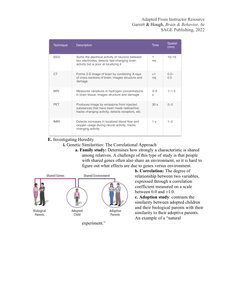
CT (Computed Tomography) Scan: Uses X-rays to create detailed images of brain structure.
MRI (Magnetic Resonance Imaging): Uses magnetic fields and radio waves to produce high-resolution images of brain anatomy.
DTI (Diffusion Tensor Imaging): A type of MRI that maps white matter tracts by tracking water diffusion.
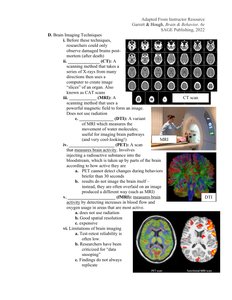
Additional info: These techniques are non-invasive and widely used in both research and clinical settings to diagnose brain injuries and diseases.
Recording Brain Activity
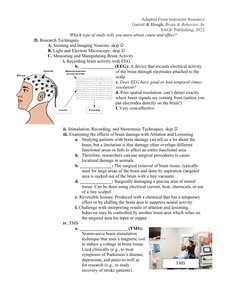
EEG (Electroencephalography): Measures electrical activity of the brain via electrodes placed on the scalp. Useful for studying brain waves and diagnosing epilepsy.
Stimulation, Recording, and Neurosurgery Techniques
TMS (Transcranial Magnetic Stimulation): Uses magnetic fields to temporarily stimulate or inhibit brain regions, helping to establish causal relationships between brain areas and behavior.
Genetic Sensitivity: The Correlational Approach
Twin and Family Studies
Genetic studies help determine the influence of heredity and environment on behavior and psychological traits.
Twin studies: Compare identical (MZ) and fraternal (DZ) twins to assess genetic and environmental contributions to traits.
Family studies: Examine trait similarity among relatives to estimate heritability.
Adoption studies: Compare adopted children to biological and adoptive families to separate genetic and environmental effects.
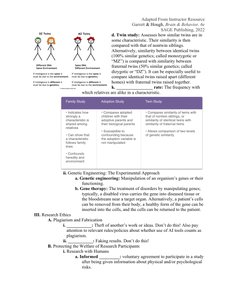
Table: Family, Adoption, and Twin Studies
Family Study | Adoption Study | Twin Study |
|---|---|---|
Examines trait similarity among relatives | Compares adopted children to biological and adoptive families | Compares identical and fraternal twins |
Cannot separate genes from environment | Separates genetic from environmental influences | Estimates heritability by comparing concordance rates |
Genetic Engineering
The Experimental Approach
Genetic engineering: Manipulation of an organism's genes to study their effects.
Gene knockout: Disabling a gene to observe its impact on behavior or physiology.
Transgenic animals: Animals with genes from another species inserted into their genome.
Example: Mice engineered to lack a specific neurotransmitter receptor to study its role in learning.
Research Ethics
Ethical Considerations in Research
Plagiarism and Fabrication: Presenting others' work as your own or making up data is unethical and undermines scientific integrity.
Deception: Sometimes used in research, but only when necessary and with proper debriefing.
Animal Research: Animals are used when research cannot be conducted on humans, but ethical guidelines require minimizing harm and using alternatives when possible.
Example: Using rats to study the effects of a new drug before human trials.
Stem Cell Therapy
Potential and Controversies
Stem cells: Undifferentiated cells that can develop into various cell types. They hold promise for treating neurological diseases and injuries.
Controversy: Ethical debates surround the use of embryonic stem cells versus adult stem cells.
Example: Using stem cells to repair spinal cord injuries.
Summary Table: Research Techniques
Technique | Description | Invasive? | Used in Humans? |
|---|---|---|---|
CT Scan | X-ray images of brain structure | No | Yes |
MRI | Magnetic fields for brain anatomy | No | Yes |
DTI | Maps white matter tracts | No | Yes |
EEG | Measures electrical activity | No | Yes |
TMS | Magnetic stimulation of brain regions | No | Yes |
