 Back
BackClassical Conditioning: Principles, Processes, and Applications
Study Guide - Smart Notes
 Tailored notes based on your materials, expanded with key definitions, examples, and context.
Classical Conditioning
Introduction to Classical Conditioning
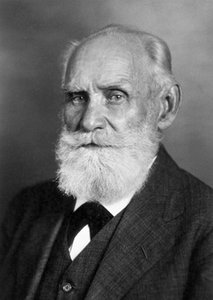
Classical conditioning is a fundamental learning process in psychology, first systematically studied by Ivan Pavlov. It involves learning to associate two stimuli so that one stimulus comes to elicit a response that was originally elicited only by the other stimulus. This process helps organisms anticipate and prepare for important events in their environment.
Key Concepts and Terminology
Unconditioned Stimulus (UCS): A stimulus that naturally and automatically triggers a response without prior learning (e.g., food).
Unconditioned Response (UCR): The unlearned, naturally occurring response to the UCS (e.g., salivation to food).
Neutral Stimulus (NS): A stimulus that does not initially elicit any intrinsic response (e.g., a bell before conditioning).
Conditioned Stimulus (CS): A previously neutral stimulus that, after being paired with the UCS, triggers a conditioned response.
Conditioned Response (CR): The learned response to the previously neutral stimulus (now the CS).
Pavlov’s Experiments
Pavlov’s research with dogs demonstrated how a neutral stimulus (such as a bell) could, through repeated pairings with an unconditioned stimulus (food), come to elicit a conditioned response (salivation). This process is illustrated in the stages of conditioning:
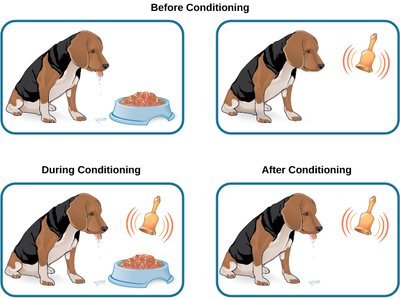
Before Conditioning: UCS (food) → UCR (salivation); NS (bell) → no response
During Conditioning: NS (bell) + UCS (food) → UCR (salivation)
After Conditioning: CS (bell) → CR (salivation)
Processes in Classical Conditioning
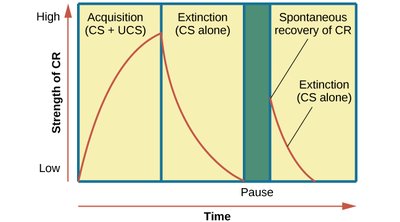
Acquisition: The initial stage of learning when an organism begins to associate a neutral stimulus with an unconditioned stimulus so that the neutral stimulus begins to elicit the conditioned response.
Extinction: The gradual weakening and disappearance of the conditioned response when the conditioned stimulus is repeatedly presented without the unconditioned stimulus.
Spontaneous Recovery: The reappearance of a previously extinguished conditioned response after a pause or rest period.
Stimulus Generalization: The tendency for stimuli similar to the conditioned stimulus to elicit the conditioned response.
Stimulus Discrimination: The learned ability to distinguish between a conditioned stimulus and other stimuli that do not signal an unconditioned stimulus.
Higher-Order (Second-Order) Conditioning
Higher-order conditioning occurs when a conditioned stimulus is used to condition a new neutral stimulus. This process allows for more complex chains of association, but it is generally less robust than first-order conditioning.
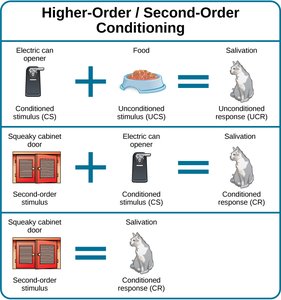
Example: A cat learns to associate the sound of a can opener (CS) with food (UCS), leading to salivation (CR). If a squeaky cabinet (second-order stimulus) is paired with the can opener, the cat may eventually salivate to the cabinet sound alone.
Applications and Real-World Examples
Cancer Treatment: Patients may develop nausea (CR) in response to the sight of a doctor's office (CS) after repeated pairings with chemotherapy drugs (UCS) that cause vomiting (UCR).
Pet Behavior: Pets can learn to associate sounds (e.g., can openers, cabinet doors) with feeding times, demonstrating classical conditioning and higher-order conditioning.
Taste Aversion: A single pairing of a novel taste (CS) with illness (UCS) can lead to a long-lasting aversion (CR), an adaptive response for survival.
Biological Constraints and the Rescorla-Wagner Model
Biological Preparedness: Some associations are learned more readily than others due to evolutionary adaptations (e.g., taste aversion is more easily learned than sound-illness associations).
Rescorla-Wagner Model: This model provides a mathematical framework for predicting the strength of associations based on the reliability of the conditioned stimulus in predicting the unconditioned stimulus. Equation (simplified): Where is the change in associative strength, and are learning rates, is the maximum associative strength, and is the current associative strength.
Summary Table: Key Terms in Classical Conditioning
Term | Definition | Example |
|---|---|---|
Unconditioned Stimulus (UCS) | Stimulus that naturally elicits a response | Food |
Unconditioned Response (UCR) | Natural, unlearned response to UCS | Salivation to food |
Neutral Stimulus (NS) | Stimulus that does not elicit a response before conditioning | Bell |
Conditioned Stimulus (CS) | Previously neutral stimulus that elicits a response after conditioning | Bell (after pairing with food) |
Conditioned Response (CR) | Learned response to the conditioned stimulus | Salivation to bell |
Glossary
Acquisition: The initial learning phase in classical conditioning.
Associative Learning: Learning that involves connecting stimuli or events that occur together.
Classical Conditioning: Learning in which a stimulus or experience occurs before the behavior and is then associated with the behavior.
Conditioned Response (CR): The learned response to the conditioned stimulus.
Conditioned Stimulus (CS): The stimulus that elicits a response after being paired with the unconditioned stimulus.
Extinction: The decrease in the conditioned response when the unconditioned stimulus is no longer paired with the conditioned stimulus.
Neutral Stimulus (NS): A stimulus that does not initially elicit a response.
Spontaneous Recovery: The return of a previously extinguished conditioned response after a rest period.
Stimulus Discrimination: The ability to respond differently to similar stimuli.
Stimulus Generalization: Demonstrating the conditioned response to stimuli that are similar to the conditioned stimulus.
Unconditioned Response (UCR): The natural, unlearned response to a given stimulus.
Unconditioned Stimulus (UCS): The stimulus that elicits a reflexive response.
