 Back
BackCognition and Mental Abilities: The Structure and Development of Language
Study Guide - Smart Notes
 Tailored notes based on your materials, expanded with key definitions, examples, and context.
Ch. 7 Cognition and Mental Abilities
The Structure of Language
Language is a uniquely human system that enables the communication of complex and abstract ideas. It is distinguished from general communication by its structure, flexibility, and cognitive influence.
Communication: The process of exchanging information or signals between organisms. Not all communication is language.
Language: A structured system of symbols and rules used to communicate. It allows for:
Generation of an infinite number of novel utterances.
Reference to intangible or abstract things.
Internal use for thought, influencing neural organization.
Key Point: All language is communication, but not all communication is language.

Example: Bees perform a "waggle dance" to direct others to pollen (communication, not language). A parent and teenager discussing college majors uses language. Vervet monkeys' predator calls are communication, not language.
Properties and Functions of Language
Language can influence brain organization.
Language can describe abstract ideas.
Language has an infinite capacity for novel combinations.
Practice Question: Which statements are true of language? (Correct: Language can influence brain organization and describe abstract ideas.)
Units of Language
Language is composed of hierarchical building blocks, from smallest to largest:
Phonemes: The smallest units of sound in a language (e.g., /d/, /o/, /g/).
Morphemes: The smallest units of language with meaning (e.g., "dog," "-s").
Phrases: Groups of words that function together.
Sentences: Complete thoughts that follow grammatical rules.

Syntax: The rules that govern how words can be combined and in what order. For example, English uses subject-verb-object order: "The dog fetched the ball." Adjectives typically precede nouns: "The fuzzy cat."
Practice: The statement "They are a student clever" violates syntax rules.
Identifying Morphemes and Phonemes
Morphemes: Carry meaning (e.g., "talking" = "talk" + "-ing").
Phonemes: Carry sound but not meaning (e.g., /t/, /a/, /l/, /k/ in "talk").
Practice: Zola is incorrect: morphemes are the smallest unit of language with meaning, but phonemes are the smallest unit of sound.
Language Development
Distinguishing Speech Sounds
Infants are born with the ability to distinguish all phonemes, even those not present in their native language. This ability declines as they specialize in their native language.
Research: Janet Werker (1980s) and Kuhl et al. (2006) demonstrated that infants can distinguish between phonemes like "ra" and "la" (present in English, not Japanese).
By about 12 months, infants lose the ability to distinguish non-native phonemes and become more attuned to their native language.
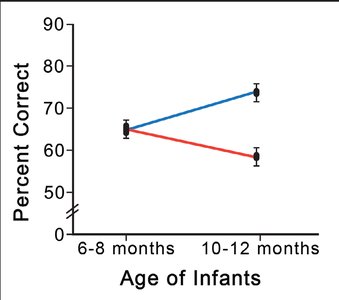
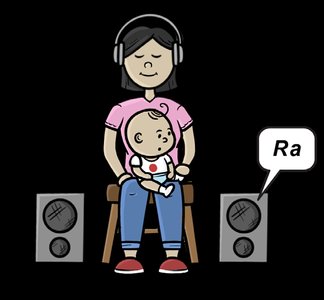
Practice: All of the following are correct: Young children are born able to hear all phonemes; over the first year, they get better at native phoneme discrimination; around 10-12 months, they lose the ability to discriminate non-native phonemes.
Language Milestones
Language development follows a predictable sequence, with comprehension generally preceding production. Grammatical errors are common and reflect rule learning.
Average Age | Milestone |
|---|---|
0-4 months | Cooing (vowel sounds) |
4-10 months | Babbling (consonant + vowel combinations) |
10-18 months | Single words (simple nouns and verbs) |
18-24 months | Telegraphic speech (short, content-rich sentences) |
24-36 months | Longer sentences, use of articles, pronouns, adjectives |
36-60 months | Overregularization (e.g., "I runned") |
60+ months | Adult-like grammar, rapid vocabulary growth |
Practice: Babbling is the developmental stage in infancy involving consonant and vowel combinations. Overregularization is exemplified by "two mouses."
Theories of Language Development
Overview of Major Theories
Three primary theories explain how language is acquired:
Theory | Key Proponent | Core Idea | Support | Critiques |
|---|---|---|---|---|
Behaviorist | B.F. Skinner | Language learned through operant conditioning; children repeat reinforced phrases. | Adults reinforce language use. | Cannot explain novel utterances, learning without reinforcement, or overregularization. |
Nativist | Noam Chomsky | Humans are born with an innate universal grammar; sensitive period for language acquisition (pre-puberty). | Newborn phoneme discrimination; research supports sensitive periods; Nicaraguan sign language development. | Cannot account for the diversity of language learning; hard to find direct evidence for universal grammar. |
Interactionist | Jerome Bruner | Innate capacity for language, but social factors are crucial. | Infant-directed speech aids learning; Nicaraguan sign language continues to evolve. | Underestimates the role of innate mechanisms; shares some critiques with other theories. |
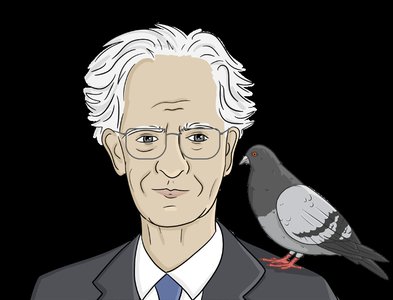
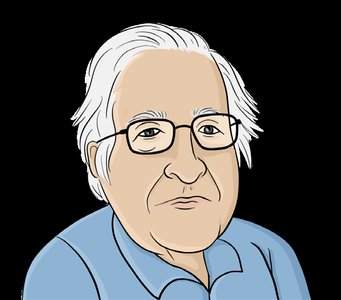

Practice: The idea of a sensitive period for language learning was first introduced as part of the nativist theory. The behaviorist view holds that language development results from positive reinforcement by caregivers.
Additional info: Overregularization errors (e.g., "I runned") show that children are not simply imitating adult speech but are actively applying grammatical rules, supporting the nativist and interactionist perspectives.
