Back
BackCognitive Development in Infancy: Key Concepts and Theories CH.5
Study Guide - Smart Notes
 Tailored notes based on your materials, expanded with key definitions, examples, and context.
Cognitive Development in Infancy
Overview
Cognitive development in infancy encompasses the changes in thinking, learning, memory, and language that occur during the first two years of life. This period is marked by rapid growth in mental abilities, as infants begin to understand their environment, develop memory, and acquire language skills.
Cognitive Changes in Infancy
General Cognitive Growth
Cognitive skills such as thinking, learning, and remembering increase significantly during the first two years.
These changes are consistent across different environments, though two-year-olds are still far from cognitive maturity.
Infants take important steps toward mature thinking, including the development of mental representation and problem-solving abilities.
Piaget’s Theory: Sensorimotor Stage
Substages of the Sensorimotor Stage
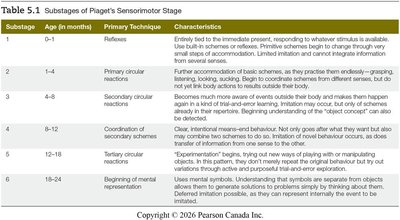
Jean Piaget proposed that infants progress through six substages in the sensorimotor stage, each characterized by different cognitive abilities and behaviors.
Substage | Age (months) | Primary Technique | Characteristics |
|---|---|---|---|
1 | 0–1 | Reflexes | Responds to immediate stimuli; limited imitation and integration of information. |
2 | 1–4 | Primary circular reactions | Begins to coordinate sensations and new schemas; repeats actions for pleasure. |
3 | 4–8 | Secondary circular reactions | Becomes more aware of external events; repeats actions to trigger responses. |
4 | 8–12 | Coordination of secondary schemas | Begins to show intentionality; coordinates schemas to achieve goals. |
5 | 12–18 | Tertiary circular reactions | Experiments with new behaviors; explores different outcomes. |
6 | 18–24 | Beginnings of mental representation | Develops mental symbols; can represent events mentally. |
Object Permanence
Object permanence is the understanding that objects continue to exist even when they cannot be seen.
Developmental progression:
2 months: Shows surprise when an object disappears.
6–8 months: Looks for a partially hidden object.
8–12 months: Searches for a completely hidden object.
Imitation
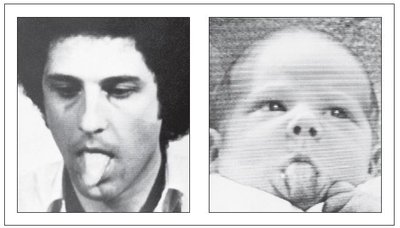
2 months: Can imitate actions they can see themselves make.
8–12 months: Can imitate others’ facial expressions.
12 months: Begins to imitate actions not in their repertoire; deferred imitation (imitating later) begins.
Early television viewing can negatively affect later social interactions.
Challenges to Piaget’s View
Modern Research Findings
Infants show signs of object permanence and imitation earlier than Piaget proposed.
Babies as young as 4 months demonstrate object permanence by tracking hidden objects.
Imitation of facial gestures and deferred imitation occur earlier than Piaget suggested.
Some cognitive skills may be inborn rather than learned.
Object Concept and Individuation
Object Concept
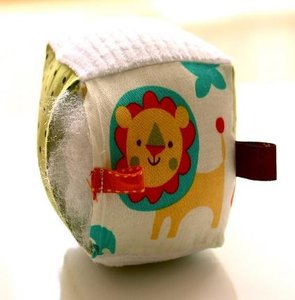
Refers to an infant’s understanding of the nature and behavior of objects.
Violation-of-expectancy studies show that infants as young as 3 months have sophisticated knowledge of object properties.
Object Individuation
Infants differentiate and recognize distinct objects based on mental images.
4 months: Use location and motion to individuate objects.
10 months: Use properties like color and texture.
9–12 months: Use object kind (e.g., duck vs. ball).
Learning, Categorizing, and Remembering
Learning in Infancy
Learning is defined as permanent changes in behavior resulting from experience.
Infants learn from birth, organizing their interactions with the environment.

Conditioning and Modelling
Classical conditioning: Infants learn to associate stimuli (e.g., refusing a breast that caused discomfort).
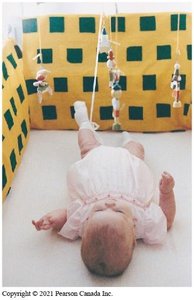
Operant conditioning: Infants learn to repeat behaviors that produce rewards (e.g., sucking a pacifier to turn on music).
Observational learning: Infants imitate others, especially successful models, and learn through watching.

Schematic Learning
Infants organize experiences into schemas (known combinations or categories).
By 7 months, infants use categories but cannot process hierarchical levels (e.g., animals vs. furniture, but not dogs vs. birds).
Hierarchical categorization develops by age 2 and matures by age 5.
Memory in Infancy
Infants can remember auditory stimuli heard while asleep.
By 3 months, infants remember specific objects and their actions for up to a week.
Early memory is context-dependent and more sophisticated than previously thought.
Measuring Intelligence in Infancy
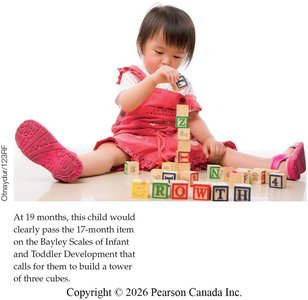
Bayley Scales of Infant and Toddler Development
Measures cognitive, language, motor, adaptive, and social-emotional development.
Not a strong predictor of later IQ or school performance (correlation ~0.20–0.30).
Fagan’s Test of Infant Intelligence
Assesses habituation rate and can be used with infants with health issues.
Intelligence is relatively stable after age two but can be influenced by environment and early interventions.
The Beginnings of Language
Prelinguistic Development
Many developments precede first words, which typically appear around 12 months.
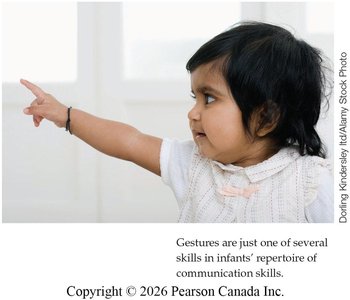
Includes cooing, babbling, and recognition of language patterns.
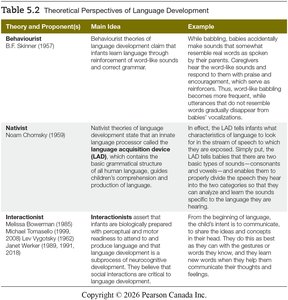
Theoretical Perspectives on Language Development
Theory and Proponent(s) | Main Idea | Example |
|---|---|---|
Behaviourist (B.F. Skinner) | Language learned through reinforcement of sounds and grammar. | Babbling reinforced by parents; correct sounds encouraged. |
Nativist (Noam Chomsky) | Innate language acquisition device (LAD) guides language learning. | Children learn grammar rules not explicitly taught. |
Interactionist (Bowerman, Tomasello, Vygotsky) | Language development is a subprocess of cognitive development, influenced by both biology and environment. | Children learn language through social interaction and cognitive growth. |
Infant-Directed Speech (IDS)
Simplified, higher-pitched speech used with infants.
Preferred by infants and helps them identify language-specific sounds and grammatical forms.
Role of Experience
Frequent reading and conversational turn-taking enhance vocabulary and language skills.
Cultural differences may affect language development and assessment.
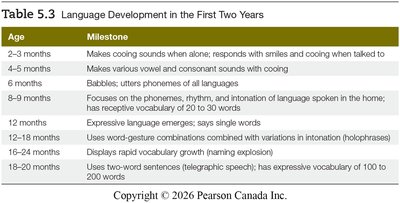
Milestones of Language Development
Age | Milestone |
|---|---|
2–3 months | Makes cooing sounds; responds with smiles and cooing when talked to. |
4–5 months | Makes various vowel and consonant sounds with cooing. |
6 months | Babbles; utters phonemes of all languages. |
8–9 months | Focuses on phonemes, rhythm, and intonation of home language; receptive vocabulary of 20–30 words. |
12 months | Expressive language emerges; says single words. |
12–18 months | Uses word-gesture combinations (holophrases). |
16–24 months | Displays rapid vocabulary growth (naming explosion). |
18–20 months | Uses two-word sentences (telegraphic speech); expressive vocabulary of 100–200 words. |

Word Production and Use
Expressive Language and Holophrases
First words appear around 12 months; learned slowly in context.
Holophrases: Single words combined with gestures to express complete thoughts (12–18 months).

Naming Explosion and Sentence Formation
Between 16–24 months, vocabulary grows rapidly (naming explosion).
By 24 months, children may know up to 320 words.
Sentences appear when vocabulary reaches 100–200 words (18–24 months); sentences are short and simple (telegraphic speech).

Individual Differences in Language Development
Variation in Rate and Bilingualism
Wide range of normal variation in language development rate.
Exposure to multiple languages influences rate and fluency.
Early exposure to two languages promotes higher competence, but equal fluency is rare.
Children with persistent delays may need professional assessment.
Language Development Across Cultures
Cooing, babbling, first words, holophrases, and telegraphic speech occur in all languages at similar ages and in the same sequence.
Specific word order and sentence structure are learned in varying orders across cultures.