 Back
Back12. Cognitive Neuroscience: Bridging Levels of Analysis
Study Guide - Smart Notes
 Tailored notes based on your materials, expanded with key definitions, examples, and context.
Cognitive Neuroscience: Bridging Levels of Analysis
Introduction to Cognitive Neuroscience
Cognitive neuroscience is a field that explores the relationship between brain function and behavior, aiming to understand how cognitive processes arise from neural mechanisms. It bridges psychology and neuroscience, providing insights into how mental activities are rooted in the brain's structure and function.
Definition: Cognitive neuroscience studies how brain activity underlies mental processes such as perception, memory, language, and learning.
Mind-Body Problem: This classic philosophical issue concerns the relationship between mental states (the mind) and physical processes (the brain and body).
Materialism: Two main types are discussed:
Reductionism: The view that only the brain (and body) exist; the mind is nothing more than neural activity.
Emergentism: The mind emerges from interactions among the brain, body, and environment.
Example: Language processing illustrates how complex cognitive functions can be mapped onto specific brain regions.
Topic Areas in Cognitive Neuroscience
Learning and Memory
Learning and memory are central topics in cognitive neuroscience, focusing on how experiences are encoded, stored, and retrieved by the brain. Case studies of brain damage, such as patient H.M., have been crucial in identifying the neural substrates of different memory systems.
Declarative (Explicit) Memory: Memory for facts and events, which can be consciously recalled.
Non-declarative (Implicit) Memory: Memory for skills and procedures, typically not accessible to conscious awareness.
Case Study: H.M. H.M. suffered damage to the hippocampus, resulting in severe impairment of declarative memory but preserved non-declarative memory.
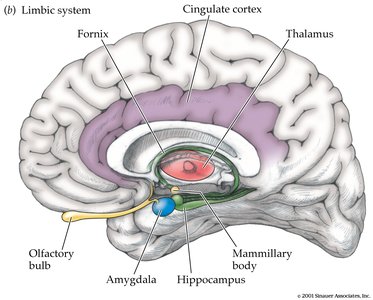
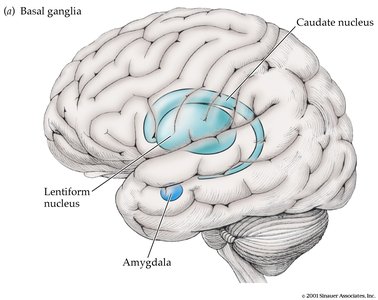
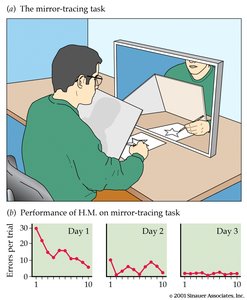
Mirror-Tracing Task: H.M. could learn new motor skills (e.g., mirror-tracing) despite not recalling the training sessions, demonstrating intact non-declarative memory.
Experience-Dependent Brain Changes
Research by Rosenzweig et al. (1962) demonstrated that environmental enrichment can alter brain structure and function in rats, showing that experience can physically change the brain.
Independent Variable (IV): Type of housing condition (enriched vs. standard).
Dependent Variables (DVs): Behavioral performance and neuronal complexity.
Results: Rats in enriched environments showed improved behavioral performance and increased neuronal complexity.
Language
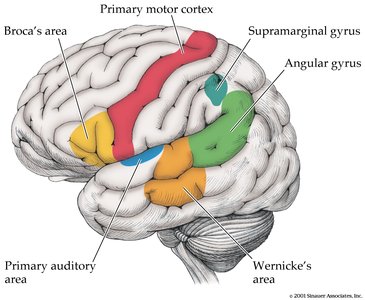
Language processing involves multiple brain regions and can be disrupted by specific types of brain damage, leading to aphasia. Cognitive neuroscience distinguishes between different aspects of language, such as syntax, semantics, morphology, phonology, and pragmatics.
Broca's Aphasia: Impairment in language production, typically due to damage in Broca's area.
Wernicke's Aphasia: Impairment in language comprehension, typically due to damage in Wernicke's area.
Methods in Cognitive Neuroscience
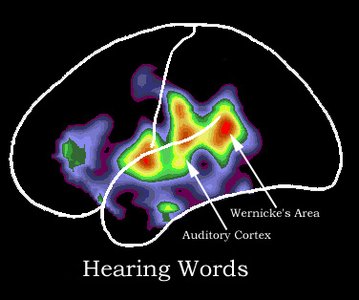
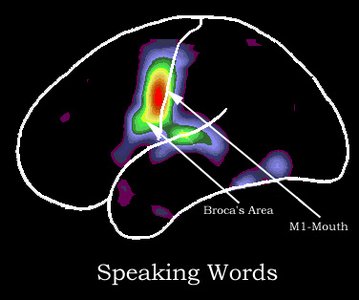
Observational studies of brain damage have limitations, so modern cognitive neuroscience often uses neuroimaging techniques such as Positron Emission Tomography (PET) to study brain activity during cognitive tasks.

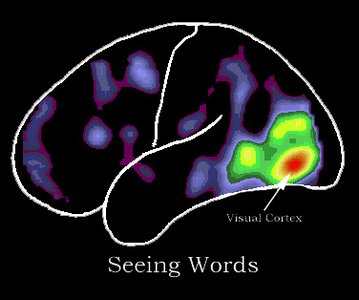
Posner & Raichle (1994): Used PET to measure brain activation during language production and comprehension tasks.
Independent Variable (IV): Type of language task (e.g., speaking, hearing, reading words).
Dependent Variable (DV): Area of brain activation.
Visual Perception
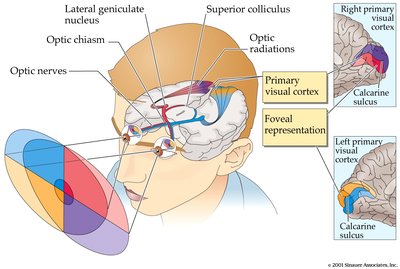
Visual perception is the process by which the brain interprets and organizes visual information from the environment. The primary visual cortex and associated pathways are critical for this function.
Visual Cortex: The region of the brain responsible for processing visual information.
Neuroimaging: PET scans can show which areas of the brain are active during visual tasks, such as reading words.
Bridging Levels of Analysis
Cognitive neuroscience seeks to connect findings from brain research with cognitive and social behavior. This approach is influenced by historical perspectives such as Gestalt psychology (Wolfgang Köhler) and functionalism (William James).
Gestalt Psychology: Emphasizes holistic processing and the idea that the whole is different from the sum of its parts.
Functionalism: Focuses on the functions of mental processes and behavior in adapting to the environment.
Key Question: What can brain research tell us about cognition and social behavior, and vice versa?
