 Back
BackDevelopmental and Social Psychology: Lifespan, Attachment, and Social Influence
Study Guide - Smart Notes
 Tailored notes based on your materials, expanded with key definitions, examples, and context.
Developmental Psychology
Basics of Developmental Psychology
Developmental psychology studies the physical, cognitive, and social changes that occur throughout the human lifespan. Psychologists in this field seek to answer three major questions:
Nature vs. Nurture: Examines the relative influence of genetics (heredity) and environment on development.
Continuity vs. Stages: Investigates whether development is a gradual, continuous process or occurs in distinct stages.
Stability vs. Change: Explores the extent to which traits persist or change throughout life.
Within each cell nucleus are 23 pairs of chromosomes (46 total), with genes as the basic units of heredity. Most traits are polygenic, meaning they are influenced by multiple genes. Twin and adoption studies help disentangle genetic and environmental influences on psychological traits.
Identical (Monozygotic) Twins: Develop from a single fertilized egg; nearly 100% genetically identical.
Fraternal (Dizygotic) Twins: Develop from two separate eggs; share about 50% of their genes, like regular siblings.
Heritability: The proportion of variation in a trait attributable to genetic factors.
Some psychological disorders (e.g., bipolar disorder, schizophrenia, autism spectrum disorder) are highly heritable, but family environment still plays a significant role in shaping values, morals, and beliefs.
Prenatal Development
Zygote (0-2 weeks): Fertilized egg; rapid cell division; less than half survive this stage.
Embryo (2 weeks-2 months): Major cell differentiation begins after implantation in the uterine wall.
Fetus (2 months-birth): Final stage; continued growth and development.
Cephalocaudal Direction: Development proceeds from head to tail.
Teratogen: Any agent that can cause harm during prenatal development (e.g., drugs, viruses).
Neurogenesis: Creation of neurons, mostly completed by 18 weeks gestation.
Synaptogenesis: Formation of synapses, continues into early childhood.
Synaptic Pruning: Elimination of rarely used synapses, continues through adolescence.
Myelination: The process of coating neurons with myelin, continues into the mid-20s.
Example: Rosenzweig et al. (1962) showed that enriched environments lead to greater brain development in rats compared to impoverished environments.
Infancy and Childhood: Physical and Cognitive Development
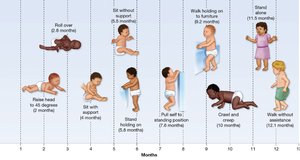
Infants are born with innate reflexes (e.g., grasping, rooting, sucking) that aid survival. Motor development follows a predictable sequence, though timing can vary by environment and culture.
Dynamic Systems Theory: Development is a self-organizing process, shaped by interactions between the child, culture, and environment.
Infants' sensory abilities are present but not fully developed at birth; vision is the slowest to mature. The preferential-looking technique is used to study infant cognition by measuring gaze duration. Infants show a preference for faces and familiar people.
Visual Cliff (Gibson & Walk, 1960): Demonstrated that depth perception is present in most infants by the time they can crawl.
Piaget’s Theory of Cognitive Development
Jean Piaget proposed that children actively construct knowledge through interaction with their environment. His stage theory includes:
Sensorimotor (0-2 years): Intelligence through sensory and motor interactions; development of object permanence.
Preoperational (2-7 years): Symbolic thinking, pretend play; limitations include egocentrism and lack of conservation.
Concrete Operational (7-12 years): Logical reasoning about concrete objects; mastery of conservation and basic math.
Formal Operational (12+ years): Abstract and hypothetical reasoning; not all individuals reach this stage.
Key processes:
Assimilation: Incorporating new information into existing schemas.
Accommodation: Modifying schemas in response to new experiences.
Equilibration: Balancing assimilation and accommodation for stable understanding.
Critiques of Piaget include underestimating young children's abilities and the role of social context in development.
Vygotsky’s Sociocultural Theory
Social Scaffolding: More knowledgeable individuals provide temporary support to help children reach higher levels of thinking.
Zone of Proximal Development: The range between what a child can do alone and what they can achieve with guidance.
Attachment and Social Development
Attachment Theory (Bowlby): Children are biologically predisposed to form attachments with caregivers, providing a secure base for exploration.
Imprinting: Early bonding process seen in some animals (e.g., ducks).
Harlow’s Monkeys: Demonstrated the importance of comfort and social interaction in attachment.
Stranger Anxiety: Peaks around 13 months; distress in the presence of unfamiliar people.
Mary Ainsworth’s Strange Situation Paradigm: Identified attachment styles:
Secure Attachment: Distress when caregiver leaves, comforted upon return.
Insecure-Ambivalent: Clingy, difficult to comfort.
Insecure-Avoidant: Indifferent to caregiver’s presence or absence.
Securely attached children tend to have better social and academic outcomes.
Parenting Styles
Parenting can be classified along two dimensions: responsiveness and demandingness. The four main styles are:
Parenting Style | Responsiveness | Demandingness | Outcomes |
|---|---|---|---|
Authoritative | High | High | High self-esteem, self-reliance, social competence |
Authoritarian | Low | High | Lower social skills, self-esteem |
Permissive | High | Low | More aggression, immaturity |
Neglectful/Uninvolved | Low | Low | Poor academic/social outcomes |
Adolescence and Emerging Adulthood
Adolescence: Transition from childhood to adulthood, marked by puberty and increasing independence.
Puberty: Sexual maturation; development of primary and secondary sex characteristics.
Kohlberg’s Stages of Moral Development:
Preconventional (0-9): Morality based on consequences and self-interest.
Conventional (9-15): Morality based on social rules and laws.
Postconventional (15+): Morality based on personal ethical principles.
Delayed Gratification: The ability to resist immediate rewards for greater long-term benefits (e.g., Marshmallow Test).
Freud and Erikson: Psychosocial Development
Freud: Proposed psychosexual stages, each associated with an erogenous zone and conflict. Unresolved conflicts can lead to fixation.
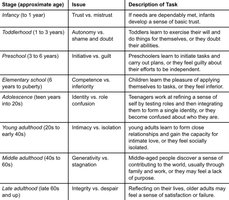
Erikson: Developed eight psychosocial stages, each with a central conflict to resolve.
Stage (Approximate Age) | Issue | Description of Task |
|---|---|---|
Infancy (0-1) | Trust vs. Mistrust | If needs are dependably met, infants develop a sense of basic trust. |
Toddlerhood (1-3) | Autonomy vs. Shame and Doubt | Toddlers learn to exercise will and do things for themselves, or they doubt their abilities. |
Preschool (3-6) | Initiative vs. Guilt | Preschoolers initiate tasks and carry out plans, or feel guilty about efforts to be independent. |
Elementary School (6-puberty) | Competence vs. Inferiority | Children learn the pleasure of applying themselves to tasks, or they feel inferior. |
Adolescence (teen years-20s) | Identity vs. Role Confusion | Teens work at refining a sense of self by testing roles and integrating them to form a single identity, or they become confused about who they are. |
Young Adulthood (20s-early 40s) | Intimacy vs. Isolation | Young adults form close relationships and gain the capacity for intimate love, or they feel socially isolated. |
Middle Adulthood (40s-60s) | Generativity vs. Stagnation | Middle-aged adults discover a sense of contributing to the world, or they may feel a lack of purpose. |
Late Adulthood (late 60s+) | Integrity vs. Despair | Reflecting on their lives, older adults may feel a sense of satisfaction or failure. |
Social Psychology
Introduction to Social Psychology
Social psychology is the scientific study of how individuals’ thoughts, feelings, and behaviors are influenced by the presence of others. It differs from sociology, which focuses on groups and institutions at a macro level.
Social Cognition and Attribution
Attribution Theory: Explains behavior by attributing it to internal dispositions or external situations.
Fundamental Attribution Error: Tendency to overestimate dispositional factors and underestimate situational factors in others’ behavior.
Self-Serving Bias: Attributing successes to oneself and failures to external factors.
Covariation Principle (Kelley, 1967): Uses consensus, distinctiveness, and consistency to determine causality.
Attitudes and Behavior
Attitudes: Evaluations of people, objects, or ideas (affect, behavior, cognition).
Explicit vs. Implicit Attitudes: Conscious vs. unconscious attitudes; measured by self-report or Implicit Association Test.
Theory of Planned Behavior: Behavioral intentions are predicted by attitudes, subjective norms, and perceived control.
Cognitive Dissonance Theory: People change attitudes to reduce discomfort from inconsistent thoughts or behaviors.
Self-Perception Theory: People infer attitudes by observing their own behavior.
Social Influence
Persuasion: Central route (logic, evidence) vs. peripheral route (cues, attractiveness).
Conformity: Adjusting behavior to align with group norms (informational and normative influence).
Compliance: Responding to direct requests (e.g., foot-in-the-door, door-in-the-face techniques).
Obedience: Following orders from authority (Milgram’s studies).
Group Processes
Social Facilitation: Improved performance in the presence of others.
Social Loafing: Reduced effort in group tasks.
Deindividuation: Loss of self-awareness in groups.
Group Polarization: Strengthening of group opinions through discussion.
Groupthink: Desire for harmony overrides realistic decision-making.
Social Relations
Proximity: Physical closeness increases likelihood of friendship and attraction (mere-exposure effect).
Physical Attractiveness: Influences first impressions and social outcomes (halo effect, beautiful-is-good bias).
Similarity: Shared attitudes and interests foster attraction.
Sternberg’s Triangular Theory of Love: Passion, intimacy, and commitment as components of love.
Bystander Effect: Individuals are less likely to help when others are present.
