 Back
BackEarly Childhood Development: Physical, Cognitive, and Socioemotional Growth (Ages 2–6)
Study Guide - Smart Notes
 Tailored notes based on your materials, expanded with key definitions, examples, and context.
Early Childhood: Key Concepts
Overview of Early Childhood Development
Early childhood, typically defined as ages 2–6, is a period of rapid and dynamic growth across physical, cognitive, and socioemotional domains. Development during this stage is characterized by spurts rather than constant change, with increasing independence, language, and emotional regulation. Social influences expand beyond the family to include teachers and peers.
Physical, cognitive, and socioemotional domains develop simultaneously.
Growth is not linear; children experience spurts in height, weight, and abilities.
Language and cognitive skills increase rapidly.
Children gain greater emotional control and independence.
Social environments and relationships outside the family become increasingly influential.

Physical Growth in Early Childhood
Growth Patterns and Averages
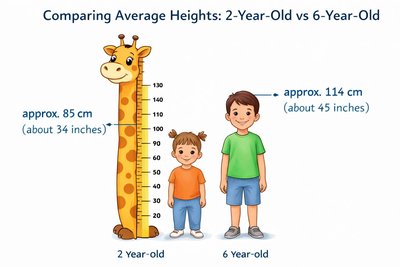
Children continue to grow steadily during early childhood, with average increases of about 3 inches in height and 4–5 pounds in weight per year. Growth occurs in spurts, and by age 6, children are significantly taller and heavier than at age 2.
At age 2: 23–28 pounds, 33–35 inches tall
At age 6: 40–50 pounds, 44–47 inches tall
Brain Development in Early Childhood
Myelination and Dendrite Growth
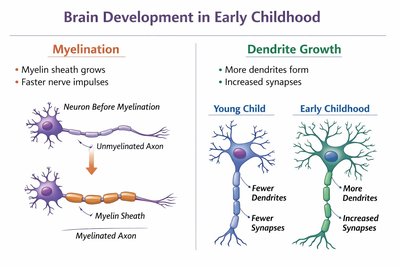
Brain maturation is a hallmark of early childhood, supporting new cognitive and behavioral abilities. Myelination (the process of coating neural fibers with myelin) increases the speed and efficiency of neural communication, while dendrite growth expands connections between neurons, allowing for more complex skills.
Myelination: Faster nerve impulses, improved communication between brain regions
Dendrite growth: More synapses, increased neural complexity
Development of the Prefrontal Cortex
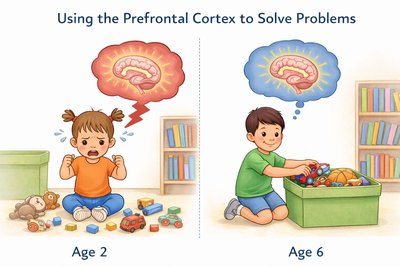
The prefrontal cortex, located behind the forehead, is responsible for planning, decision making, attention, and emotional regulation. Its development helps children control emotional outbursts and supports the ability to think ahead and plan actions.
Brain Hemispheres and the Corpus Callosum
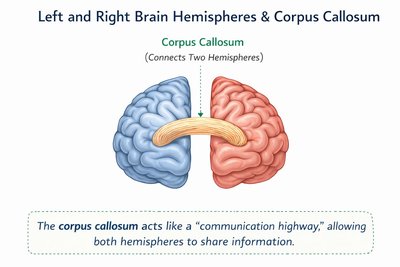
The brain is divided into left and right hemispheres. Between ages 3 and 6, the left hemisphere (associated with language) grows rapidly, while the right hemisphere (associated with spatial abilities) continues developing. The corpus callosum connects the hemispheres, supporting coordination of cognitive and motor processes.
Motor Skill Development
Gross and Fine Motor Skills
Early childhood is a major period for motor skill development. Gross motor skills involve large muscle groups (e.g., running, jumping), while fine motor skills require precision and control (e.g., drawing, buttoning clothes). Both types of skills improve with practice and maturation, supporting independence and daily activities.
Gross motor skills: Running, jumping, climbing
Fine motor skills: Drawing, pouring, buttoning


Toilet Training
Readiness and Process
Toilet training typically occurs between 24–36 months, with readiness varying widely among children. Physical and emotional readiness are more important than age. Successful training requires patience and supportive guidance from caregivers.
Signs of readiness: Staying dry, interest in toilet, following instructions, awareness of bodily functions
Girls tend to complete training slightly earlier than boys
Enuresis (bedwetting) and encopresis (soiling) are common difficulties


Sleep in Early Childhood
Sleep Patterns and Issues
Sleep patterns change significantly during early childhood. Most children ages 3–5 need about 10–13 hours of sleep per day. Bedtime routines help develop healthy sleep habits, while sleep disturbances such as nightmares or night terrors are common but usually temporary.
Nightmares: Frightening dreams that may wake the child
Night terrors: Episodes of intense fear during sleep
Sleepwalking: Performing activities while asleep

Cognitive Development in Early Childhood
Piaget’s Preoperational Stage
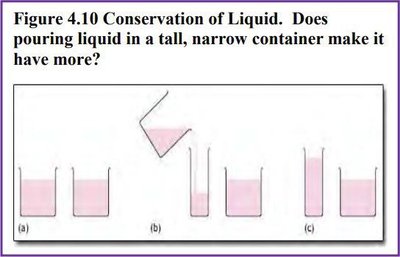
According to Jean Piaget, early childhood corresponds to the preoperational stage (ages 2–7). Children use symbols, language, and imagination, but their thinking is not yet logical. Key features include egocentrism, centration, and animism.
Egocentrism: Difficulty seeing the world from others’ perspectives
Centration: Focusing on one aspect of a situation, leading to errors in conservation
Animism: Attributing life or intentions to inanimate objects
Vygotsky’s Sociocultural Theory
Lev Vygotsky emphasized the role of social interaction and culture in cognitive development. The Zone of Proximal Development (ZPD) describes tasks a child can do with help, and scaffolding refers to temporary support provided by adults or peers. Private speech helps children guide their thinking and behavior.
Zone of Proximal Development (ZPD): Gap between what a child can do alone and with help
Scaffolding: Temporary support that is gradually removed as competence increases
Private speech: Self-directed speech that aids problem-solving
Information Processing Perspective
This approach compares the mind to a system that processes information. Early childhood shows improvements in attention, memory, and executive function, supporting learning and problem-solving.
Attention: Ability to focus, ignore distractions, and sustain effort
Working memory: Holding and manipulating information temporarily
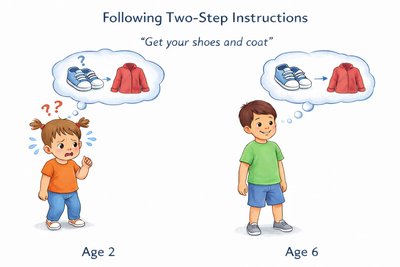
Executive function: Inhibitory control, cognitive flexibility, and planning
Memory Development
Types and Strategies
Memory abilities improve significantly during early childhood. Children develop both implicit (procedural) and explicit (episodic, semantic) memory. Older preschoolers begin using strategies such as rehearsal and organization to remember information more effectively.
Autobiographical memory: Memories of personal experiences, contributing to sense of self
Caregiver conversations help children organize and describe past experiences
Children’s Understanding of the World
Theory-Theory and Theory of Mind
Children actively construct informal theories about how the world works. Theory of mind is the ability to understand that others have their own thoughts, beliefs, and perspectives, which develops gradually during early childhood and supports empathy and communication.
False-belief tasks: Used to assess theory of mind development
Egocentrism makes it challenging for young children to understand others’ viewpoints
Language Development
Vocabulary and Grammar
Vocabulary expands rapidly from about 200 words at age two to 10,000 words by age six. Children learn grammar rules, often making overregularization errors (e.g., “I goed there”). Bilingual children may mix languages initially but gradually learn to separate them.
Language development supports thinking, communication, and social interaction
Rich exposure and interaction in both languages benefit bilingual children
Socioemotional Development
Erikson’s Initiative vs. Guilt
Erik Erikson described early childhood as the stage of initiative vs. guilt (ages 3–6). Children assert control, initiate activities, and make decisions. Encouragement fosters initiative and confidence, while excessive criticism may lead to guilt.
Self-Concept, Self-Esteem, and Self-Efficacy
Self-concept refers to how children describe themselves, often in concrete and positive terms. Self-esteem is self-evaluation, and self-efficacy is the belief in one’s ability to succeed at tasks.
Gender Development
Gender Identity and Socialization
Gender identity refers to a person’s internal sense of being male, female, both, or neither. Children learn gender roles through socialization by parents, peers, teachers, and media. Theories of gender development include social learning, cognitive developmental, and gender schema theories.
Parenting Styles
Baumrind’s Four Parenting Styles
Parenting style is defined by responsiveness (warmth) and demandingness (expectations). The four main styles are:
Authoritative: High warmth, high expectations
Authoritarian: Low warmth, high control
Permissive: High warmth, low control
Uninvolved: Low warmth, low control
Authoritative parenting is often linked to stronger social competence and self-confidence in children.
Play in Early Childhood
Types and Importance of Play
Play is central to early childhood development, supporting cognitive, social, emotional, and physical growth. Types of play include physical, constructive, pretend, and games with rules. Play helps children practice new skills, negotiate rules, and manage emotions.
Child Abuse and Adverse Childhood Experiences (ACEs)
Types and Impact
Child abuse includes physical, emotional, and sexual abuse, as well as neglect. Adverse Childhood Experiences (ACEs) are linked to increased risk for mental health problems and chronic disease. Mandatory reporting laws require professionals and community members to report suspected abuse.
COVID-19 and Early Childhood Development
The COVID-19 pandemic disrupted children’s daily lives, leading to delays in language, social, and cognitive development for some. Ongoing support from families, educators, and communities is essential for recovery and resilience.
Summary Table: Physical and Cognitive Milestones in Early Childhood
Domain | Age 2 | Age 6 |
|---|---|---|
Height | 33–35 inches | 44–47 inches |
Weight | 23–28 pounds | 40–50 pounds |
Vocabulary | ~200 words | ~10,000 words |
Motor Skills | Basic running, climbing | Coordinated jumping, skipping, drawing |
Memory | Simple recall, needs cues | Autobiographical memory, uses strategies |
