 Back
BackEarly Cognitive and Language Development in Infancy
Study Guide - Smart Notes
 Tailored notes based on your materials, expanded with key definitions, examples, and context.
Early Cognitive & Language Development
Piaget’s Theory of Cognitive Development
Jean Piaget’s theory is foundational in understanding how children develop cognitively. He proposed that children progress through four major stages of cognitive development, each characterized by distinct ways of thinking and understanding the world.
Sensorimotor Period (Birth to Age 2): Infants learn through sensory experiences and manipulating objects.
Preoperational Period (Ages 2 to 7): Children begin to use language and think symbolically, but their thinking is still intuitive and egocentric.
Concrete Operational Period (Ages 7 to 11): Children gain a better understanding of logic and can think about concrete events.
Formal Operational Period (Age 11 onward): Adolescents develop abstract reasoning skills.
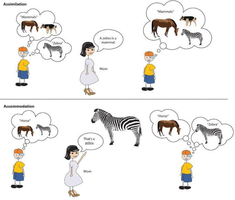
Piaget emphasized that children are active explorers, constantly organizing their experiences into mental structures called schemas. Adaptation occurs through two processes:
Assimilation: Interpreting new experiences in terms of existing schemas.
Accommodation: Modifying schemas to incorporate new information.
Example: A child who sees a zebra for the first time may call it a “horse” (assimilation), but after learning about its stripes, creates a new schema for “zebra” (accommodation).
Sensorimotor Stage and Object Permanence
During the sensorimotor stage, infants learn about their world through direct interaction. They experiment with objects, learning through trial and error. A critical milestone is object permanence—the understanding that objects continue to exist even when out of sight.
Object Permanence: Typically acquired by 8 months; infants begin to search for hidden objects, indicating mental representation.
Peek-a-Boo: This game helps infants develop object permanence, as they learn that people and objects exist even when not visible.

Vygotsky’s Social Development Theory
Lev Vygotsky emphasized the role of social interaction in cognitive development. He introduced the concepts of scaffolding and the zone of proximal development (ZPD).
Scaffolding: Temporary support provided by adults to help children learn new skills, gradually withdrawn as children become more competent.
Zone of Proximal Development: The gap between what a child can do independently and what they can achieve with guidance.
Infantile Amnesia
Infantile amnesia refers to the inability to recall memories from the first few years of life. Memory formation requires brain maturation, and early memories are often fleeting and fragile.
Example: Adults rarely remember events from before age three; early memories are likely reconstructed or influenced by later information.
Emotions in Infancy
Infants express primary emotions (happiness, anger, fear, surprise, sadness, disgust) early in life, often through facial expressions. Self-conscious emotions (envy, pride, shame, guilt, embarrassment) develop later, requiring social instruction and self-awareness.
Social Smile: Appears between 4 and 8 weeks, in response to external stimuli.
Innate Expressions: Even blind infants display typical emotional expressions, suggesting biological foundations.
Language Development
Language development is a complex process involving both biological and environmental factors. Humans are uniquely equipped for language, which is productive and generative.
Speech vs. Language: Speech is the vocal expression of language; language includes spoken, written, and signed forms.
Sign Language: American Sign Language (ASL) is a complete language system, not merely nonverbal communication.

Animal Communication vs. Human Language
While animals communicate, their systems lack the infinite generativity and complexity of human language. For example, whales use clicks and calls, but do not possess true language.
Phonemes and Early Language Perception
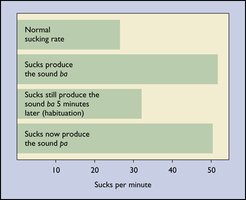
A phoneme is the smallest unit of sound that distinguishes words. Infants are born able to detect all phonemes, but specialize in their native language by 10-12 months.
Example: Infants can distinguish between "ba" and "pa" sounds, as shown by changes in sucking rate.
Stages of Early Language Development
Language development follows a predictable sequence:
Crying: Birth
Cooing: 1-2 months
Babbling: 6 months
Gestures: 8-12 months
First Words: 10-15 months
Vocabulary Spurt: 18 months
Two-word Utterances: 18-24 months
Babbling and Holophrastic Speech
Babbling is the first vocalization resembling human speech, often combining consonants and vowels. Holophrastic speech refers to single-word utterances that convey complex meaning.
Telegraphic Speech
By age two, children use telegraphic speech—short, content-rich sentences omitting less important words (e.g., "Get ball", "Kitty go").
Receptive vs. Productive Language
Children understand more words than they can produce. Receptive language (comprehension) precedes productive language (expression).
Stimulating Language Development
Effective strategies for promoting language include:
Using child-centered speech (simple, repetitive, clear)
Reading, singing, and talking to the child
Encouraging imitation and gesturing
Providing praise and opportunities for conversation
Bilingualism
Early exposure to multiple languages is beneficial. Bilingual children develop proficiency in both languages and may experience cognitive advantages.
Multilingualism: Common worldwide; learning new languages changes thought patterns and perspectives.
Do Infants Learn Words from TV & Educational DVDs?
Research shows that infants learn language best through direct human interaction, not from screen media. Educational DVDs do not significantly improve vocabulary or language skills.
Theories of Language Development
Noam Chomsky and nativist theorists argue for a biological basis of language acquisition, proposing an innate language acquisition device and universal grammar.
Language and the Brain
Language is primarily processed in the left hemisphere, in Broca’s area (production) and Wernicke’s area (comprehension). Damage to these areas can result in different types of aphasia:
Broca’s Aphasia: Difficulty producing speech, but comprehension is intact.
Wernicke’s Aphasia: Fluent speech with poor comprehension and nonsensical content.
Primary Progressive Aphasia: Gradual loss of language abilities, often associated with frontotemporal dementia.
Key Terms and Concepts
Schema: Mental structure for organizing knowledge.
Assimilation: Integrating new information into existing schemas.
Accommodation: Modifying schemas for new information.
Object Permanence: Understanding that objects exist when out of sight.
Scaffolding: Temporary support for learning.
Zone of Proximal Development: Range of tasks achievable with guidance.
Phoneme: Smallest unit of sound in language.
Holophrastic Speech: Single-word utterances with complex meaning.
Telegraphic Speech: Short, content-rich sentences.
Aphasia: Loss of language ability due to brain damage.
Relevant Images

Illustrates infancy, the period of rapid cognitive and language development.
Demonstrates the complexity and linguistic properties of sign language.
Visualizes research on infants' ability to distinguish phonemes.
Clarifies Piaget’s concepts of assimilation and accommodation.
Shows object permanence in action.
