 Back
BackEarly Cognitive and Language Development in Infancy and Early Childhood
Study Guide - Smart Notes
 Tailored notes based on your materials, expanded with key definitions, examples, and context.
Early Cognitive and Language Development
Introduction
During the first two years of life, infants undergo rapid cognitive and language development. This period is marked by the formation of neural connections, the emergence of memory, and the acquisition of language. Theories by Piaget and Vygotsky provide foundational frameworks for understanding these processes, while research into language development highlights the interplay between biological predispositions and environmental influences.
Piaget’s Theory of Cognitive Development
Stages of Cognitive Development
Jean Piaget proposed that children progress through four major stages of cognitive development:
Sensorimotor Period (birth to age 2): Infants learn through sensory experiences and manipulating objects.
Preoperational Period (ages 2 to 7): Characterized by symbolic thinking and egocentrism.
Concrete Operational Period (ages 7 to 11): Logical thinking about concrete events emerges.
Formal Operational Period (age 11 onward): Abstract and hypothetical reasoning develops.
Schemas, Assimilation, and Accommodation
Piaget described schemas as mental structures that help children organize and interpret information. Cognitive development occurs through:
Assimilation: Interpreting new experiences using existing schemas.
Accommodation: Modifying schemas to incorporate new information.
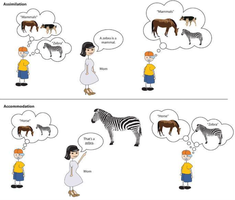
Example: A child who calls all four-legged animals "doggie" assimilates new animals into an existing schema. When learning that a zebra is not a dog, the child accommodates by creating a new schema for zebras.
Sensorimotor Stage and Object Permanence
In the sensorimotor stage, infants learn through direct interaction with their environment. A key milestone is object permanence—the understanding that objects continue to exist even when out of sight.
Before object permanence, infants do not search for hidden objects.
After acquiring object permanence (typically by 8 months), infants will search for hidden objects and enjoy games like "peek-a-boo."

Example: When a toy is hidden under a blanket, infants with object permanence will attempt to find it.
Vygotsky’s Sociocultural Theory
Scaffolding and the Zone of Proximal Development (ZPD)
Lev Vygotsky emphasized the role of social interaction in cognitive development. Scaffolding refers to temporary support provided by adults or more knowledgeable peers to help children learn new skills. The Zone of Proximal Development is the gap between what a child can do alone and what they can achieve with guidance.
Scaffolding is gradually removed as the child becomes more competent.
Optimal learning occurs when assistance is tailored to the child’s current abilities.
Example: A parent helps a child solve a puzzle by suggesting strategies, then allows the child to try independently.
Memory Development in Infancy
Infantile Amnesia
Infantile amnesia refers to the inability of adults to recall memories from the first few years of life. This is due to the immaturity of brain structures involved in memory formation. While infants can form memories, these are typically not long-lasting or accessible later in life.
Memory formation improves as the brain matures.
Early experiences contribute to the development of memory systems.
Example: Most people cannot recall events from before age three, even if they believe they do.
Emotional Development in Infancy
Primary and Secondary Emotions
Emotions in infancy are divided into:
Primary emotions: Happiness, anger, fear, surprise, sadness, and disgust. These are innate and appear early.
Secondary (self-conscious) emotions: Envy, pride, shame, guilt, doubt, and embarrassment. These require self-awareness and social learning.
Facial expressions for primary emotions are universal and biologically programmed. Social smiles and laughter emerge between 4 and 8 weeks, strengthening caregiver-infant bonds.
Example: Infants smile in response to faces and voices, encouraging caregiver interaction.
Language Development
Nature of Language
Language is a system of symbols and rules used for communication. It is unique to humans and involves both spoken and signed forms. Sign languages are complete languages with their own grammar and structure, distinct from nonverbal communication.

Example: American Sign Language (ASL) is a fully developed language used by the Deaf community in North America.
Animal Communication vs. Human Language
While animals communicate using sounds and gestures, human language is distinguished by its productivity and generativity—the ability to create an infinite number of messages from a finite set of elements. Animal communication lacks this complexity.
Phoneme Perception in Infancy
A phoneme is the smallest unit of sound that distinguishes meaning in language. Infants are born able to perceive all phonemes but specialize in their native language by 10-12 months.
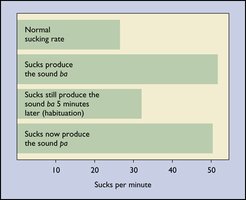
Example: Research by Peter Eimas showed that infants increase their sucking rate when they hear a new phoneme, indicating discrimination ability.
Stages of Early Language Development
Age | Milestone |
|---|---|
Birth | Crying |
1-2 months | Cooing begins |
6 months | Babbling begins |
8-12 months | Gestures, comprehension of words |
10-15 months | First word spoken |
18 months | Vocabulary spurt |
18-24 months | Two-word utterances |
Babbling is the first vocalization resembling speech. Infants also use gestures before speaking, such as pointing, which is a precursor to verbal communication.
Holophrastic and Telegraphic Speech
Early speech includes:
Holophrastic speech: Single words representing whole ideas (e.g., "juice" for "I want juice").
Telegraphic speech: Two-word combinations omitting less important words (e.g., "get ball").
Vocabulary grows rapidly after 18 months, with a "naming explosion" where children learn many new nouns.
Bilingualism
Children exposed to multiple languages early can become proficient in both. Bilingualism is associated with cognitive advantages, such as enhanced problem-solving and metalinguistic awareness. Early exposure is critical for native-like pronunciation and fluency.
Language and the Brain
Language processing is primarily localized in the left hemisphere of the brain:
Broca’s area: Language production
Wernicke’s area: Language comprehension
Aphasia is an acquired language disorder, often due to stroke or injury. Types include:
Broca’s aphasia: Difficulty producing speech, comprehension intact.
Wernicke’s aphasia: Fluent but nonsensical speech, poor comprehension.
Primary progressive aphasia: Gradual loss of language abilities, often associated with frontotemporal dementia.
Key Concepts Table: Piaget vs. Vygotsky
Aspect | Piaget | Vygotsky |
|---|---|---|
Role of Social Interaction | Limited | Central |
Mechanism of Change | Assimilation/Accommodation | Scaffolding/ZPD |
Language | Follows cognitive development | Drives cognitive development |
Additional info: Vygotsky emphasized the importance of cultural tools and language in shaping thought, while Piaget focused on individual discovery and maturation.
Summary
Infancy is a period of rapid cognitive, emotional, and language development.
Piaget and Vygotsky offer complementary perspectives on how children learn and grow.
Language acquisition is a complex interplay of biological readiness and social experience.
Early experiences, including bilingual exposure and responsive caregiving, support optimal development.
