 Back
BackEmotion: Theories, Components, and Cultural Contexts
Study Guide - Smart Notes
 Tailored notes based on your materials, expanded with key definitions, examples, and context.
Emotion: Foundations and Theories
Introduction to Emotion
Emotions are complex psychological and physiological responses to stimuli that play a crucial role in human adaptation and survival. They involve subjective experiences, bodily changes, expressive behaviors, cognitive appraisals, and motivational drives.
Emotion: A coordinated psychological and physiological response to a stimulus, involving subjective experience, physiological arousal, expressive behavior, and cognitive appraisal, which motivates adaptive action.
Key Components of Emotion:
Subjective Experience: The personal, internal feeling associated with the emotion (e.g., feeling happy, sad, or angry).
Physiological Response: Bodily changes, often driven by the autonomic nervous system (e.g., increased heart rate, sweating, blushing), preparing the body for action.
Behavioral Expression: Observable actions or facial expressions that communicate emotion to others (e.g., smiling, frowning, crying).
Cognitive Appraisal: The mental evaluation of the stimulus or situation that triggers the emotion (e.g., "Is this a threat?"). Appraisals help differentiate between emotions.
Motivational Component: Emotions drive adaptive actions (e.g., running from danger, seeking comfort).

Emotions vs. Moods vs. Feelings
It is important to distinguish between emotions, moods, and feelings, as they differ in duration, intensity, and specificity.
Emotions: Short-lived, intense responses to specific stimuli.
Moods: Longer-lasting, less intense, and not necessarily tied to a specific stimulus.
Feelings: The subjective experience of emotions, often part of but not equivalent to emotions.
Theories of Emotion
Discrete Emotion Theory
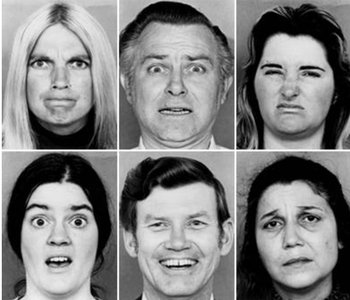
Discrete Emotion Theory posits that emotions are distinct, universal, and biologically hardwired responses to specific stimuli. Each basic emotion is associated with unique physiological patterns, expressive behaviors, and cognitive appraisals.
Key Points:
Emotions are primary and universal across cultures.
Each emotion involves unique physiological responses (e.g., heart rate), expressive behaviors (e.g., smiling for happiness), and cognitive appraisals (e.g., interpreting threat for fear).
Paul Ekman's research demonstrated that people across diverse cultures can recognize basic emotions from facial expressions.
Basic emotions can combine to form complex emotions (e.g., sadness + fear = shame).
Evolutionary Basis of Emotion
Charles Darwin argued that emotions are adaptive responses that organize action and promote survival and reproduction. Emotional expressions are seen across species, indicating their evolutionary roots.
Functions of Emotions:
Protect against danger (fight or flight response).
Mobilize energy to overcome obstacles or defend oneself.
Encourage withdrawal and reflection to cope with loss or failure.
Strengthen social bonds and motivate pursuit of rewarding experiences.
Protect against contamination and disease (disgust).
Enhance readiness to respond to novel events (surprise).
Maintain social harmony by encouraging reparative actions (guilt, shame).
Encourage achievement and social status (pride).
Promote long-term social bonds essential for survival (attachment).
Encourage exploration and integration of new experiences (curiosity, awe).

Beyond Basic Emotions: Awe
Recent research has identified additional emotions beyond the basic six. Awe is an emotion of wonder, amazement, or grandeur felt when experiencing stimuli that cannot be easily explained or do not fit into existing schemas. Awe is generally positive but can include elements of fear or uncertainty, making the self feel small in comparison to the vastness of the experience.
Cognitive Theories of Emotion
James-Lange Theory
The James-Lange Theory suggests that emotions result from our interpretations of physiological reactions to events. In other words, we feel afraid because we notice our body trembling, not the other way around.
Sequence: Event → Physiological Arousal → Interpretation → Emotion

Cannon-Bard Theory
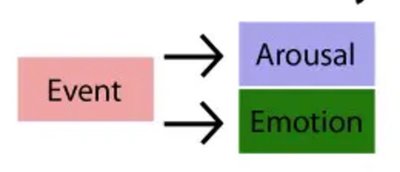
The Cannon-Bard Theory challenges the James-Lange model, arguing that physiological arousal and emotional experience occur simultaneously and independently in response to an event.
Sequence: Event → Simultaneous Arousal and Emotion
Key Criticisms of James-Lange:
We are not always aware of our physiological reactions.
Similar physiological responses can be associated with different emotions.

Two-Factor Theory of Emotion (Schachter-Singer)
This theory integrates elements of both previous models. It proposes that an event causes undifferentiated physiological arousal, which is then cognitively interpreted based on context, leading to the labeling of the emotion.
Sequence: Event → Arousal → Cognitive Interpretation → Emotion
Example: Drinking coffee causes arousal; if you interpret the arousal as excitement, you feel happy; if you interpret it as anxiety, you feel nervous.
Constructivist Theories of Emotion
Core Principles
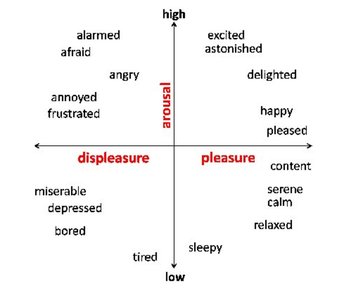
Constructivist theories argue that emotions are not discrete, biologically hardwired states but are constructed from several ingredients, including core affect, conceptual knowledge, and physiological signals.
Core Affect: The basic feeling of pleasure or displeasure (valence) and the level of physical activation or energy (arousal).
Conceptual Knowledge: Using prior knowledge and situational context to label core affect as specific emotions.
Physiological Signals: Bodily responses that contribute to the emotional experience.
Culture and Emotion
Constructivist theories emphasize that emotions are learned within cultural contexts. Emotional categories (e.g., "happiness," "shame") are shaped by cultural norms and language. Cross-cultural research shows that some emotions are universally experienced, while others are culture-specific or experienced differently across cultures.
Example: Interviews with Hazda hunter-gatherers in Tanzania and Americans in North Carolina reveal differences in how emotions are described and experienced in response to similar events.

Conclusion: The Role of Emotion in Human Life
Emotions are not obstacles to rationality; rather, they guide reasoning and adaptive action. They equip individuals to act, grow, and flourish, including so-called "negative" emotions, which serve important functions in coping and adaptation.
