 Back
BackHealth Psychology: Stress, Coping, and Well-being
Study Guide - Smart Notes
 Tailored notes based on your materials, expanded with key definitions, examples, and context.
Health Psychology: Stress, Coping, and Well-being
Introduction to Health Psychology
Health psychology examines the interplay between psychological factors, physical health, and well-being. It focuses on how stress, coping mechanisms, and lifestyle choices impact mental and physical health outcomes.
Stress and Its Impact
Definition and Sources of Stress
Stress is a response to events that threaten or challenge an individual, often depending on personal perception and available resources. Common sources include major life events, daily hassles, and traumatic experiences.
Cataclysmic Events: Sudden, intense stressors affecting many people (e.g., natural disasters).
Personal Stressors: Major life events with immediate but fading reactions (e.g., death, marriage).
Background Stressors: Everyday irritations that can accumulate and cause long-term effects (e.g., traffic jams).
Life Stress Inventory/Social Readjustment Scale quantifies stress by scoring 43 major life events; higher scores indicate greater stress.
Transactional Model of Stress (Lazarus & Folkman)
This model emphasizes the subjective nature of stress, highlighting individual differences in response.
Primary Appraisal: Assessing the significance of the event for oneself.
Secondary Appraisal: Evaluating resources and options for coping.
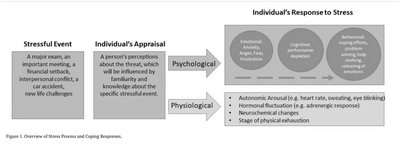
Science of Stress: Biological and Psychological Responses
Stress triggers the release of hormones such as adrenaline and cortisol from the adrenal glands, leading to various physiological and psychological responses.
Short-term Stress: Prepares the body for fight-or-flight; increases heart rate, blood pressure, and breathing.
Long-term Stress: Weakens the immune system and can lead to chronic health issues.
Psychoneuroimmunology studies the relationship between psychological factors, the immune system, and the brain. Chronic stress suppresses immune function, increasing susceptibility to illness.
Lymphocytes: White blood cells suppressed by stress hormones.
Placebo Effect: Demonstrates the influence of psychological factors on health.
General Adaptation Syndrome (GAS) Model
GAS describes the physiological progression of stress responses:
Alarm: Initial reaction to stressor.
Resistance: Ongoing coping and adaptation.
Exhaustion: Depletion of resources, leading to illness or biological damage.
Additional info: The model suggests uniform biological reactions to stress, which is debated in current research.
Psychological Disorders Related to Stress
Post-Traumatic Stress Disorder (PTSD)
PTSD can develop after exposure to traumatic events. Symptoms include flashbacks, emotional numbing, sleep disturbances, substance abuse, and increased risk of physical health problems.
Episodes may be triggered by innocuous stimuli.
Feelings of helplessness during trauma increase risk.
Therapies: Eye Movement Desensitization and Reprocessing (EMDR), Dialectical Behavior Therapy (DBT).
Additional info: Cultural differences affect coping and symptom expression.
Psychophysiological Disorders
Chronic stress is linked to physical health issues such as headaches, back pain, skin rashes, stomach problems, and weight gain due to increased cortisol.
Coping Mechanisms and Resilience
Coping Strategies
Emotion-Focused Coping: Managing emotional responses (e.g., talking, music, deep breathing).
Problem-Focused Coping: Addressing the source of stress (e.g., seeking help, problem-solving).
Unhealthy (Maladaptive) Coping: Avoidance, substance use, excessive screen time, social withdrawal.
Resilience and Hardiness
Resilience is the ability to recover from stress, often associated with optimism and a growth mindset. Hardiness includes commitment, control, and viewing stress as a challenge.
Building resilience: Support systems, learning from challenges.
Perceived Control and Locus of Control
Perceived Control refers to the belief in one's ability to influence outcomes. Locus of Control describes whether individuals attribute outcomes to internal factors (self-driven) or external factors (luck, fate).
Internal Locus: Belief in personal influence; associated with motivation and action.
External Locus: Belief in external control; may lead to passivity.
Learned Helplessness
When individuals believe they cannot change a negative situation, they may stop trying, leading to passivity and depression. This concept was demonstrated in animal studies and is relevant to depressive disorders.
Compensatory Control
Psychological strategies to maintain a sense of order when personal control is compromised, such as adopting religious beliefs or conspiracy theories during uncertainty.
Positive Health Behaviors and Interventions
Exercise
Regular physical activity improves cognitive function, increases dopamine and BDNF, and reduces risk of Alzheimer's and dementia.
BDNF (Brain Derived Neurotrophic Factor): Protein promoting neuron survival and growth.
Meditation and Prayer
Meditation and prayer reduce stress hormones, improve sleep, enhance memory and attention, and alter brain activity (increased prefrontal cortex activity, decreased amygdala activity).
Guided Imagery Intervention
Relaxation and visualization techniques can improve health outcomes, especially in illness recovery.
Small Positive Actions
Minor positive experiences, such as social interactions, can significantly improve mental health and well-being.
Technology and Stress
Impact of Technology Use
Studies show increased mental health issues among teens using new technology, with higher depression rates in girls. Physical activity and sleep are protective factors.
Doomscrolling as Maladaptive Coping
Doomscrolling is the compulsive consumption of negative online content, driven by evolutionary bias, fear of missing out, and variable-reward feedback loops. It provides short-term distraction but increases long-term distress and rumination.
Personality and Health Outcomes
Coronary Heart Disease and Personality Types
Type A: High risk (competitive, impatient).
Type B: Low risk (relaxed, easy-going).
Type D: Very high risk (distressed).
Cancer and Emotional Response
Emotional responses can influence the course of cancer, highlighting the importance of psychological well-being in physical health.
Summary Table: Stress Response and Coping
Type of Stressor | Response | Coping Mechanism |
|---|---|---|
Cataclysmic Event | Acute stress, widespread impact | Emotion-focused, social support |
Personal Stressor | Immediate reaction, fades over time | Problem-focused, resilience building |
Background Stressor | Chronic, cumulative effects | Healthy lifestyle, mindfulness |
Key Equations and Concepts
General Adaptation Syndrome:
Stress Hormone Release:
Life Stress Inventory:
