 Back
BackHow Memory Functions: Processes, Types, and Models
Study Guide - Smart Notes
 Tailored notes based on your materials, expanded with key definitions, examples, and context.
Memory: An Overview
Introduction to Memory
Memory is a fundamental cognitive process that allows us to encode, store, and retrieve information. It is often compared to a computer system, as it involves the systematic processing of information over time. Understanding how memory functions is essential for grasping how we learn, retain, and recall knowledge and experiences.
The Three Basic Functions of Memory
Encoding, Storage, and Retrieval
Memory operates through three primary functions: encoding, storage, and retrieval. Each function plays a distinct role in the formation and use of memories.
Encoding: The process of inputting information into the memory system. It involves transforming sensory input into a form that can be stored.
Storage: The retention of encoded information over time, creating a permanent record.
Retrieval: Accessing and bringing stored information back into conscious awareness when needed.
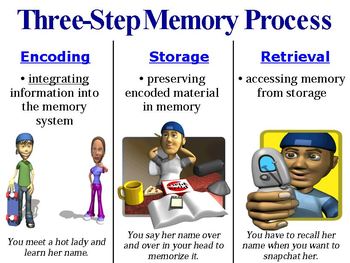
Encoding: How Information Enters Memory
Types of Encoding
Encoding is the first step in creating a memory. It can occur automatically or require effortful processing, depending on the nature of the information.
Automatic Processing: Encoding details such as time, space, and frequency without conscious effort (e.g., remembering what you ate for lunch).
Effortful Processing: Encoding that requires attention and conscious effort, such as studying for an exam or learning a new skill.

Types of Encoding
Semantic Encoding: Encoding the meaning of words and concepts. This type of encoding leads to better memory retention, especially when information is personally meaningful.
Visual Encoding: Encoding images and visual sensory information. High-imagery words (e.g., "car," "dog") are easier to remember than abstract words (e.g., "truth," "value").
Acoustic Encoding: Encoding sounds, particularly the sounds of words. Songs, rhymes, and rhythms are often remembered well due to acoustic encoding.
Self-Reference Effect: Information related to oneself is more easily remembered. Applying personal relevance to study material enhances encoding and recall.
Storage: Maintaining Information Over Time
The Three Stages of Memory Storage
Information must pass through three distinct stages to become a long-term memory. This process is described by the Atkinson-Shiffrin (A-S) model.
Sensory Memory: Brief storage of sensory events (sights, sounds, tastes) lasting only a few seconds.
Short-Term Memory (STM): Temporary storage system that holds about 7 items for approximately 20 seconds. Also called "working memory." Information can be maintained through rehearsal.
Long-Term Memory (LTM): Continuous, relatively permanent storage of information with essentially limitless capacity.
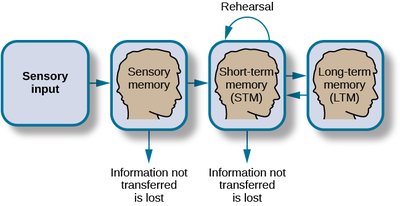
Alternative Models
Other models, such as Baddeley and Hitch's working memory model, propose that short-term memory consists of multiple subsystems (visuospatial sketchpad, episodic buffer, phonological loop) managed by a central executive.
Sensory Memory and the Stroop Effect
Sensory memory filters incoming stimuli, allowing only valuable information to proceed to short-term memory. The Stroop effect demonstrates the challenge of processing conflicting sensory information, such as naming the color of a word when the word itself names a different color.
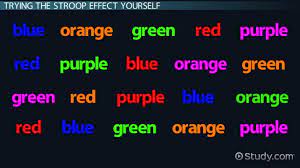
Short-Term Memory (STM) and Working Memory
STM is limited in capacity and duration. Rehearsal (conscious repetition) helps consolidate information into long-term memory. George Miller's research suggests STM holds about 7 ± 2 items. Recall is often better for numbers than letters and for auditory information compared to visual information.
Long-Term Memory (LTM)
LTM stores information for extended periods, from minutes to a lifetime. Not all long-term memories are equally strong; some require cues for retrieval.
Types of Long-Term Memory
Explicit (Declarative) vs. Implicit (Non-Declarative) Memory
Long-term memory is divided into explicit and implicit types, each with distinct characteristics and functions.
Type | Subtypes | Description |
|---|---|---|
Explicit (Declarative) | Episodic, Semantic | Memories we consciously try to remember and recall (e.g., facts, events). |
Implicit (Non-Declarative) | Procedural, Priming, Emotional Conditioning | Memories not part of conscious awareness, formed through behaviors (e.g., skills, conditioned responses). |
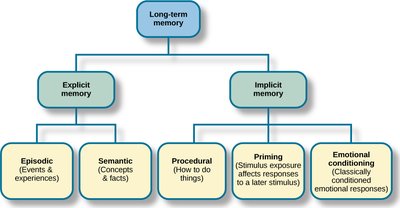
Explicit Memory
Semantic Memory: Knowledge about words, concepts, and facts (e.g., "What is democracy?").
Episodic Memory: Information about events personally experienced, including the what, where, and when of an event. Also called autobiographical memory.
Implicit Memory
Procedural Memory: Memory for skilled actions (e.g., riding a bike, playing an instrument).
Priming: Exposure to a stimulus influences response to a later stimulus.
Emotional Conditioning: Classically conditioned emotional responses.
Highly Superior Autobiographical Memory
Some individuals possess highly superior autobiographical memory, allowing them to recall vast amounts of personal life events in detail. This rare ability is known as hyperthymesia.

Retrieval: Accessing Stored Information
Methods of Retrieval
Retrieval is the process of bringing stored information into conscious awareness. There are three main methods:
Recall: Accessing information without cues (e.g., essay tests).
Recognition: Identifying previously learned information when encountered again (e.g., multiple-choice tests).
Relearning: Learning information more quickly the second time it is encountered.
Summary Table: Memory Systems and Processes
Stage | Duration | Capacity | Function |
|---|---|---|---|
Sensory Memory | Milliseconds to 2 seconds | Large | Briefly holds sensory information |
Short-Term Memory | ~20 seconds | 7 ± 2 items | Temporary storage and manipulation |
Long-Term Memory | Minutes to lifetime | Essentially limitless | Permanent storage |
Key Terms and Definitions
Acoustic Encoding: Input of sounds, words, and music.
Atkinson-Shiffrin Model: Memory model with three systems: sensory, short-term, and long-term memory.
Automatic Processing: Encoding of details without conscious awareness.
Declarative Memory: Long-term memory of facts and events.
Effortful Processing: Encoding that requires attention and effort.
Encoding: Input of information into the memory system.
Episodic Memory: Memory of personal events (autobiographical).
Explicit Memory: Memories we consciously try to remember.
Implicit Memory: Memories not part of conscious awareness.
Long-Term Memory (LTM): Continuous storage of information.
Memory Consolidation: Rehearsal to move information from STM to LTM.
Procedural Memory: Memory for skilled actions.
Recall: Accessing information without cues.
Recognition: Identifying previously learned information.
Rehearsal: Conscious repetition of information.
Relearning: Learning information previously learned.
Retrieval: Getting information out of LTM into awareness.
Self-Reference Effect: Better memory for information related to oneself.
Semantic Encoding: Input of words and their meaning.
Semantic Memory: Memory about words, concepts, and facts.
Sensory Memory: Brief storage of sensory events.
Short-Term Memory (STM): Holds about seven bits of information temporarily.
Storage: Creation of a permanent record of information.
Visual Encoding: Input of images.
