 Back
BackIdentifying Reinforcers: Methods and Assessments in Behavioral Psychology
Study Guide - Smart Notes
 Tailored notes based on your materials, expanded with key definitions, examples, and context.
Identifying Reinforcers
Introduction to Reinforcers
Reinforcers are stimuli that increase the likelihood of a behavior when presented following that behavior. Identifying effective reinforcers is a foundational process in behavioral psychology, especially in applied settings such as education and therapy. The process involves systematic assessment to determine which stimuli are most likely to motivate and sustain desired behaviors.
Stimulus Preference Assessment
Overview of Stimulus Preference Assessment
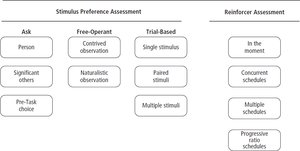
Stimulus preference assessments are methods used to identify potential reinforcers by determining which stimuli an individual prefers. These assessments can be conducted in several ways, each providing valuable information about the individual's likes and dislikes.
Ask Method: Directly asking the individual or significant others about preferred items or activities. This can include open-ended questions, choice formats, or rank-ordering.
Pre-task Choice: Presenting a set of options before a task and asking which item the individual would like to earn for completing the activity.
Free Operant: Allowing the individual free access to various stimuli and observing how they allocate their time among them. This can be done in contrived or naturalistic settings.
Trial-Based Methods: Presenting stimuli in a series of tests and measuring the individual's responses. Common trial-based methods include single stimulus, paired stimulus (forced choice), and multiple stimulus assessments.
Types of Trial-Based Stimulus Preference Assessments
Single Stimulus: One stimulus is presented at a time, and the individual's engagement is recorded. A hierarchy is constructed based on the percentage of engagement.
Paired Stimulus (Forced Choice): Two stimuli are presented simultaneously, and the individual is prompted to choose one. Each stimulus is paired with all others, and a hierarchy is developed based on the percentage chosen.
Multiple Stimulus: An array of three or more stimuli is presented, and the individual is asked to choose one. This can be done with replacement (items are replaced after each trial) or without replacement (chosen items are removed and the array is rearranged).
Reinforcer Assessment
Overview of Reinforcer Assessment
Reinforcer assessments are direct, data-based methods used to determine whether a stimulus actually functions as a reinforcer. This involves presenting the stimulus contingent on a target response and measuring its effect on future behavior.
In-the-Moment Reinforcer Analysis: The preferred stimulus is presented immediately after a response, and the effect on future responding is observed.
Concurrent Schedules: Two or more contingencies of reinforcement operate simultaneously for different behaviors, allowing comparison of the effectiveness of different stimuli.
Multiple Schedule Reinforcer Assessment: Two or more component schedules of reinforcement are alternated for a single response, with discriminative stimuli signaling each schedule.
Progressive-Ratio Schedule: The response requirement for reinforcement is systematically increased until the response rate declines, indicating the breaking point for the reinforcer's effectiveness.
Key Considerations in Preference and Reinforcer Assessments
Preferred Items May Not Always Serve as Reinforcers: Highly preferred stimuli do not necessarily function as reinforcers. The only way to confirm a stimulus's reinforcing effect is through direct testing.
Direct Testing: Presenting the stimulus immediately after a behavior and observing its effect on future responding is essential for determining reinforcement.
Control Procedures for Positive Reinforcement
Manipulating Contingencies
Control procedures involve manipulating the contingent presentation of a potential reinforcer and observing its effects on behavior. Control is demonstrated by comparing response rates in the presence and absence of the contingency, showing that behavior can be turned on and off or modulated.
Using Reinforcement Effectively
Best Practices
Effective use of reinforcement requires careful selection of stimuli, ongoing assessment, and adjustment of contingencies based on observed effects. Practitioners should use data-driven methods to ensure that reinforcement strategies are tailored to individual needs and are effective in promoting desired behaviors.
Summary Table: Stimulus Preference and Reinforcer Assessment Methods
Stimulus Preference Assessment | Reinforcer Assessment |
|---|---|
Ask (Person, Significant Others, Pre-task Choice) | In the Moment |
Free-Operant (Contrived/Naturalistic Observation) | Concurrent Schedules |
Trial-Based (Single Stimulus, Paired Stimuli, Multiple Stimuli) | Multiple Schedules |
Progressive Ratio Schedules |
Example Application
For instance, in a classroom setting, a teacher may use a stimulus preference assessment to determine which rewards (such as extra playtime, snacks, or toys) are most motivating for students. The teacher then conducts a reinforcer assessment by providing the chosen reward after a desired behavior and measuring whether the behavior increases over time.
Additional info: Reinforcer assessments are critical in applied behavior analysis (ABA) and other therapeutic contexts to ensure interventions are effective and individualized.
