 Back
BackInfancy: Developmental Psychology Study Notes
Study Guide - Smart Notes
 Tailored notes based on your materials, expanded with key definitions, examples, and context.
Infancy: Developmental Psychology
Dependence and Maslow's Hierarchy of Needs
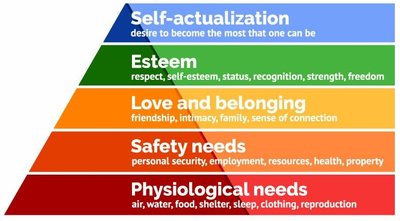
Infants are highly dependent on caregivers to meet their basic needs, which aligns with Maslow's Hierarchy of Needs. This hierarchy outlines the progression of human needs from basic physiological requirements to self-actualization.
Physiological needs: Air, water, food, shelter, sleep, clothing, reproduction.
Safety needs: Personal security, employment, resources, health, property.
Love and belonging: Friendship, intimacy, family, sense of connection.
Esteem: Respect, self-esteem, status, recognition, strength, freedom.
Self-actualization: Desire to become the most that one can be.
Physical Development in Infancy
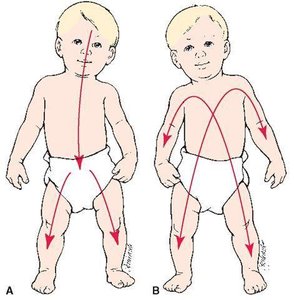
Physical growth in infancy follows predictable patterns and is marked by rapid changes in height, weight, and neural development.
Cephalocaudal pattern: Growth occurs from head to toe.
Proximodistal pattern: Growth occurs from the center of the body outward.
Height and weight: Newborns average 20 inches in height and 7.5 lbs in weight. Weight doubles by 4 months and triples by 12 months. Height increases about 1 inch per month in the first year.
Growth spurts: Periods of rapid growth occur frequently in infancy.
Brain Development in Infancy
Infant brain development is characterized by rapid growth, increased connectivity, and specialization of brain regions.
Myelination: The process of coating neurons with a fatty sheath (myelin) to increase the speed of neural communication.
Connectivity: Formation of new synaptic connections between neurons.
Blooming and pruning: Rapid increase in synaptic connections (blooming) followed by elimination of unused connections (pruning).
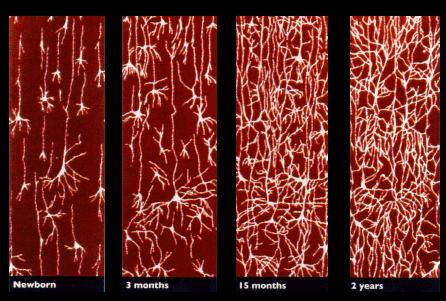
Specialization: Brain regions such as the auditory cortex, visual cortex, and prefrontal cortex begin to specialize in function.
Enrichment: Infants raised in stimulating environments show greater brain activity and development.
Shaken Baby Syndrome
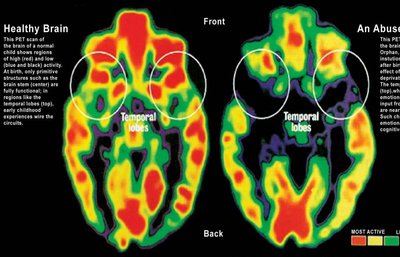
Shaking an infant can cause severe brain injury, including swelling, hemorrhaging, and even death. This is a preventable cause of infant mortality and disability.
Symptoms: Brain swelling, hemorrhaging, death.
Prevalence: Affects hundreds of babies each year.

Neural Plasticity and Experience
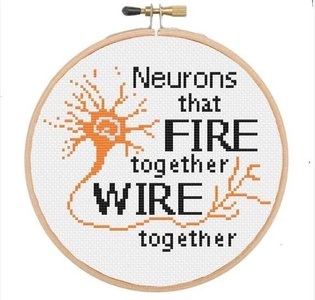
Neural plasticity refers to the brain's ability to adapt and reorganize itself in response to experience. The phrase "neurons that fire together wire together" summarizes this principle.
Myelination and pruning: Both processes are influenced by experience and are critical for efficient brain function.
Enrichment: Providing toys and play opportunities supports optimal brain development.
Sleep in Infancy
Sleep is essential for brain development in infancy. Infants have unique sleep patterns that change rapidly in the first years of life.
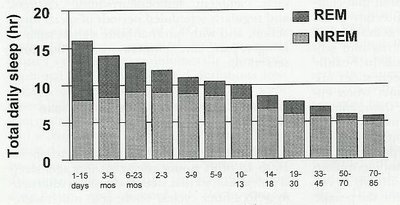
Sleep architecture: Newborns spend about 50% of their sleep in REM and 50% in NREM. By 3-5 months, NREM sleep increases.
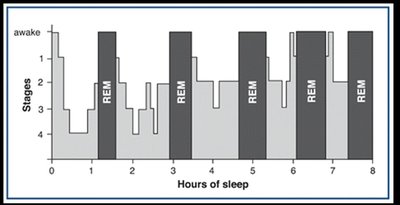
Sleep cycles: Infants typically go straight to REM sleep. NREM stages develop by 3-6 months, and by 3 years, sleep resembles adult patterns.
Stages of sleep: Five stages, with stages 1-4 as NREM and stage 5 as REM (vivid dreams, rapid eye movements).
Circadian Rhythms in Infancy
Circadian rhythms are biological processes that follow a roughly 24-hour cycle, regulated by the suprachiasmatic nucleus (SCN) in the hypothalamus. In infants, these rhythms are not present at birth and develop over time.
Body temperature: Entrainment occurs about a week after birth.
Sunlight entrainment: Sleep/wake cycles begin to align with sunlight around 45 days after birth, but may take up to a year.
Disruptions: Can lead to sleep problems in childhood.
Sleep and Brain Development
Sleep is crucial for brain development, particularly for the growth of grey matter and neural plasticity. Insufficient sleep can delay brain development and impact cognitive and physical outcomes.
REM sleep: Facilitates the release of kinase, an enzyme critical for neural plasticity.
Neural plasticity: Allows the brain to adapt by pruning and reinforcing neural connections.
Grey matter: Unmyelinated neurons responsible for movement, memory, and emotions.

Sleep and Cognitive Development
Research indicates that insufficient sleep in infancy is associated with delayed language skills and poor executive functioning.
Language development: Sleep supports the acquisition of language and cognitive skills.
Executive functioning: Includes skills such as attention, problem-solving, and self-regulation.
Sleep and Physical Development
Insufficient sleep in infancy is linked to higher body mass index (BMI) and an increased risk of being overweight in childhood.
Physical growth: Sleep supports healthy weight and growth patterns.
Sleep Disturbances in Infancy
Infant Sleep Disturbance (ISD) includes frequent night-waking and delays in sleep onset, affecting 15-35% of infants. These disturbances are associated with parental depression, later behavior problems, and poor parent-child relationships.
Night-waking: Normal with polyphasic sleep, but high frequency can be problematic.
Parental influence: Caregiver sleep practices, stress, and attachment style impact infant sleep.
Sleep Training Approaches
Several methods exist for teaching infants to fall asleep independently:
Cry it out/Ferber method: Leave the baby to self-soothe after bedtime routine.
Check and console: Periodically check and comfort the baby if crying persists.
Fading: Gradually reduce parental presence as the baby falls asleep.
No tears: Provide support whenever the baby cries, gradually reducing intervention.
Co-Sleeping and SIDS
Co-sleeping, or sharing a sleep surface with an infant, has both benefits (easier feeding, bonding) and risks (suffocation, sleep fragmentation). Sudden Infant Death Syndrome (SIDS) is a rare but serious risk, with several identified risk factors and recommended precautions.
Risk factors for SIDS: Side/stomach sleeping, premature birth, overheating, soft sleep surfaces, maternal smoking, neglect.
Precautions: Back sleeping, firm sleep surface, smoke-free environment, cool sleep space, breastfeeding.
Nutrition in Infancy
Proper nutrition is essential for healthy development. Infants require about 50 calories per pound of body weight per day. Feeding transitions from caregiver-led to self-feeding over the first year.
Breastfeeding vs. bottle feeding: Breastfeeding is generally recommended for its health benefits, but alternatives are necessary in certain medical situations.
Caregiver sensitivity: Responsive feeding supports optimal cognitive and physical outcomes.
Motor Skills in Infancy
Motor development in infancy is explained by Dynamic Systems Theory, which emphasizes the integration of perception, motivation, and action.
Reflexes: Innate, pre-programmed physical skills.
Gross motor skills: Large-muscle activities such as walking and running, requiring postural control.
Fine motor skills: Small, precise movements such as grasping and using utensils. Development progresses from palmer to pincer grasp.
Sensation and Perception in Infancy
Infants' sensory systems develop rapidly after birth, with a strong preference for human faces and the emergence of perceptual constancy.
Visual acuity: Improves throughout the first year; infants prefer faces.
Perceptual constancy: Understanding that objects retain size and shape despite changes in perspective.
Hearing: Volume and pitch sensitivity develop over time; localization is crucial for survival.
Cognitive Development in Infancy
Piaget's framework describes cognitive development as a series of stages, though modern research suggests more flexibility and earlier abilities than originally proposed.
Object permanence: Understanding that objects continue to exist when out of sight, typically achieved by two years.
Conditioning: Infants learn through operant and classical conditioning.
Attention: Develops from basic orienting to sustained attention and detailed investigation.
Language Development in Infancy
Language is a complex, rule-based system that develops rapidly in infancy and early childhood.
Phonemes: Basic sound units; infants begin recognizing native language sounds before birth.
Morphemes: Smallest units of meaning.
Syntax: Rules for sentence structure.
Semantics: Meaning of words and sentences.
Extralinguistic information: Nonverbal cues, context, and pragmatics.
Language milestones: Babbling, word recognition, first words, and combining words.
Biological influences: Broca's and Wernicke's areas, critical period for language acquisition.
Social/environmental influences: Exposure to language, caregiver strategies (recasting, expanding, labeling).
Socioemotional Development in Infancy
Socioemotional development includes the emergence of emotions, attachment, temperament, and the early sense of self.
Primary emotions: Present in infants and animals (e.g., joy, anger, fear).
Self-conscious emotions: Require a sense of self (e.g., embarrassment, pride).
Attachment: Emotional bond with caregivers, classified as secure or various forms of insecure attachment.
Temperament: Individual differences in emotional reactivity and regulation (easy, difficult, slow-to-warm-up).
Goodness of fit: The match between a child's temperament and environmental demands.
Sense of self: Emerges in the second year, studied using the mirror technique.
Family and social context: Reciprocal socialization between parents and children shapes development.
