 Back
BackIntelligence and IQ Testing: Controversy and Consensus
Study Guide - Smart Notes
 Tailored notes based on your materials, expanded with key definitions, examples, and context.
Intelligence and IQ Testing
Defining Intelligence
Intelligence is a complex and debated concept in psychology, with no universally accepted definition. Early theorists and modern psychologists have proposed various models to explain what intelligence is and how it can be measured.
Boring's definition: "Intelligence is whatever intelligence tests measure." This sidesteps the deeper question of what makes some people smarter than others.
Galton's theory: Intelligence as a byproduct of sensory capacity (e.g., hearing, vision). Research did not support this, as sensory abilities are only weakly related to each other and to intelligence.
Binet and Simon: Developed the first intelligence test in 1905, focusing on higher mental processes such as reasoning, understanding, and judgment. Most psychologists now agree that intelligence is closely related to abstract thinking.
Cultural differences: Views of intelligence may differ between Western and Eastern cultures.
General vs. Specific Abilities
Charles Spearman observed positive correlations among items on intelligence tests, leading to the theory of general intelligence (g).
General intelligence (g): Accounts for overall differences in intellect among people.
Specific abilities (s): Unique to particular tasks.
Fluid and Crystallized Intelligence
Cattell and Horn proposed that intelligence consists of two main capacities:
Fluid intelligence: The ability to learn new ways of solving problems and think logically in novel situations.
Crystallized intelligence: Accumulated knowledge and skills gained over time.
Fluid intelligence tends to decline with age, while crystallized intelligence remains stable or may increase.
Multiple Intelligences
Howard Gardner argued for multiple independent domains of intellectual skill, known as "frames of mind." His theory has influenced education but remains controversial due to difficulties in falsification and lack of evidence for independence among intelligences.
Intelligence Type | Characteristics of High Scorers | Suggested Occupation |
|---|---|---|
Linguistic | Speak and write well | Translator, editor |
Logico-mathematical | Use logic and mathematical skills | Scientist, engineer |
Spatial | Reason about objects in three-dimensional space | Architect, artist |
Musical | Perform, understand, and enjoy music | Musician, teacher |
Bodily-kinesthetic | Manipulate the body in sports, dance, etc. | Athlete, coach |
Interpersonal | Understand and interact with others | Salesperson, counsellor |
Intrapersonal | Insight into self | Philosopher, prophet |
Naturalistic | Understand living things | Biologist, veterinarian |
Triarchic Model of Intelligence
Robert Sternberg proposed three distinct types of intelligence:
Analytical intelligence: Logical reasoning and academic problem-solving ("book smarts").
Practical intelligence: Ability to solve real-world problems ("street smarts").
Creative intelligence: Capacity to generate novel and effective solutions.
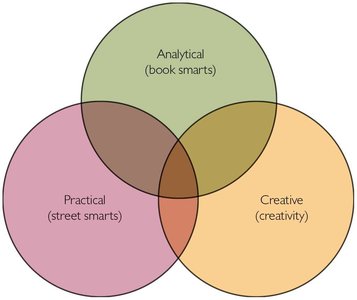
Criticisms include overlap with general intelligence and difficulty in proving independence of practical intelligence.
Biological Bases of Intelligence
Brain Structure and Function
Research shows a positive correlation between brain volume and measured intelligence (correlation coefficients between 0.3 and 0.4). The cerebral cortex develops more slowly in gifted children, and higher intelligence is associated with more efficient brain processing and lower reaction times.
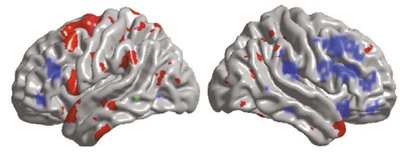
Prefrontal cortex: Especially active during tasks highly correlated with general intelligence.
Other regions: Parietal cortex and others also play important roles.
Measuring Intelligence
IQ Testing
Self-reports of intelligence are unreliable. Objective measures, such as standardized IQ tests, are used instead. Metacognitive skills (the ability to estimate one's own cognition) are important, but people with lower cognitive ability often overestimate their skills.
Calculating IQ
Stanford-Binet Test: Developed in 1916, compares individual performance to population norms.
Original IQ formula: This formula works for children but not adults, as intelligence peaks early while chronological age increases.
Deviation IQ: Modern tests compare an individual's score to age-group norms.
History and Misuse of IQ Testing
IQ tests were misused in the early 20th century, leading to the eugenics movement, which promoted selective breeding and resulted in harmful policies such as forced sterilization and restrictive immigration laws.
IQ Testing Today
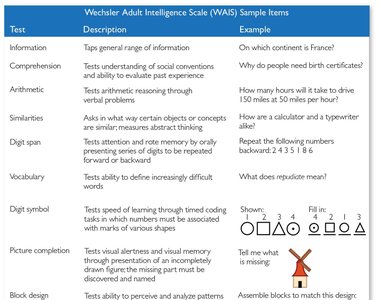
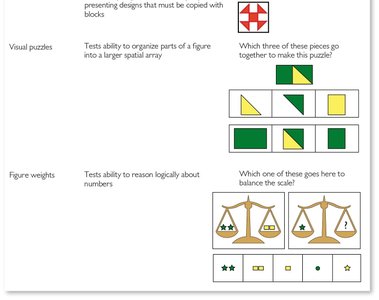
The most widely used test for adults is the Wechsler Adult Intelligence Scale (WAIS), which includes 15 subtests and generates five main scores: overall IQ, verbal comprehension, perceptual reasoning, working memory, and processing speed.
Culture-Fair IQ Tests
These tests use abstract reasoning items that do not depend on language, such as Raven's Progressive Matrices.
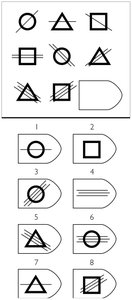
Post-Secondary Admissions Tests
Tests like the SAT, MCAT, LSAT, and GRE are designed to predict academic success and correlate highly with certain aspects of IQ testing.
Reliability and Validity of IQ Scores
Reliability: IQ scores are highly stable in adults (test-retest reliability ~0.95), but unstable in young children.
Validity: IQ scores moderately predict academic grades (correlation ~0.5) and job performance, and are associated with health outcomes.
Distribution and Extremes of Intelligence
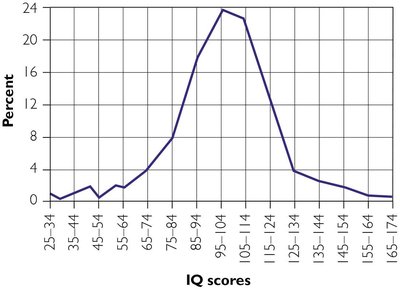
IQ Score Distribution
IQ scores in the population form a bell curve, with most people scoring near the average and fewer at the extremes.
Intellectual Disability
Definition: Onset in childhood, IQ below 70, and impaired daily functioning.
Prevalence: About 1% of the North American population, more common in males.
Levels: Mild, moderate, severe, profound.
Causes: Over 200 causes, including Fragile X syndrome and Down syndrome.
Mental Giftedness
Definition: Top 2% of IQ scores.
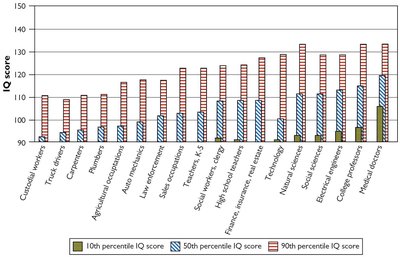
Professions: Many gifted individuals become doctors, lawyers, engineers, or professors.
Research: Terman's study showed gifted children are not more likely to "burn out" or develop mental illness.
Genetic and Environmental Influences on Intelligence
Genetic Influences
Family studies: IQ runs in families (siblings: 0.5, cousins: 0.15 correlation).
Twin studies: Identical twins: 0.7–0.8 correlation; fraternal twins: 0.3–0.4. Identical twins reared apart are as similar as those reared together.
Adoption studies: Support both genetic and environmental influences.
Environmental Influences
Mindset: Belief that IQ is fixed leads to less academic risk-taking (Dweck's Growth Mindset theory).
Family size: Larger families tend to have slightly lower average IQs.
Schooling: More schooling increases IQ; early intervention programs have short-term effects.
Poverty: Poor environments can lead to cumulative deficits in IQ, partly due to nutrition and exposure to toxins.
Flynn Effect: Average IQ scores have risen about 3 points per decade, likely due to environmental improvements.
Group Differences in Intelligence
Sex Differences
Few or no average differences in IQ between males and females, but males show greater variability.
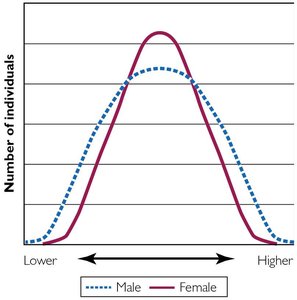
Females tend to excel in verbal tasks and emotion recognition; males tend to excel in spatial tasks.
Most differences are due to environmental factors.
Ethnic Differences
Small average differences in IQ by ethnic group, but substantial overlap exists.
Differences are largely environmental, not genetic.
As environments improve, group differences diminish.
Within-Group vs. Between-Group Heritability
Differences within groups are due to genetics, while differences between groups are due to environment.
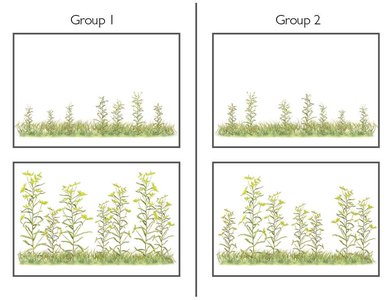
Stereotype Threat
Stereotype threat can affect test performance in laboratory settings, but its real-world impact is debated.
Creativity and Emotional Intelligence
Creativity
Measured by divergent thinking (generating many solutions) and convergent thinking (finding the best solution).
Creativity is only mildly correlated with IQ (0.2–0.3).
Emotional Intelligence
The ability to understand and manage one's own and others' emotions.
May overlap with personality traits and does not predict job performance beyond general IQ.
Other Attributes
Grit and wisdom: Proposed as additional predictors of success, but research is ongoing and controversial.
