 Back
BackIntroduction to Community Psychology: Origins, Values, and Possibilities
Study Guide - Smart Notes
 Tailored notes based on your materials, expanded with key definitions, examples, and context.
Why Community Matters: Origins, Values, and Possibilities of Community Psychology
Learning Outcomes
Upon completing this lesson, students should be able to:
Define community and recognize its multiple forms and dimensions.
Explain the concept and research related to the importance of community for health, well-being, and social connection, using examples such as Roseto and studies on loneliness.
Describe research on community and health/well-being, including examples such as Roseto and studies on loneliness and social capital.
Summarize the history and context of community psychology, including its development in the U.S., Canada, and internationally.
Articulate what community psychology is and identify how it differs from traditional psychology.
Recognize the core values of community psychology and explain how they can be lived in practice.
Welcome to Community & Community Psychology
Introduction to Community
The concept of community is multifaceted, encompassing neighborhoods, social groups, teams, online networks, and cultural or religious affiliations. Community psychologists and social scientists study how communities provide support, connection, and meaning, but also how they can exclude or reinforce boundaries. Understanding these dimensions is essential for grasping the role of community in our lives.
What is Community?
Defining Community
Health and well-being are deeply influenced by the communities in which we live. The connections, values, and everyday practices of a community can protect or, in some cases, harm its members. As Bess, Fisher, Sonn, and Bishop (2002) note:
"The idea that we belong to communities and that these communities provide benefits and responsibilities is one that has gained a growing appreciation in the last decade."
Communities are not just physical locations but also networks of relationships and shared identities.
Community as Defined by Community Psychology
Multiple Definitions of Community
There is no single, universal definition of community. Communities can be based on geography, culture, identity, shared interests, or common goals. Key definitions include:
Seymour Sarason (1974): "The readily available, mutually supportive network of relationships on which one could depend."
Geoff Nelson and Isaac Prilleltensky: "At the most basic level, the word community implies a group or groups of citizens who share something in common."
Krause and Montemayor (2017): "Community as a human group that develops upon shared meaning and a common identity, whose members define themselves as such, and who establish relationships with one another in a particular and shared social and historical context."
These definitions highlight the interconnected dimensions of community: psychological, emotional, relational, action, time-space, motivation, culture, and social identity.
(More) Science on Community and Wellness
Community Influence on Health and Well-being
Scientific research demonstrates that community relationships significantly impact health and well-being. For example, Susan Pinker’s work emphasizes the physiological and psychological benefits of mutual trust and face-to-face contact. Close relationships are as critical to survival as diet, exercise, or money.
"Our relationships—the people we know and care about—are just as critical to our survival as diet, exercise, or money."
Key studies include:
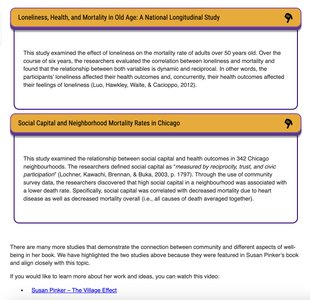
Loneliness, Health, and Mortality in Old Age: Examined the effect of loneliness on mortality rates in adults over 50, finding that loneliness is linked to higher mortality rates (Luo, Hawkley, Waite, & Cacioppo, 2012).
Social Capital and Neighborhood Mortality Rates in Chicago: Found that higher social capital (trust, reciprocity, and civic participation) is associated with lower mortality rates (Lochner, Kawachi, Brennan, & Buka, 2003).
Community Psychology: History and Context
Development of Community Psychology
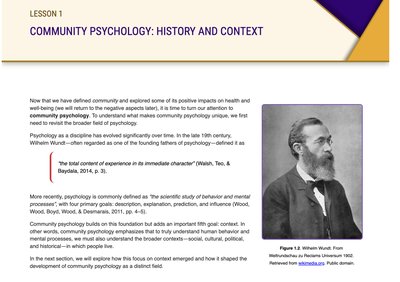
Community psychology emerged as a discipline in the late 19th century, with Wilhelm Wundt as a foundational figure. The field shifted focus from individual behavior to the broader social context, emphasizing prevention, social change, and collective well-being.
Community psychology developed differently across countries. In the U.S., it grew out of the 1960s social context, focusing on mental health reform and social justice. In Canada and Latin America, the field has unique histories and emphases, such as liberation and social justice.
Key Definitions of Community Psychology
Scholarly Definitions
Bret Kloos et al. (2012): "Community psychology concerns the relationships of individuals with communities and societies. By integrating research with action, it seeks to understand and enhance quality of life for individuals, communities, and societies overall."
Richard Walsh et al. (2015): "Community psychologists aim to study individuals in their social contexts, focusing on strengths instead of deficits, while attempting to prevent illness and disease by means of social change instead of adjustment to existing institutions."
Carolyn Kagan and Mark Burton (2007): "Community psychology offers a framework for working with people often marginalized by the social system that leads to well-being and empowerment as an ethical value, while seeking to prevent psychological and other forms of ill health."
Concepts and Values in Community Psychology
Core Themes and Values
Several overlapping themes are central to community psychology:
Relationship between individuals and broader contexts (e.g., communities, societies, social systems)
Focus on social change rather than only individual change
Value-based, participatory research and action
Integrating research with practice
Enhancing quality of life and contributing to a better world
Key values articulated by scholars and practitioners include:
Contextual/Ecological Perspectives
Prevention and Promotion
Community, Sense of Community, and Psychological Sense of Community
Individual and Family Wellness
Power, Colonialism, Development, and Decolonization
Respect for Human Diversity
Social Justice
Empowerment and Citizen Participation
Collaboration and Community Strengths
Empirical Grounding
Commitment to Action, Research, and Theory
Your Community Service-Learning Placement
Practical Application of Community Psychology
Students are required to participate in a Community Service-Learning (CSL) placement, integrating classroom instruction with practical service. This experience is designed to:
Encourage work with marginalized community members
Broaden perspectives through new experiences
Support community organizations and the people they serve
Lesson Conclusion
By the end of this lesson, students should be able to:
Define community
Explain the importance of community
Describe research on community and health/well-being
Summarize the history and context of community psychology
Articulate what community psychology is
Explain how core values can be lived in practice
