 Back
Introduction to Psychology: Core Concepts and Study Guide
Study Guide - Smart Notes
 Tailored notes based on your materials, expanded with key definitions, examples, and context.
Biology and Psychology
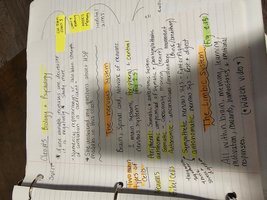
The Nervous System
The nervous system is the body's communication network, responsible for transmitting information throughout the body and coordinating actions. It consists of the central nervous system (CNS) and the peripheral nervous system (PNS).
Central Nervous System (CNS): Includes the brain and spinal cord. The CNS processes information and is the control center for the body.
Peripheral Nervous System (PNS): Composed of nerves outside the CNS. It connects the CNS to limbs and organs.
Somatic Nervous System: Controls voluntary movements and transmits sensory information.
Autonomic Nervous System: Regulates involuntary functions (e.g., heart rate, digestion). Includes the sympathetic (activates fight-or-flight) and parasympathetic (calms the body) divisions.
Limbic System: Involved in emotion, motivation, and memory.
Methods in Psychology
Research Methods
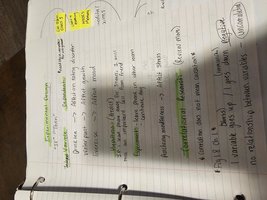
Psychologists use various methods to study behavior and mental processes. Understanding these methods is essential for interpreting psychological research.
Naturalistic Observation: Observing subjects in their natural environment without interference.
Case Study: In-depth analysis of an individual or group.
Survey: Collecting data from large groups using questionnaires or interviews.
Experiment: Manipulating variables to determine cause and effect. Includes independent and dependent variables.
Correlation: Examines relationships between variables but does not imply causation.
Learning
Classical Conditioning
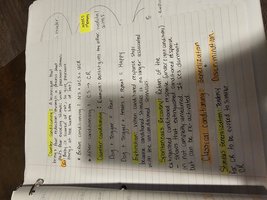
Classical conditioning is a learning process where a neutral stimulus becomes associated with a meaningful stimulus, eliciting a conditioned response.
Unconditioned Stimulus (US): Naturally elicits a response (e.g., food).
Unconditioned Response (UR): Natural reaction to the US (e.g., salivation).
Conditioned Stimulus (CS): Previously neutral, now elicits a response after association (e.g., bell).
Conditioned Response (CR): Learned response to the CS (e.g., salivation to bell).
Acquisition: Initial learning phase.
Extinction: Disappearance of the conditioned response when the CS is no longer paired with the US.
Spontaneous Recovery: Reappearance of the CR after extinction.
Generalization: Similar stimuli elicit the same response.
Discrimination: Ability to distinguish between different stimuli.
Operant Conditioning
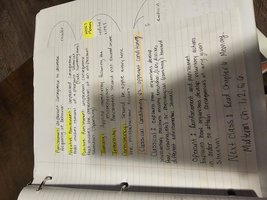
Operant conditioning involves learning through consequences, such as rewards and punishments. Developed by B.F. Skinner, it focuses on how behavior is influenced by reinforcement.
Positive Reinforcement: Adding a pleasant stimulus to increase behavior.
Negative Reinforcement: Removing an unpleasant stimulus to increase behavior.
Punishment: Adding or removing a stimulus to decrease behavior.
Shaping: Gradually guiding behavior toward a desired outcome.
Memory
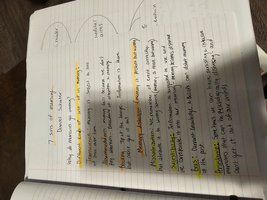
Stages of Memory
Memory is the process of encoding, storing, and retrieving information. It is divided into three main stages.
Encoding: Transforming information into a form that can be stored.
Storage: Maintaining information over time.
Retrieval: Accessing stored information when needed.

Types of Memory
There are several types of memory, each serving different functions.
Sensory Memory: Brief storage of sensory information.
Short-Term Memory: Temporary storage, limited capacity (about 7 items).
Long-Term Memory: Permanent storage, unlimited capacity.
Explicit Memory: Conscious recall (facts, events).
Implicit Memory: Unconscious recall (skills, procedures).
Thinking, Language, and Intelligence
Cognition and Problem Solving
Cognition refers to mental processes involved in acquiring knowledge and understanding. Problem solving is a key aspect of cognition.
Algorithms: Step-by-step procedures for solving problems.
Heuristics: Mental shortcuts for quick decision-making.
Insight: Sudden realization of a solution.
Motivation and Emotion
Theories of Motivation
Motivation is the process that initiates, guides, and sustains goal-oriented behavior. Several theories explain motivation.
Drive Theory: Behavior is motivated by biological drives (e.g., hunger).
Incentive Theory: Behavior is motivated by external rewards.
Maslow's Hierarchy of Needs: Needs are arranged in a hierarchy, from physiological to self-actualization.
Emotion
Emotion is a complex psychological state involving subjective experience, physiological response, and behavioral expression.
James-Lange Theory: Emotion results from physiological responses.
Cannon-Bard Theory: Emotion and physiological responses occur simultaneously.
Schachter-Singer Theory: Emotion is determined by physiological arousal and cognitive interpretation.
The Voyage Through the Lifespan
Adolescence
Adolescence is a developmental stage marked by physical, cognitive, and social changes. It is a period of identity formation and increased independence.
Physical Changes: Puberty, growth spurts.
Cognitive Changes: Abstract thinking, moral reasoning.
Social Changes: Peer relationships, identity exploration.

Personality: Theory and Measurement
Personality Theories
Personality refers to individual differences in characteristic patterns of thinking, feeling, and behaving. Several theories explain personality development.
Trait Theory: Personality is composed of stable traits.
Psychodynamic Theory: Personality is shaped by unconscious motives and conflicts.
Humanistic Theory: Emphasizes personal growth and self-actualization.
Social-Cognitive Theory: Personality is influenced by social environment and cognitive processes.
Social Psychology
Social Influence and Group Behavior
Social psychology studies how individuals are influenced by others and how they behave in groups.
Conformity: Adjusting behavior to match group norms.
Obedience: Following orders from authority figures.
Groupthink: Desire for harmony leads to poor decision-making.
Stress, Health, and Coping
Stress and Coping Mechanisms
Stress is the body's response to challenging or threatening situations. Coping mechanisms help manage stress.
Problem-Focused Coping: Addressing the source of stress.
Emotion-Focused Coping: Managing emotional responses to stress.
Resilience: Ability to adapt and recover from stress.
Psychological Disorders and Therapy
Psychological Disorders
Psychological disorders are patterns of behavior or mental processes that cause distress or impair functioning.
Anxiety Disorders: Excessive fear or anxiety.
Mood Disorders: Disturbances in mood (e.g., depression, bipolar disorder).
Schizophrenia: Disorganized thinking, hallucinations.
Methods of Therapy
Therapy aims to treat psychological disorders and improve mental health.
Cognitive-Behavioral Therapy (CBT): Focuses on changing negative thought patterns.
Psychodynamic Therapy: Explores unconscious conflicts.
Humanistic Therapy: Emphasizes personal growth.
