 Back
BackIntroduction to Psychology: Foundations, History, and Major Domains
Study Guide - Smart Notes
 Tailored notes based on your materials, expanded with key definitions, examples, and context.
Psychological Foundations
What is Psychology?
Psychology is the scientific study of mind and behavior. It seeks to understand how individuals think, feel, and act, both as individuals and within groups. The field uses empirical methods to investigate mental processes and observable actions.

The History of Psychology
Freud and Psychoanalytic Theory
Psychoanalytic theory, developed by Sigmund Freud in the late 1800s and early 1900s, emphasizes the influence of the unconscious mind and childhood experiences on behavior. Freud proposed a model of personality consisting of the id (instinctual drives), ego (rational self), and superego (moral conscience). He also outlined stages of psychosexual development: oral, anal, phallic, latency, and genital. While controversial, Freud's ideas remain influential in understanding personality and development.
Gestalt Theory
Gestalt psychology, emerging in the early 1900s, focused on perception and the idea that the whole is different from the sum of its parts. Gestalt theorists argued that people perceive objects and patterns as unified wholes, not just as a collection of individual sensory elements. This approach has influenced modern cognitive psychology and perception research.
Behaviorism
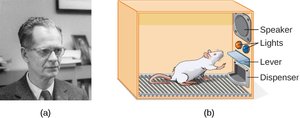
Behaviorism, prominent in the early to mid-1900s, centers on observable and measurable aspects of behavior. It rejects introspection and focuses on how behavior is learned and modified through conditioning. Key concepts include classical conditioning (learning by association) and operant conditioning (learning through consequences such as reinforcement and punishment). The operant conditioning chamber, or "Skinner box," is a classic experimental tool in this field.
Humanism
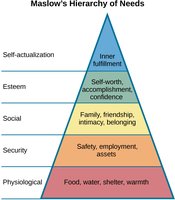
Humanistic psychology, developed in the 1950s by figures such as Abraham Maslow and Carl Rogers, emphasizes the innate potential for good in all humans. It focuses on the whole person and the capacity for self-direction and personal growth. Humanism introduced concepts such as self-actualization and the hierarchy of needs.
Cognitive Psychology
Cognitive psychology arose in the mid-1900s, accepting the scientific method and focusing on internal mental processes such as perception, memory, language, and thinking. Unlike behaviorism, cognitive psychology acknowledges the importance of mental states and processes in understanding behavior.

Major Domains of Psychology
The Five Psychological Domains
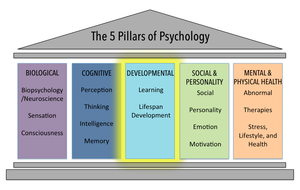
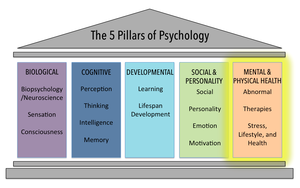
Contemporary psychology is organized into five major domains, each focusing on different aspects of mind and behavior:
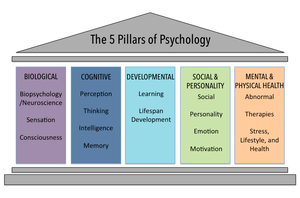
Biological: Examines the influence of biology on behavior, including neuroscience, sensation, and consciousness.
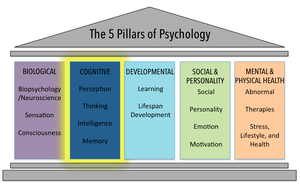
Cognitive: Studies mental processes such as perception, thinking, intelligence, and memory.
Developmental: Investigates learning and development across the lifespan, including behavioral psychology and conditioning.
Social and Personality: Explores how social interactions and personality traits shape behavior.
Mental and Physical Health: Focuses on abnormal psychology, therapies, and the interplay between psychological and physical health.
The Biological Domain
This domain explores how biological processes influence behavior. Subfields include:
Biopsychology: Studies the relationship between the brain, nervous system, and behavior.
Evolutionary Psychology: Examines how evolutionary processes shape behavior.
Sensation and Perception: Investigates how sensory information is received and interpreted.
The Cognitive Domain
The cognitive domain focuses on mental processes and their relationship to experiences and actions. Key areas include language, cognition, memory, intelligence, and problem-solving.

The Developmental Domain
This domain includes the study of learning, conditioning, and development across the lifespan. It covers classical and operant conditioning, as well as stages and milestones of human development.
The Social and Personality Psychology Domain
Social psychology examines how individuals' thoughts, feelings, and behaviors are influenced by others, while personality psychology studies the patterns of thought and behavior that make each person unique. The Five Factor Model is a widely used framework for understanding personality traits.
The Mental and Physical Health Domain
This domain addresses abnormal thoughts and behaviors, clinical psychology (diagnosis and treatment of psychological disorders), and health psychology (how biological, psychological, and sociocultural factors affect health).
Other Sub-fields in Psychology
Industrial-Organizational Psychology: Applies psychological principles to workplace settings.
Forensic Psychology: Applies psychology to the legal and justice system.
Sport and Exercise Psychology: Studies the relationship between mental factors and physical performance.
Why Study Psychology?
Studying psychology develops critical thinking and communication skills, enhances understanding of human behavior, and opens diverse career paths. Psychology is valuable in fields such as healthcare, education, business, and public service.

Quick Review
Psychology is the scientific study of mind and behavior.
Major historical schools include psychoanalysis, gestalt, behaviorism, humanism, and cognitive psychology.
Contemporary psychology is organized into five domains: biological, cognitive, developmental, social and personality, and mental and physical health.
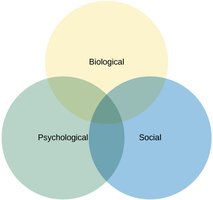
Key concepts include conditioning, personality traits, mental processes, and the biopsychosocial model.
Psychology offers valuable skills and diverse career opportunities.
