 Back
BackIntroduction to Psychology: Foundations, History, and Domains
Study Guide - Smart Notes
 Tailored notes based on your materials, expanded with key definitions, examples, and context.
Psychological Foundations
What is Psychology?
Psychology is defined as the scientific study of mind and behavior. It seeks to understand how individuals think, feel, and act, using empirical methods to investigate mental processes and observable actions.

The Earliest Schools of Psychology
Psychoanalytic Theory
Psychoanalytic theory, developed by Sigmund Freud in the late 1800s and early 1900s, emphasizes the influence of the unconscious mind and childhood experiences on personality and behavior.
Id, Ego, Superego: Components of personality that interact to shape behavior.
Stages of Development: Oral, anal, phallic, latency, and genital stages.
Controversy: While influential, many aspects of Freud's theory remain debated.
Example: The Oedipus complex illustrates the role of unconscious desires in development.
Gestalt Theory
Gestalt psychology, emerging in the early 1900s, focuses on perception and the idea that individuals respond to the whole of a sensory experience rather than its parts.
Key Principle: "The whole is greater than the sum of its parts."
Example: Perceiving an "invisible" triangle formed by the arrangement of shapes.
Behaviorism
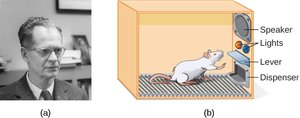
Behaviorism, prominent in the early to mid-1900s, centers on observable behavior and the processes of conditioning, reinforcement, and punishment.
Conditioning: Learning through association (classical and operant).
Operant Conditioning Chamber: Also known as the Skinner box, used to study behavior in controlled environments.
Reinforcement and Punishment: Mechanisms for increasing or decreasing behavior.
Humanism
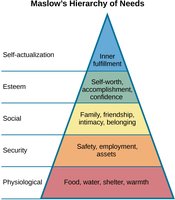
Humanistic psychology, developed in the 1950s, emphasizes the innate potential for good in humans and the importance of self-actualization and personal growth.
Key Figures: Abraham Maslow and Carl Rogers.
Maslow's Hierarchy of Needs: A model describing the progression of human needs from basic physiological requirements to self-actualization.
Cognitive Psychology
Cognitive psychology, emerging in the mid-1900s, investigates internal mental processes such as perception, memory, categorization, and language, using scientific methods and rejecting introspection.
Major Areas: Perception, memory, knowledge representation, numerical cognition, language, and thinking.
Example: Research on how people categorize objects or solve problems.

The Five Psychological Domains
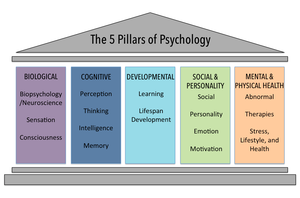
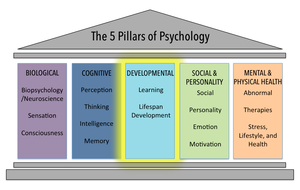
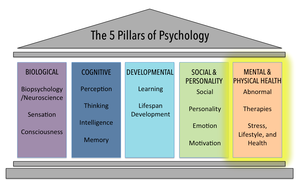
Contemporary psychology is organized into five major domains, each focusing on distinct aspects of mind and behavior.
The Biological Domain
The biological domain explores how biological processes influence behavior, including the roles of genetics, neurobiology, and evolution.
Biopsychology: Studies the relationship between brain function and behavior.
Evolutionary Psychology: Examines how human behavior has evolved.
Sensation and Perception: Investigates the physiological and psychological aspects of sensory systems.
The Cognitive Domain
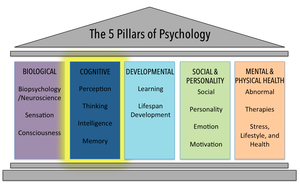
The cognitive domain focuses on mental processes such as thinking, memory, intelligence, and language, and their relationship to experiences and actions.
Key Areas: Language, cognition, memory, intelligence.
Example: Studying how memory is encoded and retrieved.

The Developmental Domain
The developmental domain examines behavioral changes and learning across the lifespan, including classical and operant conditioning, and developmental milestones.
Developmental Psychology: Scientific study of development from infancy to old age.
Learning: Processes by which behavior changes as a result of experience.
The Social and Personality Psychology Domain
This domain investigates how individuals' thoughts, feelings, and behaviors are influenced by others, and the unique patterns that define personality.
Social Psychology: Study of social influences on behavior.
Personality Psychology: Study of individual differences and personality traits.
Personality Trait: Consistent pattern of thought and behavior.
The Mental and Physical Health Domain
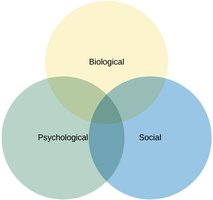
The mental and physical health domain addresses abnormal thoughts and behaviors, psychological disorders, therapies, and the interaction of biological, psychological, and sociocultural factors in health.
Abnormal Psychology: Study of atypical thoughts and behaviors.
Clinical Psychology: Diagnosis and treatment of psychological disorders.
Health Psychology: Examines how health is affected by multiple factors.
Other Sub-fields in Psychology
Psychology encompasses several applied sub-fields, each with unique focus areas:
Industrial-Organizational Psychology: Application of psychological principles in workplace settings.
Forensic Psychology: Application of psychology to the justice system.
Sport and Exercise Psychology: Study of mental and emotional factors in physical performance.
Why Study Psychology?
Studying psychology develops critical thinking and communication skills, deepens understanding of human behavior, and opens diverse career opportunities.
Career Paths: Psychology graduates work in education, healthcare, business, government, and more.
Value: Useful in all fields of work due to its focus on understanding people.

Quick Review
What is psychology? The scientific study of mind and behavior.
History: Includes psychoanalytic, gestalt, behaviorist, humanistic, and cognitive schools.
Contemporary Approaches: Five major domains and numerous sub-fields.
Major Concepts: Biological, cognitive, developmental, social/personality, and mental/physical health.
Value: Critical thinking, communication, and career versatility.
Table: Top Occupations Employing Graduates with a BA in Psychology
Occupation | Description |
|---|---|
Education | Teaching, school counseling, academic advising |
Healthcare | Clinical, counseling, health services |
Business | Human resources, marketing, management |
Government | Social services, policy analysis |
Other | Research, nonprofit, independent practice |
Additional info: Table entries inferred from typical psychology career paths.
