 Back
BackIntroduction to Psychology: Study Notes Based on 'Presenting Psychology'
Study Guide - Smart Notes
 Tailored notes based on your materials, expanded with key definitions, examples, and context.
Introduction to Psychology
Overview of Psychology
Psychology is the scientific study of behavior and mental processes. It seeks to understand how individuals think, feel, and act both individually and in groups. The field integrates knowledge from biology, medicine, philosophy, and social sciences to explore the complexities of the human mind.
Definition: Psychology is the scientific study of behavior and mental processes.
Key Goals: To describe, explain, predict, and control behavior and mental processes.
Applications: Clinical settings, education, business, sports, health, and more.
Major Subfields: Biological, cognitive, developmental, social, clinical, and industrial-organizational psychology.
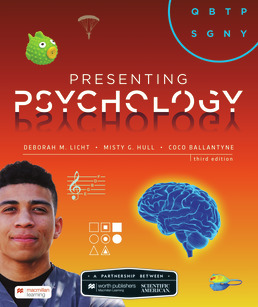
Additional info: The cover image visually represents the integration of neuroscience (brain illustration), scientific method (symbols), and the broad scope of psychology as a discipline.
Scientific Foundations of Psychology
Psychology relies on empirical evidence and the scientific method to investigate questions about behavior and mental processes. This approach distinguishes psychology from pseudoscience and common sense explanations.
Empirical Evidence: Data collected through observation and experimentation.
Scientific Method: A systematic process involving hypothesis formation, experimentation, observation, and conclusion.
Importance: Ensures that psychological theories are based on reliable and valid evidence.
Major Perspectives in Psychology
Several perspectives guide psychological research and practice, each emphasizing different aspects of behavior and mental processes.
Biological Perspective: Focuses on the influence of biology, genetics, and the brain on behavior.
Cognitive Perspective: Examines mental processes such as perception, memory, and problem-solving.
Behavioral Perspective: Studies observable behavior and the effects of learning and environment.
Humanistic Perspective: Emphasizes personal growth and self-actualization.
Psychodynamic Perspective: Explores unconscious motives and early childhood experiences.
Sociocultural Perspective: Investigates how culture and social context influence behavior.
Applications of Psychology
Psychology is applied in various fields to solve real-world problems and improve quality of life.
Clinical Psychology: Assessment and treatment of mental disorders.
Educational Psychology: Enhancing teaching and learning processes.
Industrial-Organizational Psychology: Improving workplace productivity and employee well-being.
Health Psychology: Promoting healthy behaviors and managing illness.
