 Back
BackLanguage: Structure, Acquisition, and the Brain
Study Guide - Smart Notes
 Tailored notes based on your materials, expanded with key definitions, examples, and context.
Language: Structure, Acquisition, and the Brain
What Is Language?
Language is a complex, evolving system that enables humans to communicate, express thoughts, and share information. It is not static; new words and expressions are continually created, while others change meaning or fall out of use. Understanding language requires examining its underlying systems.
Language as a Communication System: Language allows for interaction, information exchange, and emotional expression. It involves both productive language (speaking, writing, gesturing) and receptive language (understanding spoken, written, or gestural language).
Language as a Symbolic System: Words and morphemes are symbols representing ideas, objects, or actions. These symbols are conventional (shared by a language community) and arbitrary (no inherent connection between symbol and meaning).
Language as a Rule-Governed System: Each language has rules (grammar) that govern word formation, sentence structure, and usage. These rules ensure consistency and mutual understanding among speakers.
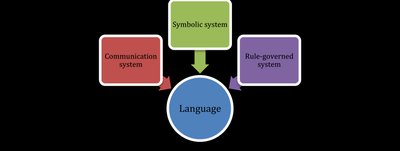
Additional info: The combination of these systems makes language a unique human ability, distinguishing it from other forms of animal communication.
Features of Language
Language is composed of several key features that allow for its complexity and flexibility:
Phonemes: The smallest units of sound in a language. For example, the word "dog" consists of three phonemes: /d/, /o/, and /g/. English uses approximately 40–45 phonemes, though estimates vary.
Morphemes: The smallest units of meaning. A word can be a morpheme ("dog"), or a part of a word can be a morpheme (the "-s" in "dogs" indicates plural).
Syntax: The set of rules that dictate sentence structure and word order. For example, in English, adjectives typically precede nouns ("grey dog"), while in French, adjectives often follow nouns ("chien gris").
Extralinguistic Information: Non-verbal cues such as facial expressions, tone of voice, and context that influence the interpretation of language. For example, the phrase "Nice hat" can be sincere or sarcastic depending on tone.
Additional info: Mastery of these features is essential for effective communication and comprehension.
Language Acquisition
The process of acquiring language has been a central debate in psychology, often framed as nature versus nurture:
Learning Theory (B.F. Skinner): Language is learned through reinforcement and imitation, similar to other behaviors. However, this theory is criticized for underestimating the complexity and inconsistency of language learning.
Nativist Theory (Noam Chomsky): Humans are born with an innate language acquisition device (LAD) and a universal grammar. Exposure to language activates this innate capacity. This theory is criticized for not accounting for individual differences and the importance of social interaction.
Interactionist Theories: Both genetic predisposition and social experience are necessary for language development. These theories integrate elements of both nature and nurture.
Additional info: Research supports the view that social interaction is crucial for language development, especially in early childhood.
Language Development
Language development occurs in three sequential stages: recognition, comprehension, and production.
Recognition: Begins prenatally as fetuses recognize the sounds of their mother's language. This ability continues to develop in early infancy, focusing on the phonemes of the languages they are exposed to.
Comprehension: Starts around 6 months of age, with infants first understanding their own name and gradually comprehending more words.
Production: Typically begins around 12 months, though there is considerable variability. Early vocalizations (babbling) prepare infants for producing actual words.
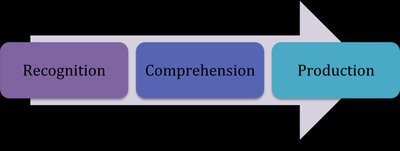
Additional info: The sequence of these stages is universal, though the timing can vary among individuals.
Language and the Brain
Language processing involves several specialized brain regions, primarily in the left hemisphere:
Broca’s Area: Located in the left frontal lobe, responsible for speech production and coordination with the motor cortex. Damage to Broca’s area results in difficulty producing speech but preserved comprehension (Broca’s aphasia).
Wernicke’s Area: Located in the left temporal lobe, responsible for speech comprehension. Damage to Wernicke’s area results in fluent but often meaningless speech and impaired comprehension (Wernicke’s aphasia).
Arcuate Fasciculus: A bundle of nerve fibers connecting Broca’s and Wernicke’s areas, facilitating communication between language production and comprehension centers.
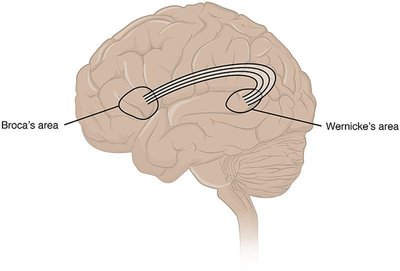
Additional info: These areas are also involved in sign language for individuals who are deaf, demonstrating the brain's adaptability for language processing.
Bilingualism
Bilingualism refers to the ability to speak two or more languages. Research on bilingualism addresses two main questions: the optimal timing for learning a second language and the cognitive benefits of bilingualism.
Optimal Timing of Second Language Learning
The earlier a second language is learned, the better the outcomes for pronunciation and fluency. Early exposure (even prenatally) helps maintain the ability to recognize and produce phonemes from both languages.
Children exposed to multiple languages may initially mix them, but by age 3–4, they can separate the languages effectively.
Brain regions used for language differ depending on when the second language is learned. Early learners use the same brain areas for both languages, while late learners use different regions within Broca’s area.
Benefits of Bilingualism
Childhood: Bilingual children often have greater metalinguistic awareness (understanding of language as a system) and cognitive flexibility (ability to switch between tasks). They also tend to have better working memory.
Late Adulthood: Lifelong bilingualism is associated with a delayed onset of Alzheimer’s disease by about five years, though it does not prevent the disease.
Additional info: Not all bilingual individuals experience these benefits; individual differences play a significant role.
Reading
Reading is a learned skill that builds on spoken language. Before learning to read, children must understand that writing is meaningful, recognize the direction of writing, identify letters, and connect letters to sounds.
Whole Word Recognition: Learning to recognize entire words by sight.
Phonetic Decomposition: Sounding out unfamiliar words by breaking them into syllables.
Once reading is learned, it becomes an automatic process, as demonstrated by the Stroop Test, where automatic reading can interfere with other tasks (e.g., naming the color of a word rather than reading the word itself).
Summary Table: Key Features of Language
Feature | Description | Example |
|---|---|---|
Phoneme | Smallest unit of sound | "d" in "dog" |
Morpheme | Smallest unit of meaning | "dog" (animal), "-s" (plural) |
Syntax | Rules for sentence structure | "The grey dog" (English), "le chien gris" (French) |
Extralinguistic Information | Non-verbal cues affecting meaning | Tone, facial expression |
Key Takeaways
Language is an arbitrary, rule-governed, symbolic system for communication.
Both genetic predisposition and social experience are essential for language acquisition.
Broca’s and Wernicke’s areas are central to language production and comprehension.
Bilingualism offers cognitive benefits, especially when acquired early and maintained throughout life.
Reading is an automatic process once learned, integrating multiple language features.
