 Back
BackLearning: Mechanisms and Applications in Psychology
Study Guide - Smart Notes
 Tailored notes based on your materials, expanded with key definitions, examples, and context.
Chapter 6: Learning
Introduction to Learning
Learning is defined as a change in an organism’s behaviour or thought as a result of experience. It is a fundamental process that underlies adaptation and survival. The most basic forms of learning are habituation (a decrease in response to a repeated stimulus) and sensitization (an increase in response to a repeated stimulus).
Classical Conditioning
Pavlov’s Model of Classical Conditioning
Classical conditioning, also known as Pavlovian conditioning, is a form of learning in which an organism comes to respond to a previously neutral stimulus after it has been paired with a stimulus that naturally elicits a response. Ivan Pavlov’s experiments with dogs are foundational in understanding this process.
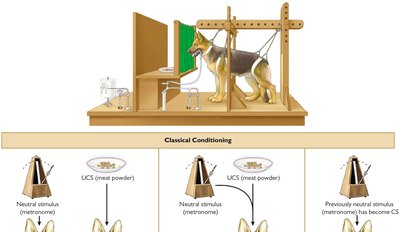

Neutral Stimulus (NS): A stimulus that does not elicit a particular response (e.g., a metronome).
Unconditioned Stimulus (UCS): A stimulus that naturally elicits a response (e.g., meat powder).
Unconditioned Response (UCR): The automatic response to the UCS (e.g., salivation).
Conditioned Stimulus (CS): The previously neutral stimulus that, after association with the UCS, elicits a response.
Conditioned Response (CR): The learned response to the CS (e.g., salivation to the metronome).
Example: Pavlov paired the sound of a metronome (NS) with meat powder (UCS), which caused the dog to salivate (UCR). After repeated pairings, the metronome alone (now CS) elicited salivation (CR).
Principles of Classical Conditioning
Acquisition: The phase during which the CR is established by pairing the CS with the UCS.
Extinction: The reduction of the CR when the CS is presented repeatedly without the UCS.
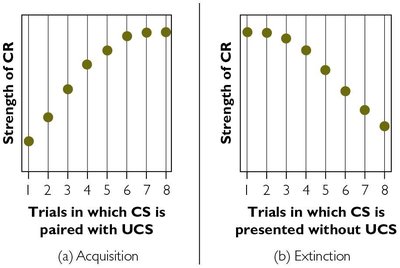
Spontaneous Recovery: The reappearance of a CR after a period of rest following extinction.
Renewal: The return of a CR when the organism is placed in a novel context.
Stimulus Generalization: Similar stimuli to the CS elicit the same CR.
Stimulus Discrimination: The CR is elicited only by the original CS, not by similar stimuli.
Higher Order Conditioning
Higher order conditioning occurs when a new neutral stimulus is paired with an existing CS, leading to a weaker CR. For example, if a Coca-Cola bottle (CS1) is paired with positive emotions, and then a glass (CS2) is paired with the bottle, the glass may also elicit positive emotions, but less strongly.

Applications of Classical Conditioning
Advertising: Products are paired with stimuli that elicit positive emotions to influence consumer behaviour.

Phobias and Fear Acquisition: Classical conditioning explains how fears and phobias can be acquired (e.g., Little Albert’s fear of rats) and treated (e.g., Little Peter’s love of rabbits).
Conditioned Compensatory Response (CCR): A CR that is the opposite of the UCR, often seen in drug tolerance and dependence.
Fetishism: Sexual attraction to nonliving things can be partly explained by classical conditioning.
Disgust Reactions: Disgust toward safe food or drink can be conditioned.
Operant Conditioning
Definition and Key Concepts
Operant conditioning is a type of learning in which the frequency of a behaviour is controlled by its consequences. The organism learns to associate a behaviour with a reward or punishment.
Target Behaviour: Elicited automatically in classical conditioning; emitted voluntarily in operant conditioning.
Behaviour Function: Controlled by preceding stimuli in classical conditioning; by consequences in operant conditioning.
Physiological Basis: Autonomic nervous system in classical; skeletal muscles in operant.
Thorndike’s Law of Effect
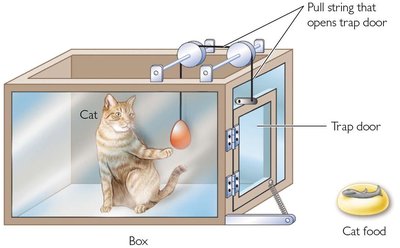
Thorndike’s Law of Effect states that behaviours followed by satisfying outcomes are more likely to be repeated, while those followed by unpleasant outcomes are less likely to recur. This principle was demonstrated using puzzle boxes with cats.
B.F. Skinner and the Skinner Box
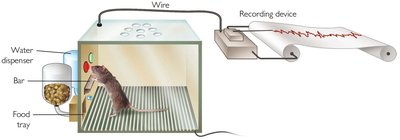
B.F. Skinner expanded on Thorndike’s work by designing the Skinner box, which allowed for the systematic study of operant conditioning in animals.
Reinforcement and Punishment
Reinforcers: Outcomes that increase the probability of a behaviour. Can be positive (adding a stimulus) or negative (removing a stimulus).
Punishment: Outcomes that decrease the probability of a behaviour. Can also be positive (adding an unpleasant stimulus) or negative (removing a pleasant stimulus).
Procedure | Effect on Behaviour | Typical Example |
|---|---|---|
Positive Reinforcement | Increases target behaviour | Giving a gold star for homework |
Negative Reinforcement | Increases target behaviour | Static on phone subsides when standing in a specific spot |
Positive Punishment | Decreases target behaviour | Scolding a pet for chewing shoes |
Negative Punishment | Decreases target behaviour | Confiscating a toy to stop tantrums |
Note: Punishment is generally less effective than reinforcement and may have negative side effects such as anxiety or aggression.
Schedules of Reinforcement
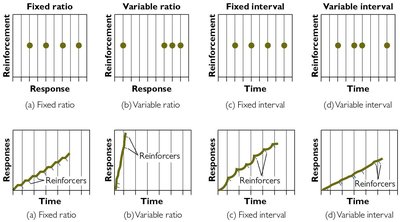
Reinforcement schedules determine how and when behaviours are reinforced. They can be continuous (every response is reinforced) or partial (only some responses are reinforced). Partial reinforcement is more resistant to extinction.
Fixed Ratio (FR): Reinforcement after a set number of responses.
Variable Ratio (VR): Reinforcement after an average number of responses.
Fixed Interval (FI): Reinforcement after a set amount of time.
Variable Interval (VI): Reinforcement after an average amount of time.
Applications of Operant Conditioning
Animal Training: Using shaping and chaining to teach complex behaviours.
Premack Principle: Using a more preferred activity to reinforce a less preferred one.
Token Economies: Used in clinical settings to reinforce desired behaviours.
Applied Behaviour Analysis: Especially effective in autism interventions.
Combining Classical and Operant Conditioning
The two-process theory of anxiety suggests that anxiety is acquired through classical conditioning and maintained through operant conditioning (negative reinforcement).
Cognitive Models of Learning
Latent Learning
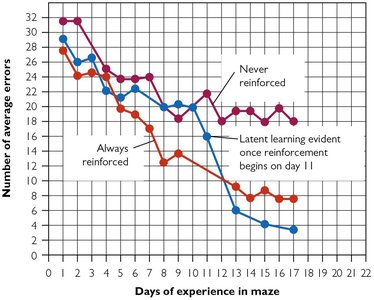
Latent learning is learning that is not immediately observable in behaviour. Tolman and Honzik’s studies with rats in mazes demonstrated that reinforcement is not always necessary for learning to occur; rats developed cognitive maps that were only used when reinforcement was introduced.
Observational Learning
Observational learning occurs when an organism learns by watching others, without direct experience. Bandura’s research on aggression demonstrated that children can learn aggressive behaviours by observing models.
Mirror Neurons
Mirror neurons are brain cells that activate both when an animal performs an action and when it observes the same action performed by another. They may play a role in observational learning and empathy.

Insight Learning
Insight learning involves a sudden realization of a problem’s solution, as demonstrated by Köhler’s chimpanzees. This suggests that some learning involves cognitive processes beyond simple conditioning.
Biological Influences on Learning
Conditioned Taste Aversion
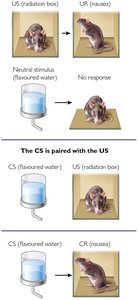
Conditioned taste aversion is a unique form of learning where an organism learns to avoid a taste after just one pairing with illness, even if the illness occurs hours later. This form of learning shows little generalization and challenges the principle of equipotentiality (the idea that any stimulus can be associated with any response).
Preparedness and Instinctive Drift
Preparedness: Evolutionary predisposition to fear certain stimuli (e.g., snakes, spiders) more than others (e.g., cars, guns).
Instinctive Drift: The tendency for animals to revert to innate behaviours after repeated reinforcement, indicating biological limits to learning.
Learning Fads and Myths
Learning Fads: Techniques such as sleep-assisted learning, accelerated learning, and discovery learning have not been shown to be more effective than traditional methods.
Learning Styles: Tailoring teaching to individual learning styles does not improve learning outcomes; direct instruction is generally more effective.
