 Back
BackLifespan Development: Key Concepts and Research Methods
Study Guide - Smart Notes
 Tailored notes based on your materials, expanded with key definitions, examples, and context.
Lifespan Development
Introduction to Lifespan Development
Lifespan development is a field of psychology that examines how humans change and grow from conception to death. Developmental psychologists study this process across three main domains: physical, cognitive, and psychosocial. The field addresses major questions about the nature of developmental change, its universality, and the influence of genetics and environment.
Lifespan development explores changes in body, mind, and social relationships throughout life.
Development is viewed as a lifelong process, not limited to childhood.
Key issues include continuity vs. discontinuity, universality vs. diversity, and nature vs. nurture.
Research Methods in Developmental Psychology
Overview of Methods
Developmental psychologists use various research methods to study changes over time. These include naturalistic observations, case studies, surveys, and experiments. Each method has strengths and limitations for understanding developmental processes.
Naturalistic observation: Observing behavior in real-world settings (e.g., children at play). Provides authentic data but limited control over variables.
Case study: In-depth study of a single individual, often used for unique or exceptional cases. Offers detailed insights but limited generalizability.
Survey: Collects self-reported data from many individuals quickly. Useful for large-scale trends but relies on honesty and may lack depth.
Experiment: Manipulates variables in controlled settings to establish causality. High control but may lack ecological validity.
Longitudinal, Cross-Sectional, and Cross-Sequential Designs
Longitudinal: Studies the same individuals over a long period to observe changes.
Cross-sectional: Compares individuals of different ages at one point in time.
Cross-sequential: Combines both approaches to provide a more comprehensive view.
Domains of Lifespan Development
Three Domains
Developmental changes are categorized into three domains:
Physical development: Growth and changes in the body, brain, senses, motor skills, health, and wellness.
Cognitive development: Learning, attention, memory, language, thinking, reasoning, and creativity.
Psychosocial development: Emotions, personality, and social relationships.
The Normative Approach
Norms and Developmental Milestones
The normative approach studies average ages at which children reach specific developmental milestones. These milestones serve as general guidelines for comparison but are not absolute standards.
Developmental milestone: Approximate age when a normative event (e.g., walking, speaking) occurs.
Biological milestones (e.g., puberty) are generally universal, while social milestones (e.g., starting school) vary by culture.
Milestones should be used as guidelines, not strict rules, due to individual and cultural differences.
Major Issues in Developmental Psychology
Continuity vs. Discontinuity
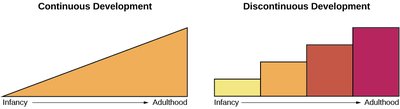
A central debate is whether development is a smooth, cumulative process (continuous) or occurs in distinct stages (discontinuous).
Continuous development: Gradual improvement of skills over time.
Discontinuous development: Development occurs in unique stages at specific ages.
Example: Physical growth (continuous) vs. acquisition of object permanence (discontinuous).
One Course of Development or Many?
Another issue is whether development follows a universal course or varies across individuals and cultures.
Stage theories: Propose universal sequences of development (e.g., language milestones).
Contextual influences (e.g., culture, environment) can affect timing and expression of milestones.
Example: Aché children in Paraguay walk later due to cultural practices but develop advanced motor skills later.

Nature vs. Nurture
The nature versus nurture debate explores the relative influence of genetics (nature) and environment (nurture) on development.
Nature: Genetic and biological factors shape traits and abilities.
Nurture: Environmental and cultural factors influence development.
Most psychologists recognize a reciprocal interaction between genes and environment.
Example: Language acquisition is influenced by both genetic predispositions and parental interaction.
Socioeconomic Status and the Achievement Gap
Impact of Socioeconomic Factors
Socioeconomic status (SES) significantly affects developmental outcomes, including academic achievement. Research shows that children from low-income families often lag behind their peers in language development and educational attainment.
Low-income children hear fewer words and know fewer words by age 3 compared to high-income peers.
Achievement gaps persist in test scores, graduation rates, and college entrance rates.
Interventions (e.g., increased parental interaction, diverse preschools) can help reduce these gaps.
Glossary of Key Terms
Cognitive development: Learning, attention, memory, language, thinking, reasoning, and creativity.
Continuous development: Gradual improvement of skills.
Developmental milestone: Approximate age for normative events.
Discontinuous development: Unique stages at specific times or ages.
Nature: Genes and biology.
Normative approach: Study of development using norms or average ages.
Nurture: Environment and culture.
Physical development: Growth and changes in body and brain.
Psychosocial development: Emotions, personality, and social relationships.
Summary
Lifespan development is a scientific study of how humans change physically, cognitively, and psychosocially from conception to death. Key issues include the nature of developmental change, its universality, and the interplay between genetics and environment. Understanding these concepts is essential for recognizing the diversity and complexity of human growth.
